
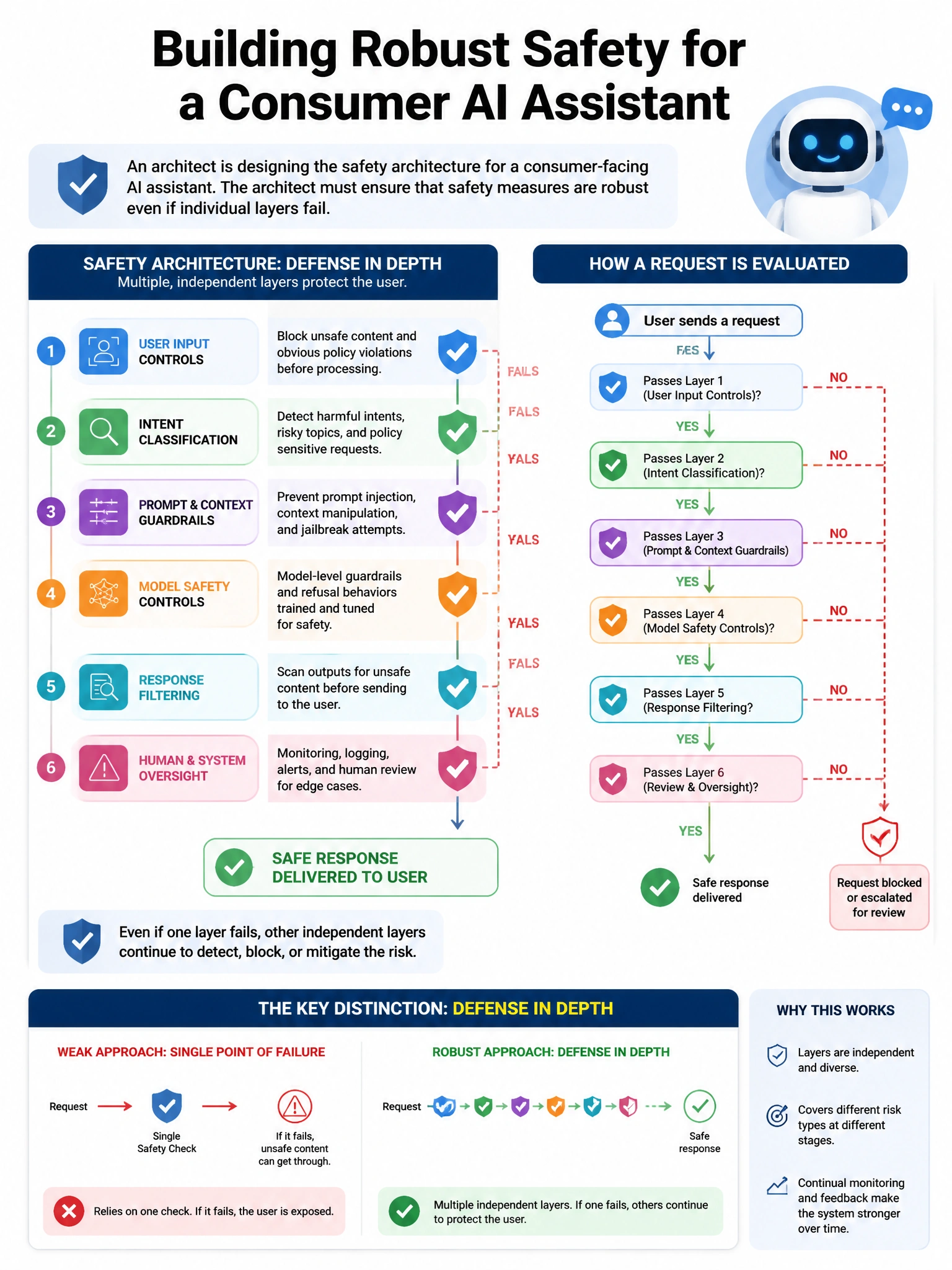
An architect is designing the safety architecture for a consumer-facing AI assistant. The architect must ensure that safety measures are robust even if individual layers fail. Which layered safety stack design is most comprehensive?
Select an answer to reveal the explanation.
Short Explanation and Infographic
Here's the deal — d is correct because defense-in-depth for AI safety requires independent layers that each provide coverage the others may miss: pre-processing classifiers can detect request types that trigger safety concerns (jailbreak attempts, harmful categories) before they reach Claude; Claude's constitutional training handles nuanced judgment on ambiguous content; post-processing classifiers provide a final gate for content that may have slipped through; human review provides escalation for uncertain cases. Each layer compensates for the failure modes of the others.
Full explanation below image
Full Explanation
D is correct because defense-in-depth for AI safety requires independent layers that each provide coverage the others may miss: pre-processing classifiers can detect request types that trigger safety concerns (jailbreak attempts, harmful categories) before they reach Claude; Claude's constitutional training handles nuanced judgment on ambiguous content; post-processing classifiers provide a final gate for content that may have slipped through; human review provides escalation for uncertain cases. Each layer compensates for the failure modes of the others. A is wrong because relying solely on Claude's built-in safety training creates a single point of failure — safety training is not perfect, and adversarial inputs can bypass it; defense requires independent layers. C is wrong because output-only filtering misses the opportunity to prevent harmful inputs from being processed at all, wastes compute on generating content that will be blocked, and misses input-level signals (the structure of an attack prompt). B is wrong because keyword blocklists are trivially bypassed through synonyms, spelling variations, and context — they provide weak coverage and high false positives; they can supplement but cannot substitute for behavioral layers.