
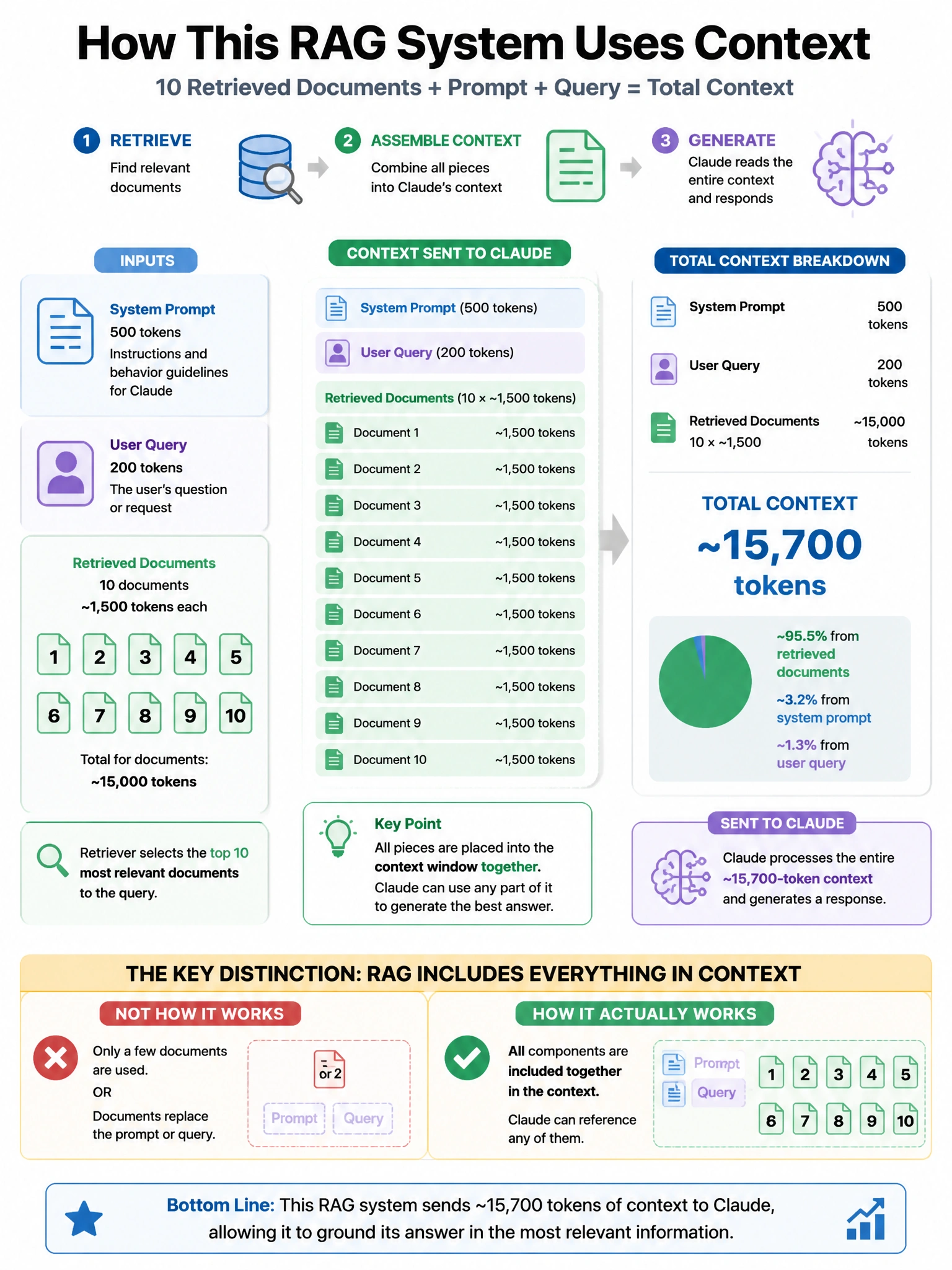
A RAG system retrieves 10 documents (each ~1,500 tokens) and includes them all in Claude's context along with a 500-token system prompt and a 200-token user query. Total context is approximately 16,200 tokens. Response quality degrades for questions whose answers appear in documents 7-10 (later in context). What phenomenon explains this and what is the mitigation?
Select an answer to reveal the explanation.
Short Explanation and Infographic
Here's the deal — d is correct because the 'lost-in-the-middle' phenomenon is a documented characteristic of transformer-based LLMs: attention patterns favor content near the start and end of the context window, with reduced attention to middle positions. Documents 7-10 in a 10-document context occupy middle positions relative to the surrounding context.
Full explanation below image
Full Explanation
D is correct because the 'lost-in-the-middle' phenomenon is a documented characteristic of transformer-based LLMs: attention patterns favor content near the start and end of the context window, with reduced attention to middle positions. Documents 7-10 in a 10-document context occupy middle positions relative to the surrounding context. Mitigations include: (1) placing the most relevant document first, (2) placing the second most relevant document last, (3) reducing retrieved document count to keep all content in high-attention zones. A is wrong because the problem description specifies degradation based on position (documents 7-10), not content relevance — this is a position-based effect, not a retrieval quality issue. C is wrong because reducing chunk size does not address the position effect — smaller chunks might move answers from middle positions to other positions, but this is indirect and not the root-cause fix. B is wrong because there is no known bug in Claude that specifically limits correct processing to 6 documents; the position effect applies to all LLMs and is a function of context length and relative position.