
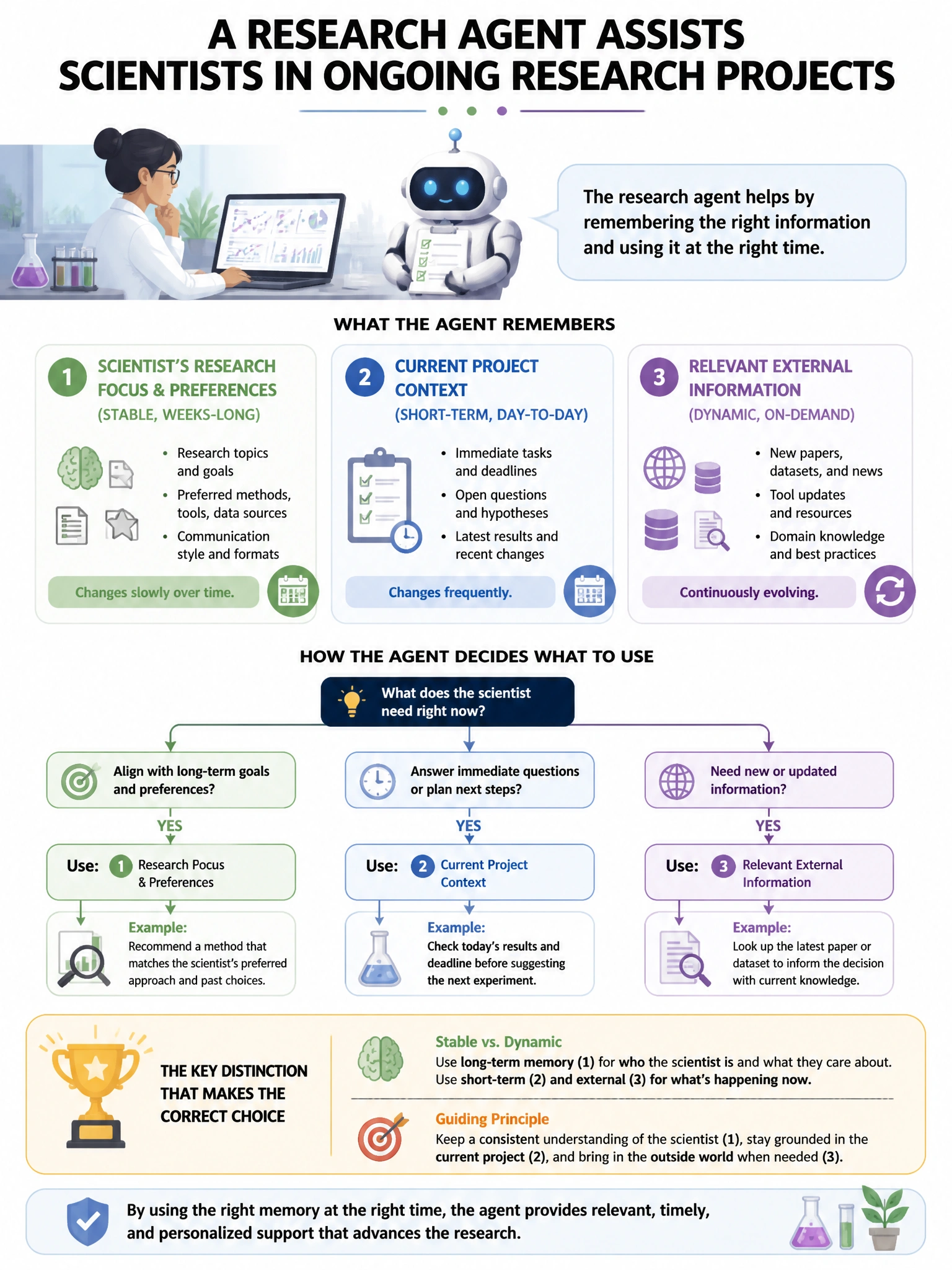
A research agent assists scientists in ongoing research projects. The agent needs to remember: (1) the scientist's research focus and preferences (stable, weeks-long), (2) the current experiment's hypotheses and prior results (project-level, days-long), and (3) the current conversation's context (session-level, hours-long). What memory architecture correctly maps these retention needs?
Select an answer to reveal the explanation.
Short Explanation and Infographic
Here's the deal — b is correct because different memory types have fundamentally different access patterns, retention durations, and retrieval semantics that require different storage mechanisms. Long-term preferences (semantic, stable) suit vector search for similarity-based retrieval.
Full explanation below image
Full Explanation
B is correct because different memory types have fundamentally different access patterns, retention durations, and retrieval semantics that require different storage mechanisms. Long-term preferences (semantic, stable) suit vector search for similarity-based retrieval. Project-level experiment data (structured, relational) suits a database with structured queries. Session state (sequential, transient) suits the in-context window. Uniform storage in any single system mismatches at least two of the three retention needs. A is wrong because a single context window can only hold a limited amount of history — weeks-long research preferences cannot be maintained in context across sessions. C is wrong because context-only storage with summaries loses fidelity on structured experiment data that requires exact values (p-values, sample sizes); summaries are lossy for structured scientific data. D is wrong because a 24-hour TTL eliminates long-term memory (research preferences), which must persist across weeks; uniform TTL ignores the fundamentally different lifetimes of the three memory types.