
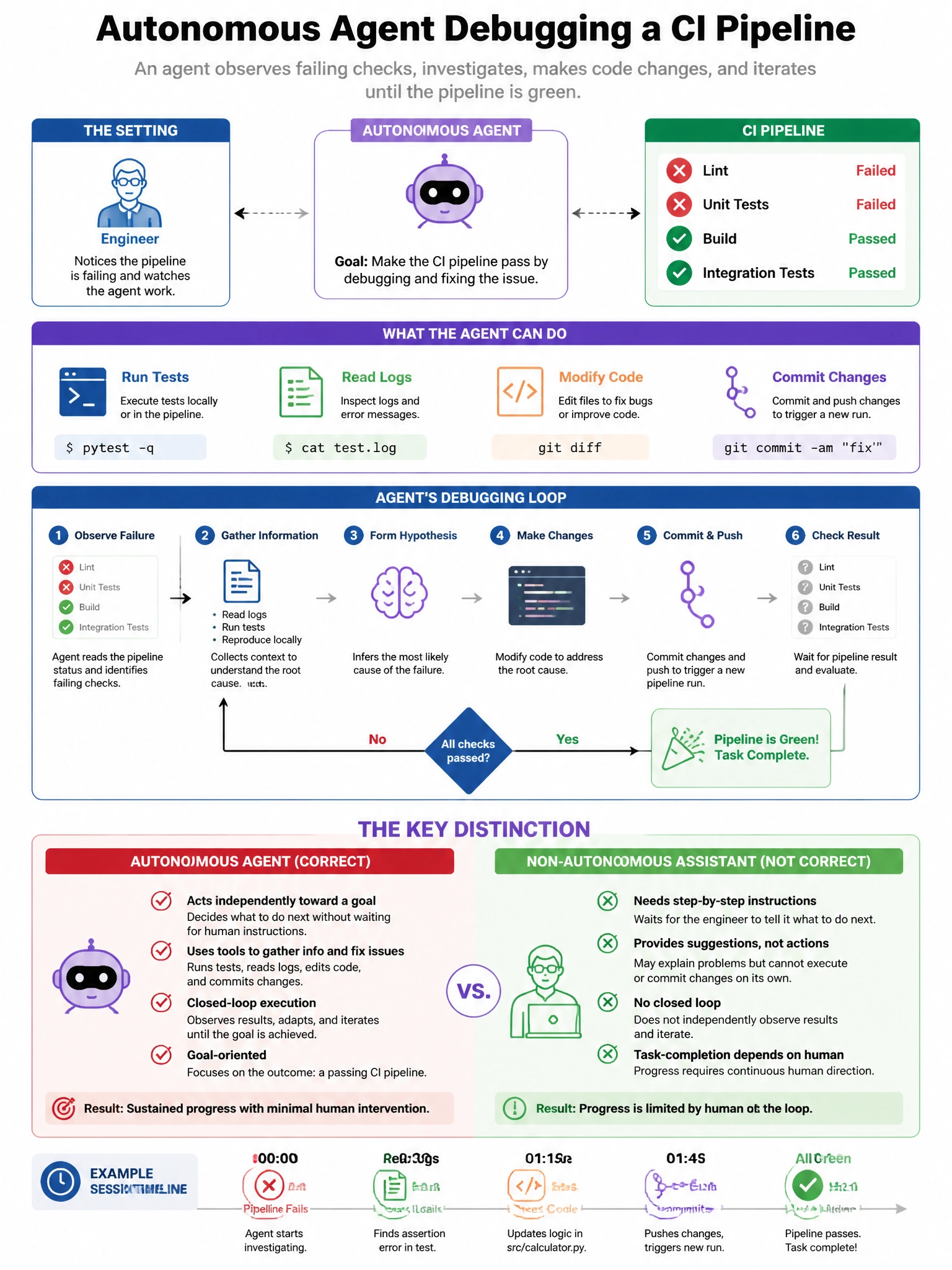
An autonomous agent is tasked with debugging a failing CI pipeline. The agent can run tests, read logs, modify code, and commit changes. During a session, an engineer notices the agent has made 47 commits in 10 minutes, each failing the same test with slight variations. What architectural safeguard should have prevented this?
Select an answer to reveal the explanation.
Short Explanation and Infographic
Here's the deal — c is correct because effective loop detection must combine action tracking (what was tried), outcome analysis (what happened), and similarity detection (are outcomes converging or cycling). When N consecutive attempts produce equivalent failures (same test error), the agent is in a loop and should halt and escalate to human review rather than continuing to vary the approach without progress.
Full explanation below image
Full Explanation
C is correct because effective loop detection must combine action tracking (what was tried), outcome analysis (what happened), and similarity detection (are outcomes converging or cycling). When N consecutive attempts produce equivalent failures (same test error), the agent is in a loop and should halt and escalate to human review rather than continuing to vary the approach without progress. A is wrong because a token budget terminates based on computation consumed, not on whether the agent is making productive progress — a loop can consume tokens efficiently while making no progress; and a budget may be exhausted before the loop is detected. B is wrong because requiring human approval for every commit eliminates the autonomy value of the agent and is impractical at scale — approval should be triggered by detected failure patterns, not applied universally. D is wrong because a hard action limit of 5 is too low for legitimate complex debugging tasks that may require many iterations; the limit should be based on progress detection, not arbitrary count.