
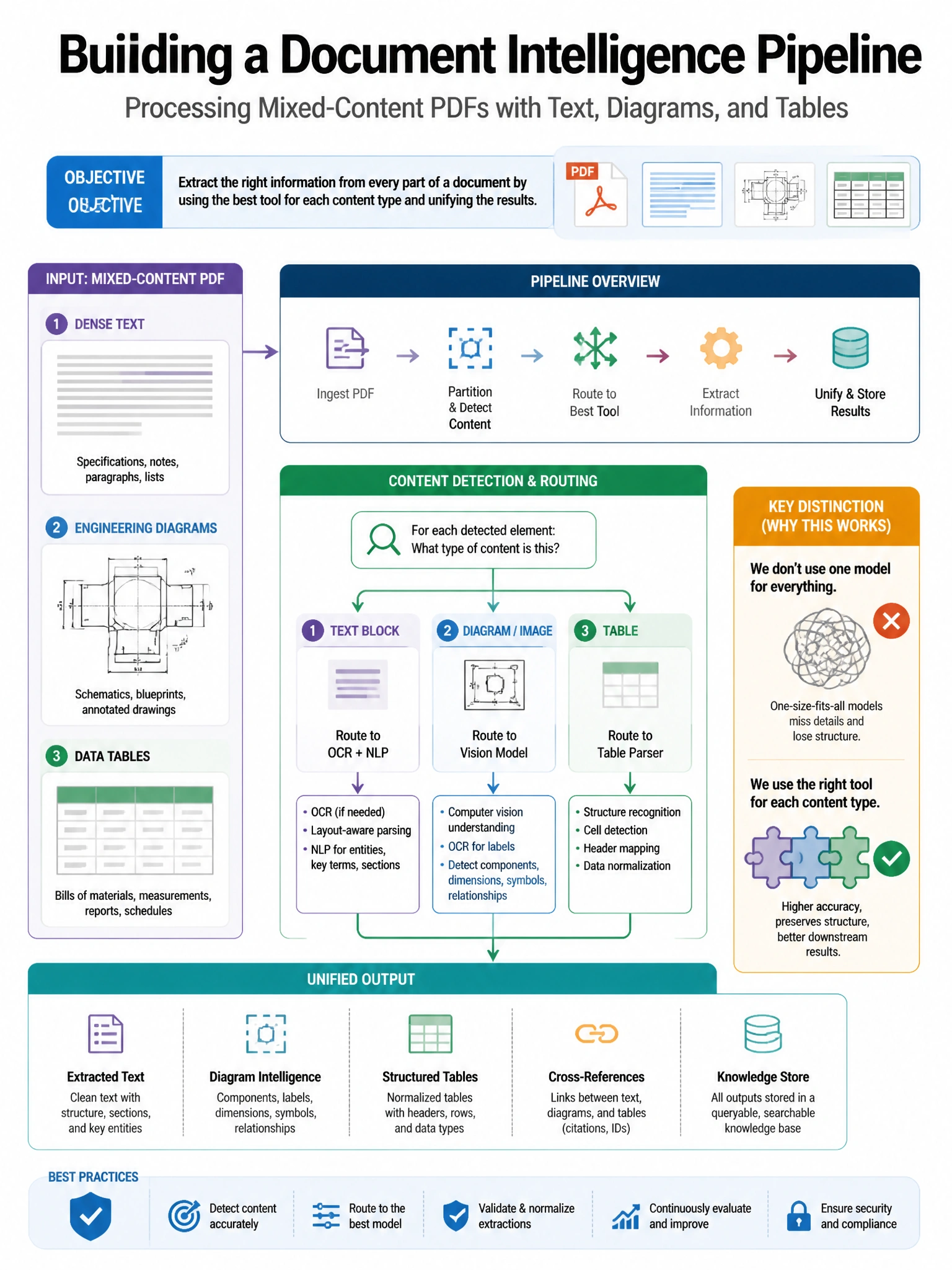
An architect is building a document intelligence pipeline that processes mixed-content PDFs containing dense technical text, engineering diagrams, and data tables. The system must extract structured data from all three content types with high accuracy. The PDFs are converted to images before processing. Which approach yields the best extraction accuracy?
Select an answer to reveal the explanation.
Short Explanation and Infographic
Here's the deal — b is correct because claude-3-5-sonnet has the strongest multimodal reasoning capability for complex mixed-content documents — it handles diagrams, tables, and dense text with high fidelity, and mixed-content pages often contain all three types together, making per-page classification fragile. A is wrong because Haiku's vision capability is weaker on complex diagrams and structured tables, leading to higher extraction errors.
Full explanation below image
Full Explanation
B is correct because claude-3-5-sonnet has the strongest multimodal reasoning capability for complex mixed-content documents — it handles diagrams, tables, and dense text with high fidelity, and mixed-content pages often contain all three types together, making per-page classification fragile. A is wrong because Haiku's vision capability is weaker on complex diagrams and structured tables, leading to higher extraction errors. C is wrong because page-level classification fails on mixed pages containing both text and diagrams simultaneously, and the routing overhead adds complexity. D is wrong because OCR loses spatial layout information critical for interpreting diagrams and the semantic structure of data tables — vision models can use visual context that OCR discards.