
An embedding model selection decision is being made for a RAG system that will serve multilingual queries (English, Spanish, Mandarin, Arabic) against a document corpus that is 90% English. Users query in their native language and expect documents in English to be retrieved. Which embedding model property is most critical for this use case?
Select an answer to reveal the explanation.
Short Explanation and Infographic
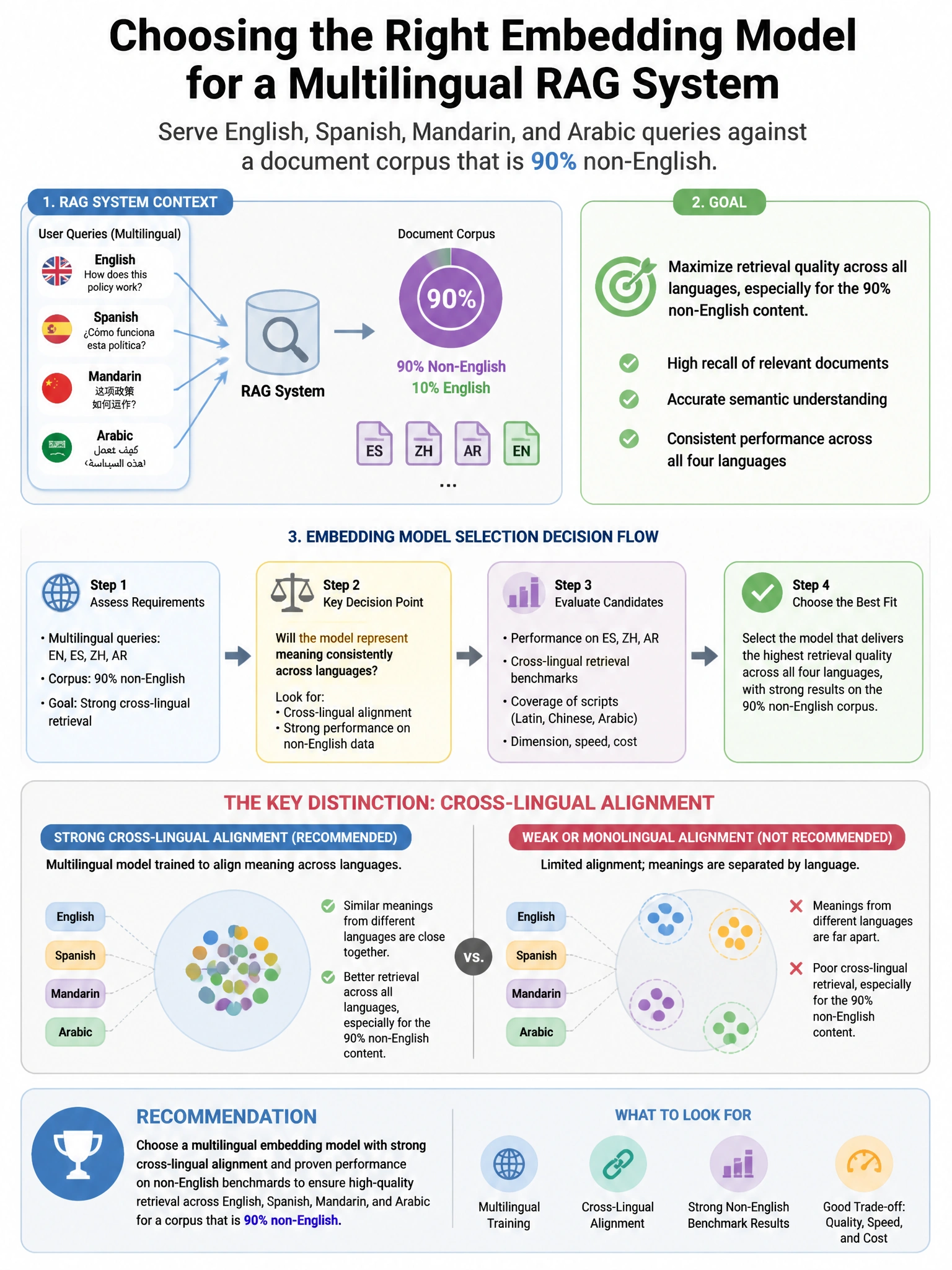
Here's the deal — b is correct because the core requirement is cross-lingual retrieval: a Spanish query must retrieve semantically matching English documents. This requires a multilingual embedding model trained on parallel or multilingual corpora such that the embedding space is language-agnostic — semantically equivalent content in different languages maps to nearby regions in the shared vector space.
Full explanation below image
Full Explanation
B is correct because the core requirement is cross-lingual retrieval: a Spanish query must retrieve semantically matching English documents. This requires a multilingual embedding model trained on parallel or multilingual corpora such that the embedding space is language-agnostic — semantically equivalent content in different languages maps to nearby regions in the shared vector space. D is wrong because dimensionality affects representational capacity in general but is not the property that enables cross-lingual alignment; a high-dimensional monolingual English model cannot align Spanish queries to English documents regardless of dimensionality. B is wrong because context length affects the chunk size that can be embedded but does not determine whether cross-lingual alignment works; it is a secondary concern after selecting a multilingual model. C is wrong because cosine similarity vs. dot-product is an indexing and scoring choice that can be configured independently of the model; neither metric inherently provides cross-lingual capability, and the choice between them does not determine retrieval language generalization.