
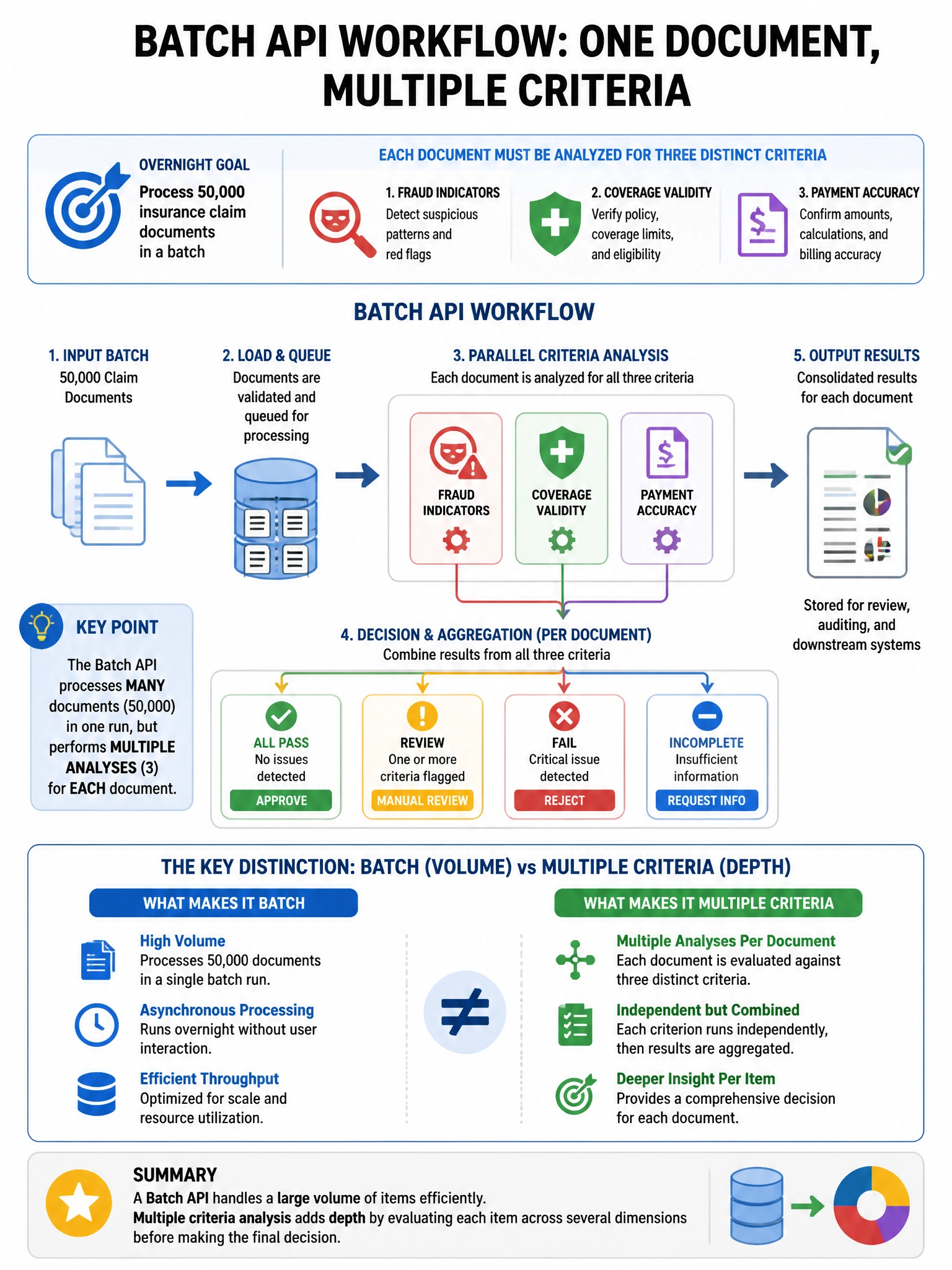
A team is designing a Batch API workflow that processes 50,000 insurance claim documents overnight. Each document must be analyzed for three distinct criteria (fraud indicators, compliance flags, and summary generation), producing three separate outputs per document. What batch architecture minimizes total API round-trips and cost?
Select an answer to reveal the explanation.
Short Explanation and Infographic
Here's the deal — b is correct because combining all three analysis criteria into a single prompt per document reduces the total number of API requests from 150,000 (3 criteria × 50,000 documents) to 50,000. This reduces batch management overhead, input token processing for the document (which is read once, not three times), and total cost.
Full explanation below image
Full Explanation
B is correct because combining all three analysis criteria into a single prompt per document reduces the total number of API requests from 150,000 (3 criteria × 50,000 documents) to 50,000. This reduces batch management overhead, input token processing for the document (which is read once, not three times), and total cost. Structured JSON output with three keys allows downstream systems to parse each criterion independently. B is wrong because submitting three separate full batches triples the number of requests and the cost of processing each document's context (the document itself must be sent three times). D is wrong because submitting 50,000 batches of 3 is operationally complex (50,000 separate batch submissions and status polls) and offers no advantage over option B; criterion isolation can be maintained within a single multi-key JSON response. A is wrong because the Batch API fully supports JSON-structured output; there is no such limitation, and using the synchronous API for 50,000 documents would be slower and potentially more expensive without the batch discount.