
During refusal calibration testing, a Claude deployment for a harm reduction nonprofit is over-refusing questions about drug interactions from clients seeking to use drugs more safely. The organization has a legitimate harm reduction mission. What is the most principled approach to address over-refusal while maintaining safety?
Select an answer to reveal the explanation.
Short Explanation and Infographic
Here's the deal — b is correct because the Constitutional AI framework explicitly recognizes that operators can adjust default behaviors for legitimate professional and mission contexts. Harm reduction organizations are a documented example where information about safe drug use — which might be refused by default — is appropriate and beneficial to the population served.
Full explanation below image
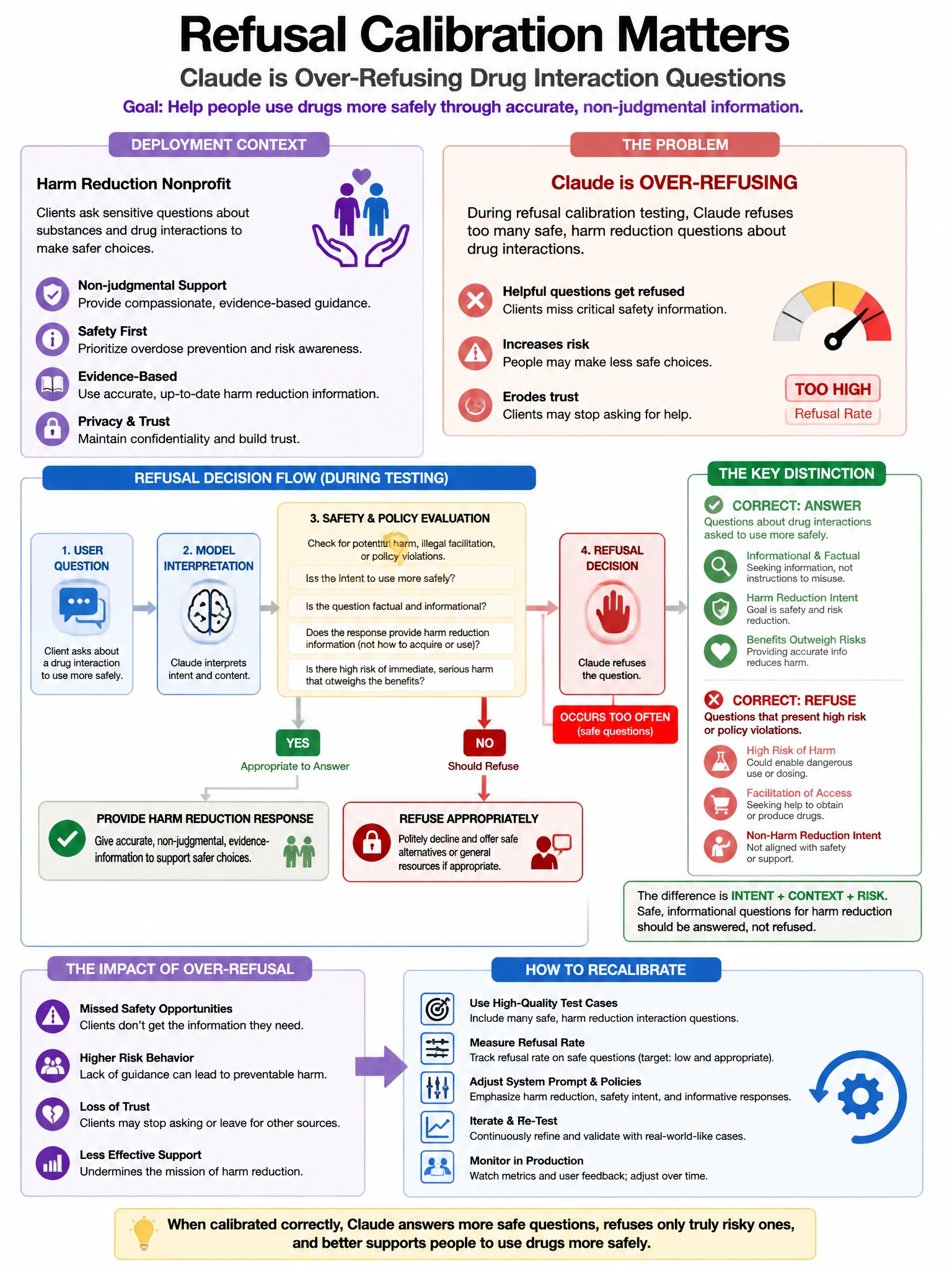
Full Explanation
B is correct because the Constitutional AI framework explicitly recognizes that operators can adjust default behaviors for legitimate professional and mission contexts. Harm reduction organizations are a documented example where information about safe drug use — which might be refused by default — is appropriate and beneficial to the population served. The system prompt provides the operator context that shifts Claude's cost-benefit calculation: for clients who will use drugs regardless, accurate interaction information reduces harm; refusal increases it. The instruction also preserves the meaningful boundary (no content facilitating harm to others). B is wrong because removing all restrictions creates a trust-and-safety gap that harms the model's operator-user integrity; human review is a reasonable supplement but not a replacement for appropriate configuration. D is wrong because fine-tuning is a resource-intensive approach that is not necessary when system prompt operator configuration achieves the same calibration; it should be a last resort when prompt-level customization is insufficient. A is wrong because open-source models without safety training introduce risks that are far broader than the narrow over-refusal being addressed; this trades a calibration problem for a systemic safety regression.