
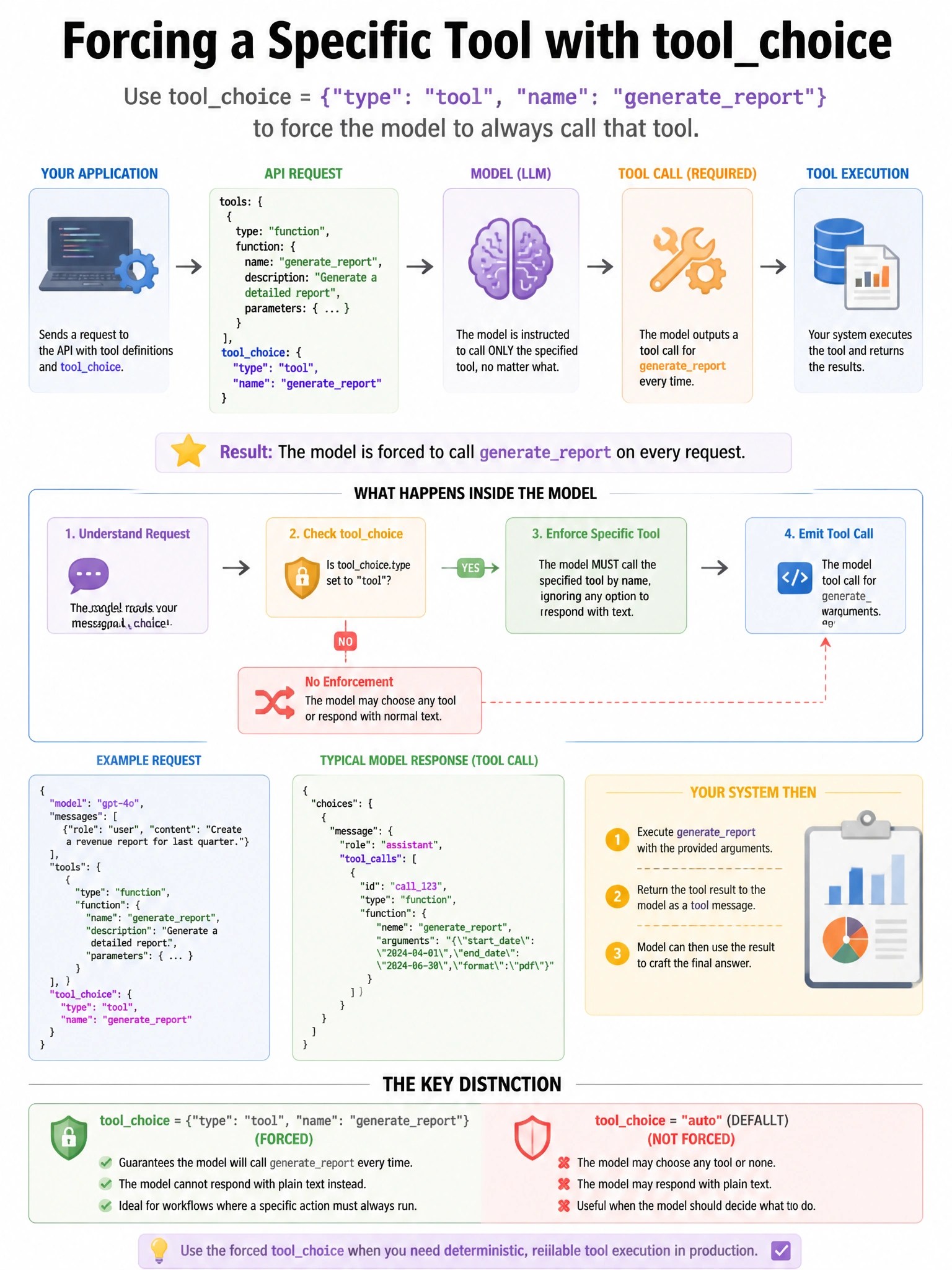
An API integration uses the tool_choice parameter set to {"type": "tool", "name": "generate_report"} to force the model to always call a specific tool. During production, engineers discover that when users ask conversational questions unrelated to report generation, the model still calls generate_report with semantically null arguments. What is the correct architectural fix?
Select an answer to reveal the explanation.
Short Explanation and Infographic
Here's the deal — b is correct because forcing a specific tool via tool_choice: {type: 'tool', name: '...'} instructs the model to always call that tool regardless of query appropriateness. Switching to tool_choice: {type: 'auto'} lets the model use its reasoning to decide when the tool is relevant and when a plain text response is more appropriate — this is the intended use of the auto mode.
Full explanation below image
Full Explanation
B is correct because forcing a specific tool via tool_choice: {type: 'tool', name: '...'} instructs the model to always call that tool regardless of query appropriateness. Switching to tool_choice: {type: 'auto'} lets the model use its reasoning to decide when the tool is relevant and when a plain text response is more appropriate — this is the intended use of the auto mode. C is wrong because adding required schema fields changes the tool's data requirements but not the forcing behavior; the model will still attempt to call the tool, potentially fabricating required field values. A is wrong because adding a pre-processing classifier adds latency and a new failure mode (classifier error leading to incorrect routing); the simpler fix is changing tool_choice to auto and relying on the model's built-in routing judgment. B is wrong because keyword-based routing is brittle and misses paraphrases ('show me the report', 'generate the analysis'); auto mode is more robust.