
An architect is evaluating whether to use extended thinking for a financial modeling task where Claude must estimate a company's fair value using DCF analysis across 12 scenarios. The current non-thinking implementation produces correct formulas but makes arithmetic errors across multi-step calculations. Budget tokens for thinking are capped at 10,000. What is the most important tradeoff to communicate to stakeholders about enabling extended thinking?
Select an answer to reveal the explanation.
Short Explanation and Infographic
Here's the deal — b is correct because extended thinking tokens are generated within the same context window as the rest of the conversation. A thinking budget of 10,000 tokens reduces by 10,000 the tokens available for system prompt, user messages, retrieved context, and final output.
Full explanation below image
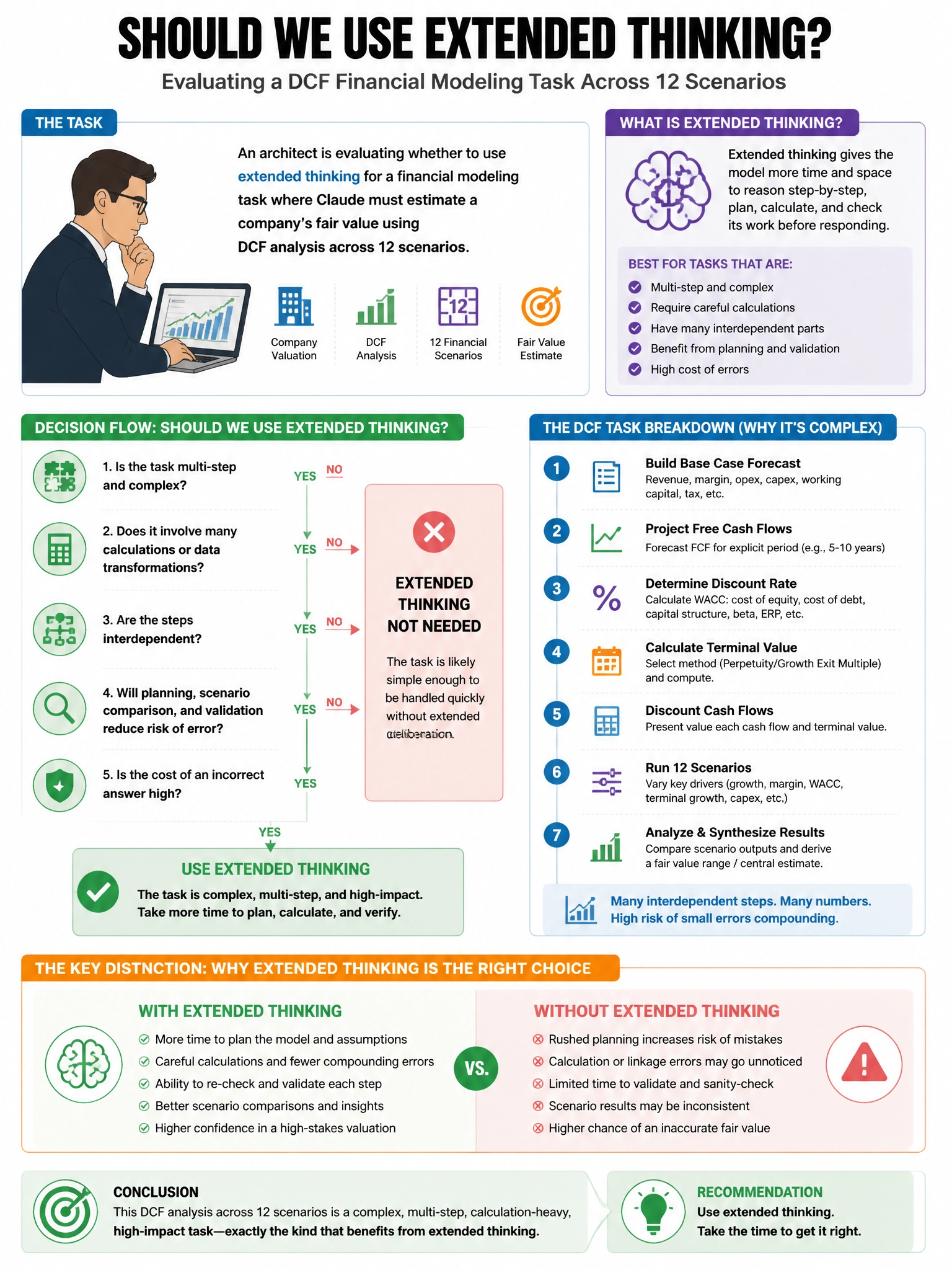
Full Explanation
B is correct because extended thinking tokens are generated within the same context window as the rest of the conversation. A thinking budget of 10,000 tokens reduces by 10,000 the tokens available for system prompt, user messages, retrieved context, and final output. Stakeholders need to understand this tradeoff when documents are large. C is wrong because while thinking tokens are billed as output tokens (at output token rates, not 5x), the billing model described is inaccurate; the cost increase comes from additional output tokens consumed by the thinking process, not a 5x multiplier. A is wrong because while extended thinking has model eligibility requirements, stating legacy models 'silently fall back' overstates the behavior; the API returns an error for unsupported configurations rather than silently degrading. B is wrong because the budget_tokens parameter is a maximum cap, not a fixed reservation; the model uses as many thinking tokens as it needs up to the budget, and unused budget is not billed.