
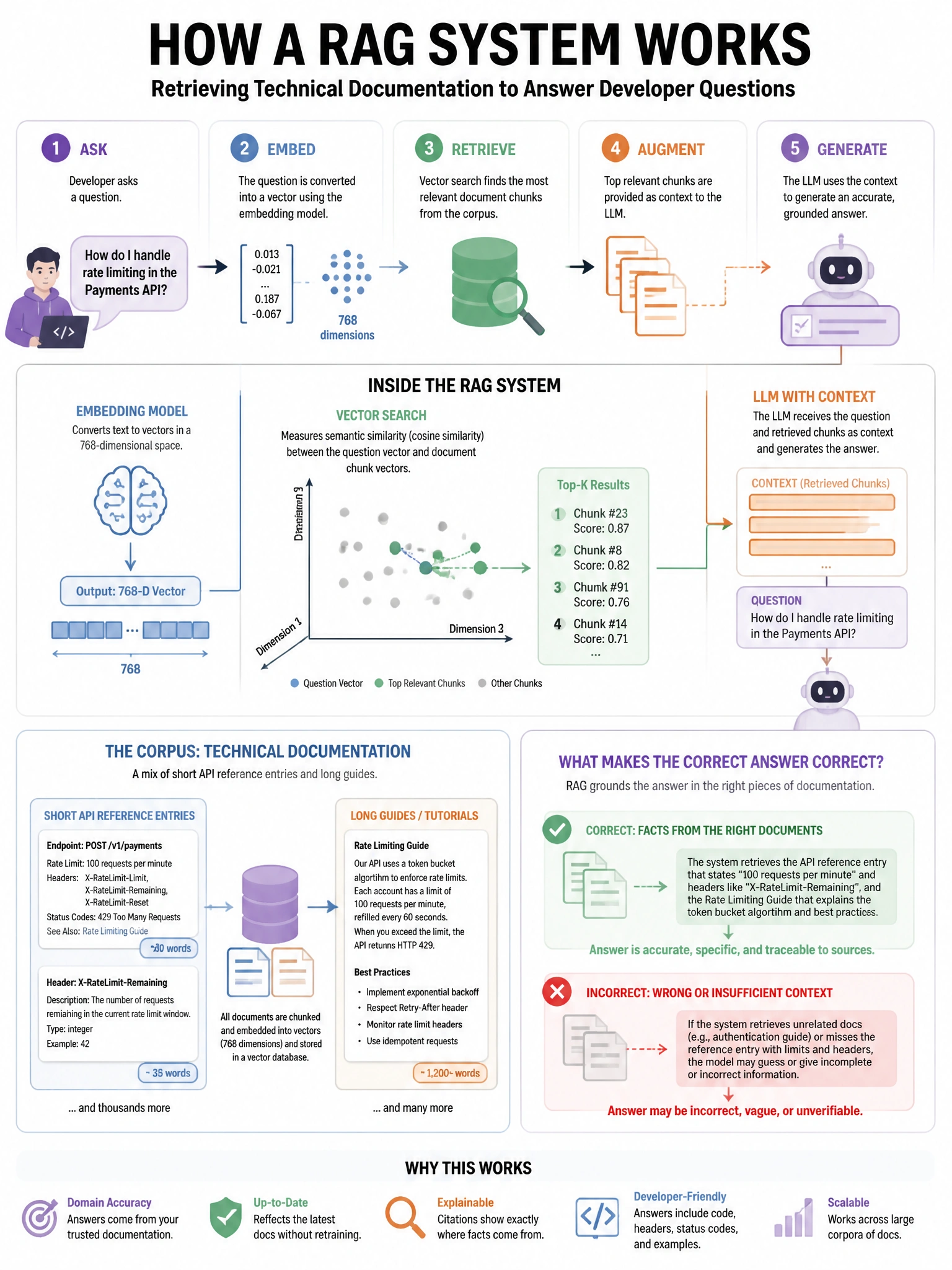
A RAG system retrieves technical documentation to answer developer questions. The embedding model produces 768-dimensional vectors. The corpus contains both short API reference entries (50–100 words) and long conceptual guides (2,000–5,000 words). Developers report that answers to conceptual questions are accurate but answers to specific API parameter questions are vague. What chunking strategy change is most likely to address this?
Select an answer to reveal the explanation.
Short Explanation and Infographic
Here's the deal — b is correct because hierarchical chunking (also called parent-child or small-to-big retrieval) solves the tension between retrieval precision and generation context. Small child chunks produce precise embeddings that match specific parameter queries; when a child chunk is retrieved, the parent chunk is returned to the LLM so sufficient context surrounds the answer.
Full explanation below image
Full Explanation
B is correct because hierarchical chunking (also called parent-child or small-to-big retrieval) solves the tension between retrieval precision and generation context. Small child chunks produce precise embeddings that match specific parameter queries; when a child chunk is retrieved, the parent chunk is returned to the LLM so sufficient context surrounds the answer. This prevents vague answers caused by over-chunking and precision loss caused by under-chunking. C is wrong because padding short entries with surrounding text corrupts the embedding of the specific reference content, reducing precision rather than improving it. A is wrong because the dimensionality of the embedding model affects the capacity to encode semantic distinctions but does not specifically improve retrieval of short entries over long ones; the root issue is chunk size mismatch, not dimensionality. B is wrong because hybrid routing adds operational complexity and requires maintaining two indexes; it also requires reliable intent classification per query, which introduces a new failure mode.