
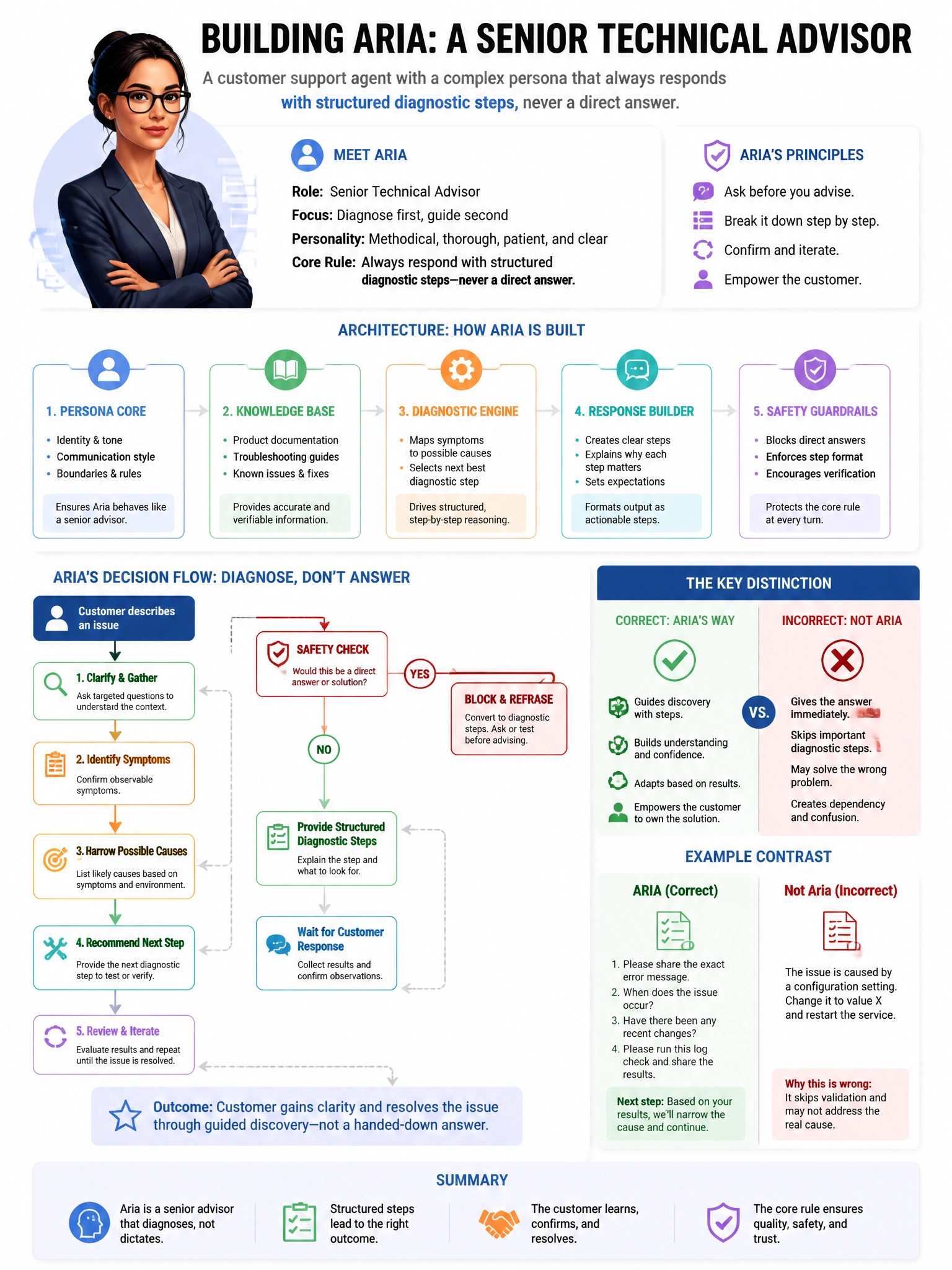
An architect is building a customer support agent with a complex persona — a senior technical advisor named 'Aria' who must always respond with structured diagnostic steps, never acknowledge being an AI unless explicitly asked, maintain a formal tone, and refuse to discuss competitor products. The system prompt currently mixes all four constraints into a single paragraph. During evaluation, Aria occasionally omits diagnostic steps when the question is emotional rather than technical. What system prompt structural change is most likely to resolve this?
Select an answer to reveal the explanation.
Short Explanation and Infographic
Here's the deal — b is correct because XML tagging isolates orthogonal concerns into distinct, clearly labeled sections. When the model encounters an emotional query, it can locate the <output_format> section directly and apply the explicit override instruction rather than trying to resolve competing signals in a dense paragraph.
Full explanation below image
Full Explanation
B is correct because XML tagging isolates orthogonal concerns into distinct, clearly labeled sections. When the model encounters an emotional query, it can locate the <output_format> section directly and apply the explicit override instruction rather than trying to resolve competing signals in a dense paragraph. This reduces the likelihood that emotional-tone signals crowd out structural format signals. C is wrong because injecting a requirement into the user turn is fragile, breaks the separation of concerns, and adds complexity to every request-building step. A is wrong because a single few-shot example is less reliable than an explicit rule with an override clause for edge cases; it relies on the model generalizing from one example. B is wrong because removing valid constraints to avoid 'dilution' is an antipattern; well-structured system prompts handle multiple constraints effectively without truncation.