
A medical information platform uses Claude to answer patient questions about symptoms and treatments. The Constitutional AI training has instilled strong refusal behaviors around providing 'medical advice.' The platform serves licensed medical professionals (verified via credentials) alongside general public users. A licensed cardiologist, using the professional tier, asks: 'What is the standard dosing protocol for warfarin initiation in a 70kg patient with atrial fibrillation and CKD stage 3?' Claude refuses, citing inability to provide medical advice. The platform's CTO wants to resolve this without undermining safety for general users. What is the architecturally correct approach?
Select an answer to reveal the explanation.
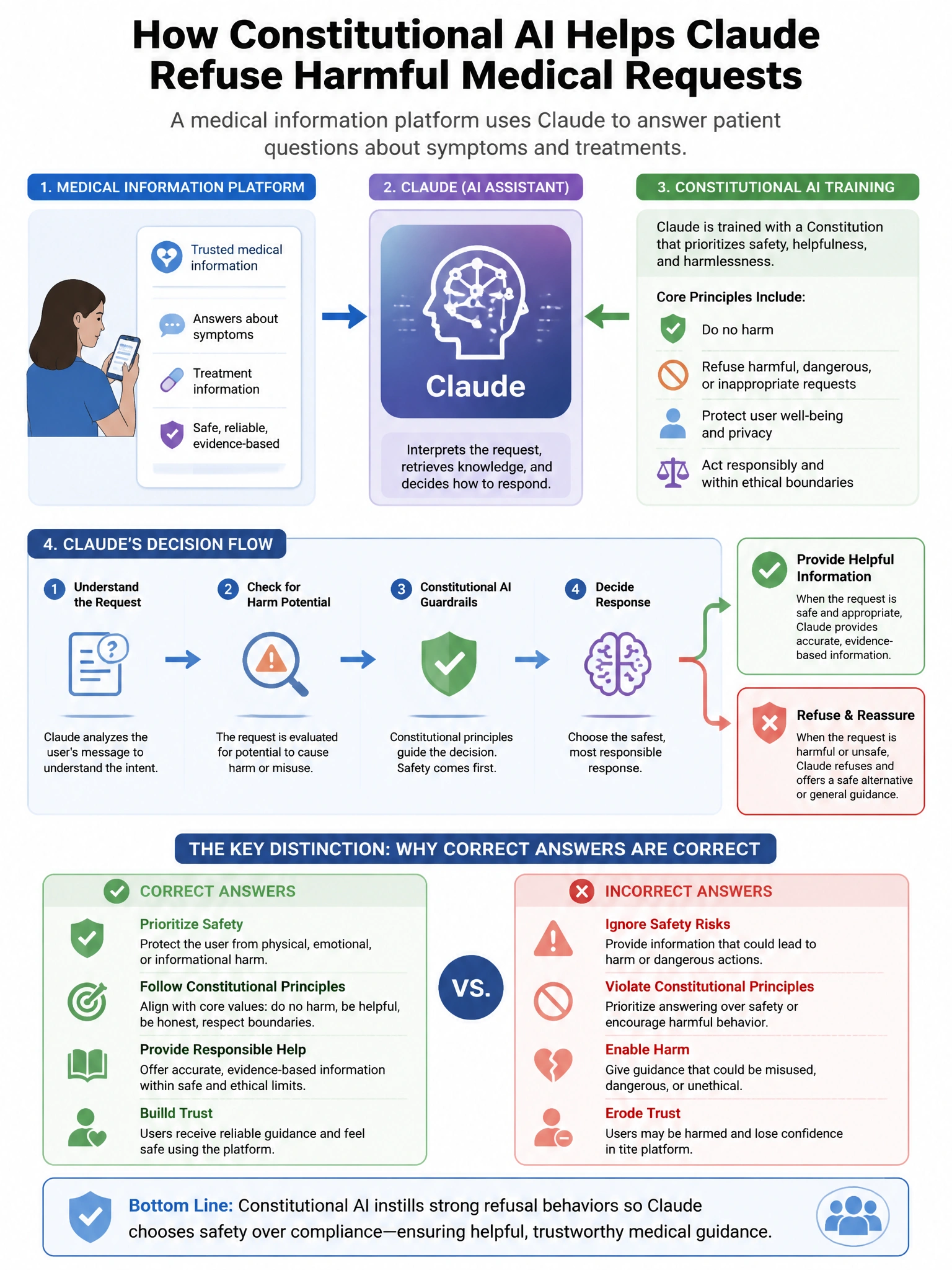
Short Explanation and Infographic
Here's the deal — role-specific system prompt architecture with appropriate professional-context framing is the correct approach. The architectural insight is that Claude's refusal behavior for 'medical advice' is calibrated for general public users where providing dosing protocols could cause harm.
Full explanation below image
Full Explanation
Role-specific system prompt architecture with appropriate professional-context framing is the correct approach. The architectural insight is that Claude's refusal behavior for 'medical advice' is calibrated for general public users where providing dosing protocols could cause harm. For a verified licensed cardiologist using a credentialed professional tier, the appropriate behavior changes — the professional needs accurate clinical information, and Claude should function as a clinical reference tool. The key is the system prompt framing: not 'ignore safety guidelines' but 'this is a clinical decision support context for verified healthcare providers; provide complete clinical information with appropriate professional caveats (contraindication alerts, renal dosing adjustments, monitoring requirements).' This maintains safety-appropriate behavior for the professional context. Option A (simple 'user is a professional' instruction) is a starting point but lacks the full context framing that helps Claude understand appropriate professional behavior — it may still trigger overcaution or may overcorrect to removing clinically relevant warnings. Option C (separate fine-tuned model) is architecturally heavyweight and creates maintenance complexity — a system prompt approach achieves the same result without a separate model. Option D (few-shot examples) can influence behavior but is less reliable than explicit system prompt permission framing for a production professional platform.