
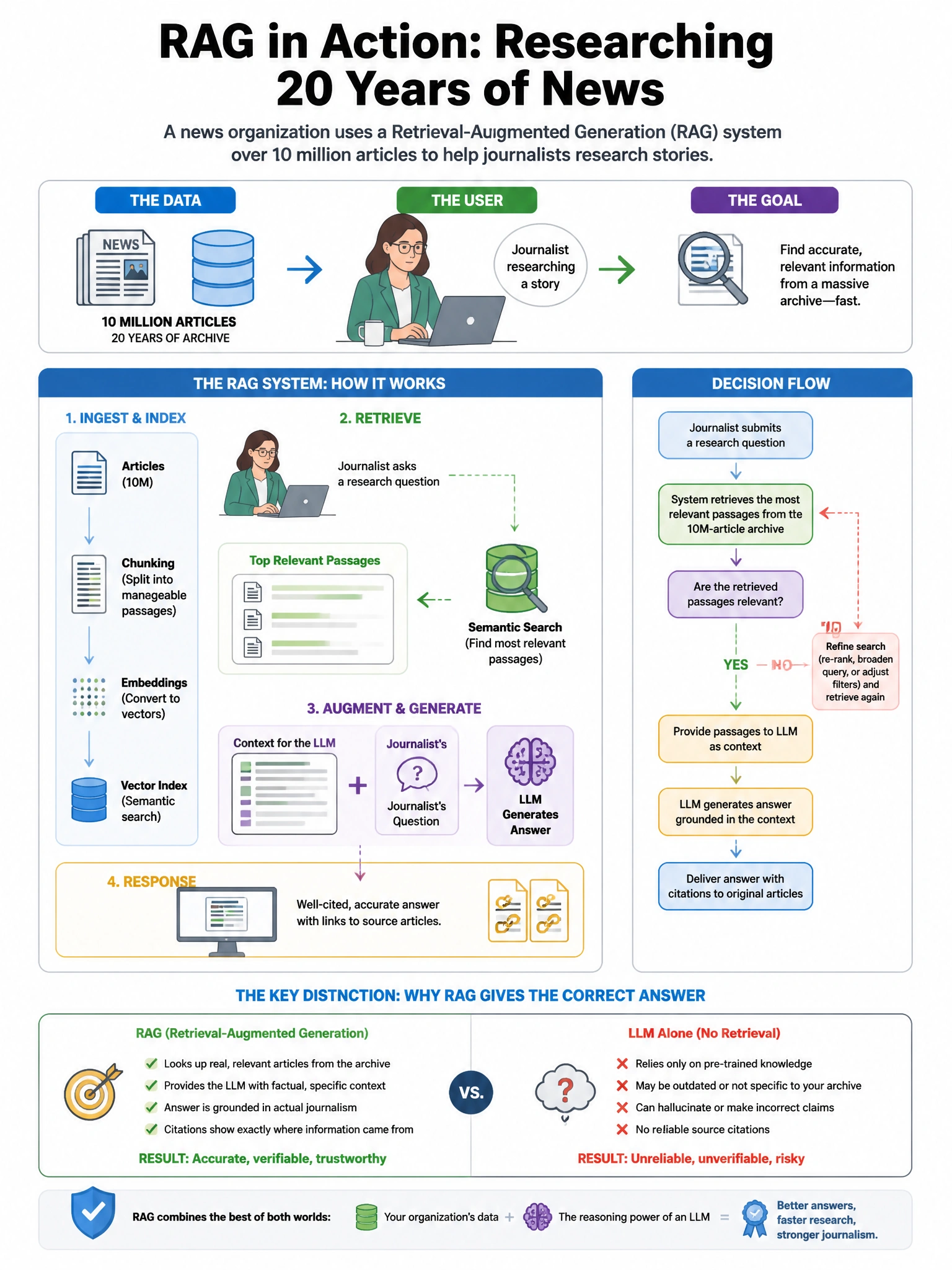
A news organization deploys a RAG system over an archive of 10 million articles spanning 20 years. The system is used by journalists to research stories. A journalist asks: 'What is the current policy on immigration detention?' The system retrieves the 5 most semantically relevant articles — which happen to be from 2019 — and Claude provides a confident answer based on outdated policy information. No disclaimer is provided. The retrieval system has no temporal metadata filtering. What architectural combination best addresses knowledge freshness in this production system?
Select an answer to reveal the explanation.
Short Explanation and Infographic
Here's the deal — the combination of recency-weighted retrieval with a freshness disclaimer is the most complete architectural solution. Recency weighting (Option A's approach) ensures the retrieval pipeline favors recent articles for time-sensitive queries.
Full explanation below image
Full Explanation
The combination of recency-weighted retrieval with a freshness disclaimer is the most complete architectural solution. Recency weighting (Option A's approach) ensures the retrieval pipeline favors recent articles for time-sensitive queries. But recency weighting alone can fail when: (1) a very relevant 2019 article outscores a less semantically similar 2024 article, still retrieving stale content, or (2) the most recent article about the topic is still from 2022. The freshness disclaimer acts as a mandatory safety net: regardless of what retrieval returns, Claude checks the publication dates of retrieved documents and flags when the freshest source is over 180 days old — giving journalists the critical context that this information may be outdated. Option A (recency weighting only) improves retrieval but doesn't prevent stale results from dominating; no user-facing signal about staleness. Option B (hard 90-day filter for 'current' queries) is too restrictive: for some policy topics, no articles exist from the last 90 days, returning empty results. Option C (output dates only) pushes responsibility entirely to users without improving retrieval — journalists researching stories may not notice a 2019 date embedded in a long response.