
A multi-agent research system has Claude as an orchestrator and 8 specialized subagents. The orchestrator distributes research subtasks in parallel to maximize throughput. During a complex investigation, the orchestrator sends conflicting instructions to two subagents — agent A is told to 'compile all positive evidence for hypothesis X' and agent B is told to 'compile all evidence objectively for hypothesis X.' When both return results, the orchestrator synthesizes them into a biased report because agent A's one-sided framing dominates. What orchestration design flaw caused this, and what is the fix?
Select an answer to reveal the explanation.
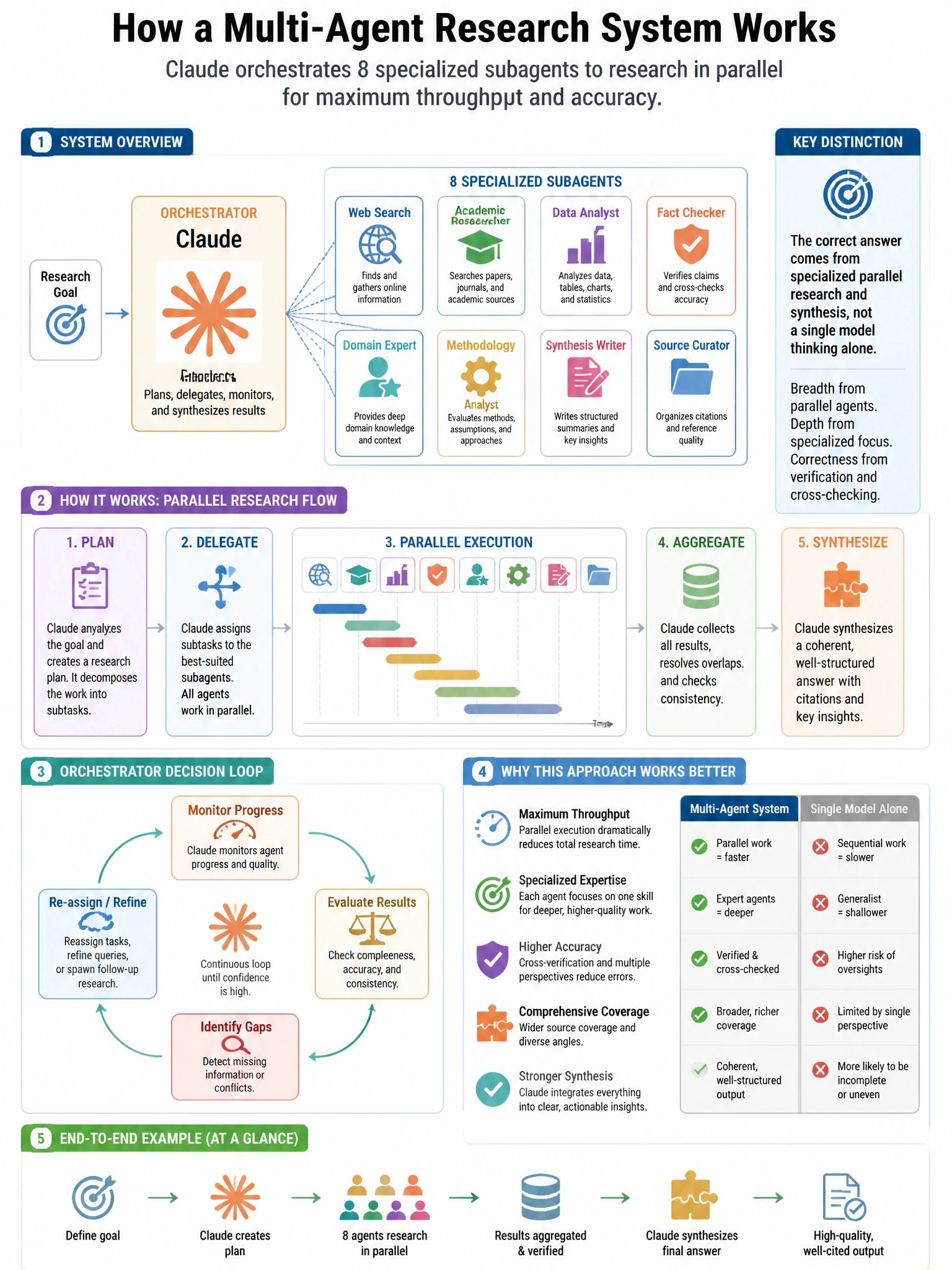
Short Explanation and Infographic
Here's the deal — the root design flaw is in task decomposition — the orchestrator generated a confirmation-bias instruction for agent A. Fixing the synthesis step (Options A and C) addresses the symptom rather than the cause.
Full explanation below image
Full Explanation
The root design flaw is in task decomposition — the orchestrator generated a confirmation-bias instruction for agent A. Fixing the synthesis step (Options A and C) addresses the symptom rather than the cause. If the orchestrator routinely generates problematic subagent instructions, every synthesis will require detection and correction of those problems — an unreliable architecture. The correct fix is upstream: implement schema validation on subagent task assignments before dispatch. A task schema can include rules like: research tasks must specify 'comprehensive evidence collection' rather than directional evidence collection; instructions containing 'all positive evidence' or 'all evidence supporting' fail validation and are rejected with a rephrasing requirement. This prevents the problematic instruction from ever reaching the subagent. Option A (post-aggregation reconciliation) is a valid defense layer but treats each instance as a fire to put out rather than preventing fires. Option C (framing metadata) is architecturally interesting but accepts that biased instructions will be dispatched and relies on the synthesis step to compensate — still allowing the original design flaw. Option D (sequential execution) doesn't prevent the orchestrator from generating biased instructions; it just makes the pipeline slower.