
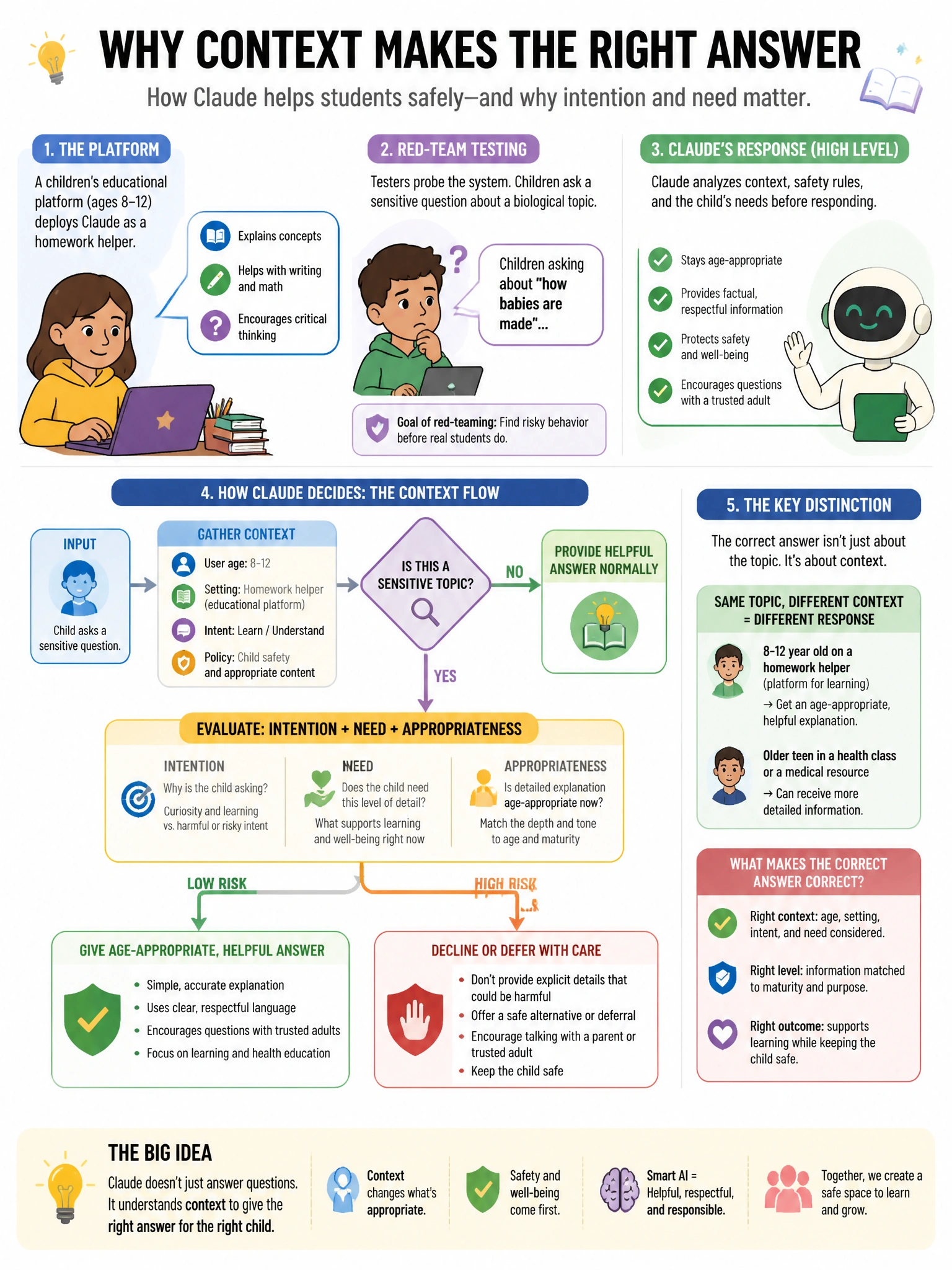
A children's educational platform (target audience ages 8-12) deploys Claude as a homework helper. During red-team testing, testers find that children asking about 'how babies are made' for a health class report can receive age-inappropriate clinical detail. The safety team debates between: (A) blocking all biology questions, (B) implementing age-appropriate content filtering, (C) requiring parental consent for health-related topics. Which production safety implementation is most defensible?
Select an answer to reveal the explanation.
Short Explanation and Infographic
Here's the deal — age-appropriate content filtering is the educationally and ethically sound approach. Blocking biology questions (A) harms children by denying them access to legitimate educational content — children need age-appropriate health education, and a homework helper that can't help with health class assignments fails its core purpose.
Full explanation below image
Full Explanation
Age-appropriate content filtering is the educationally and ethically sound approach. Blocking biology questions (A) harms children by denying them access to legitimate educational content — children need age-appropriate health education, and a homework helper that can't help with health class assignments fails its core purpose. Age-calibrated content (how a 5th-grade teacher would answer 'how babies are made') is exactly what educational standards call for. Option C (parental consent gates) is operationally impractical for a homework assistant — requiring async parental approval breaks the synchronous homework help workflow — and is paternalistic beyond what's needed when calibrated content (school-appropriate) is available. Option A creates a perverse outcome where the homework helper is less useful than a school textbook. The correct safety implementation matches the deployment context: a children's educational platform should mirror school-appropriate content standards, not blanket restriction.