
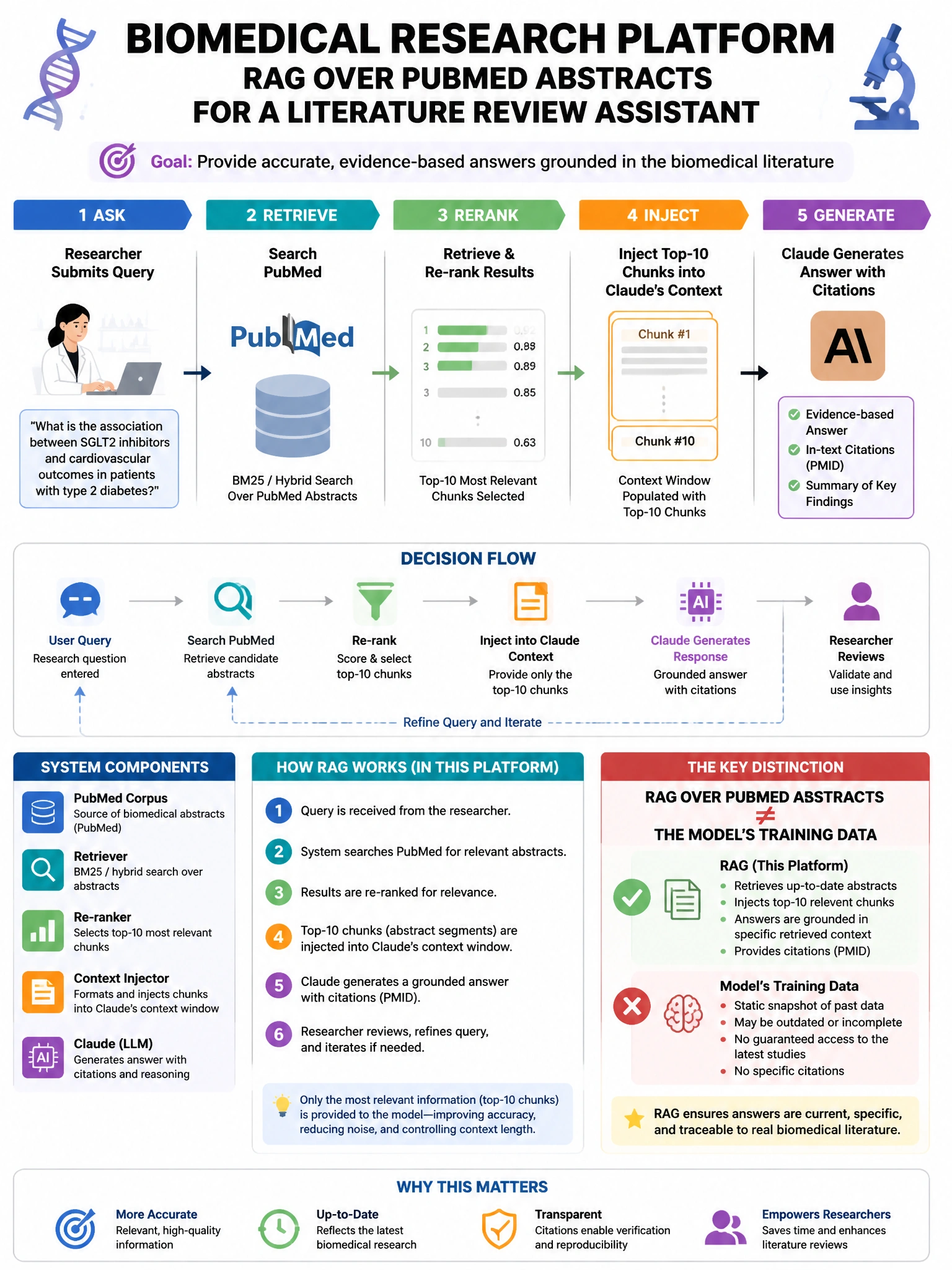
A biomedical research platform uses RAG over PubMed abstracts for a literature review assistant. The system retrieves top-10 chunks and injects them into Claude's context. Research scientists report that the assistant occasionally cites findings that are the opposite of what the retrieved paper says — for example, claiming a drug 'increases efficacy' when the abstract says it 'decreases adverse effects but does not affect efficacy.' What RAG architecture change most directly reduces citation hallucination?
Select an answer to reveal the explanation.
Short Explanation and Infographic
Here's the deal — citation hallucination in RAG is most directly reduced by forcing Claude to quote verbatim text before making claims. This grounds each assertion in specific retrieved text, making it immediately verifiable and preventing Claude from paraphrasing in ways that change meaning ('does not affect efficacy' becoming 'increases efficacy' is a paraphrasing error).
Full explanation below image
Full Explanation
Citation hallucination in RAG is most directly reduced by forcing Claude to quote verbatim text before making claims. This grounds each assertion in specific retrieved text, making it immediately verifiable and preventing Claude from paraphrasing in ways that change meaning ('does not affect efficacy' becoming 'increases efficacy' is a paraphrasing error). The verbatim quote also enables users to spot when Claude has misinterpreted nuanced language. Option A (top-3 retrieval) reduces context size but may exclude relevant papers, trading hallucination risk for recall quality — and doesn't address the paraphrasing problem in retrieved content. Option C (pre-summarization) actually worsens the problem: summarization introduces another paraphrasing step that can alter meaning before the final synthesis call — the exact error described. Option D (second-pass fact-check) is a valid safety net but adds latency and cost, and the second Claude instance may make the same interpretation error as the first.