
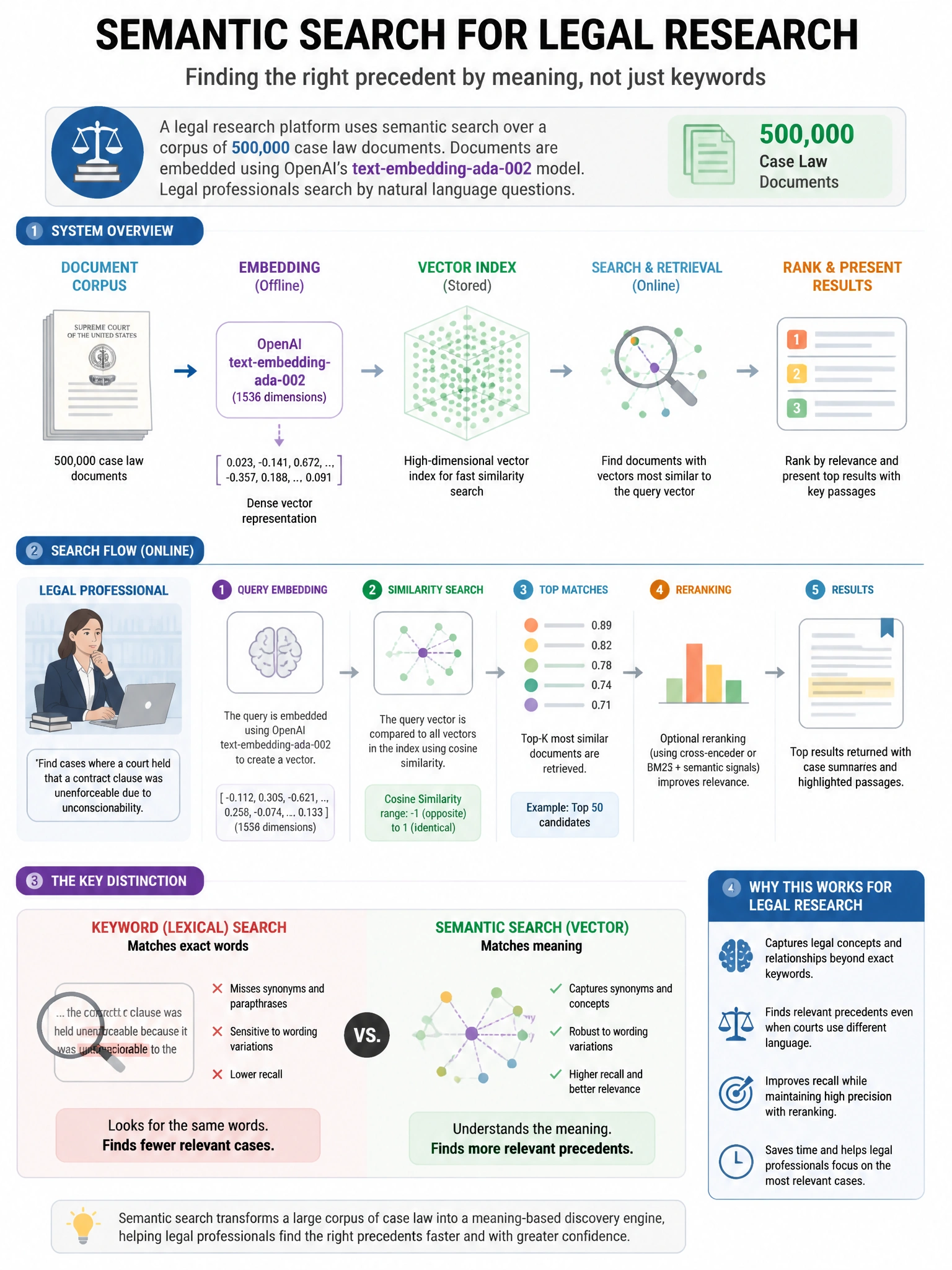
A legal research platform uses semantic search over a corpus of 500,000 case law documents. They embed documents using OpenAI's text-embedding-ada-002 model. Legal professionals report that the system fails to retrieve cases with unusual legal terminology or specific statute references (e.g., 'Dormant Commerce Clause challenges to state tax apportionment under Complete Auto Transit'). Standard semantic search retrieves topically similar cases but misses the specific statutory citation. What retrieval architecture improves retrieval of highly specific legal terminology?
Select an answer to reveal the explanation.
Short Explanation and Infographic
Here's the deal — hybrid search is the standard solution for retrieval that requires both semantic understanding and exact term matching. BM25 (sparse retrieval) excels at retrieving documents containing specific terms like 'Dormant Commerce Clause' or 'Complete Auto Transit' — it operates on exact token overlap.
Full explanation below image
Full Explanation
Hybrid search is the standard solution for retrieval that requires both semantic understanding and exact term matching. BM25 (sparse retrieval) excels at retrieving documents containing specific terms like 'Dormant Commerce Clause' or 'Complete Auto Transit' — it operates on exact token overlap. Dense semantic search excels at topical relevance but may miss cases that use different terminology for the same concepts. Reciprocal rank fusion merges both result sets, promoting documents that rank highly in both systems. Option A (domain-specific embeddings) would improve semantic retrieval of legal concepts but still wouldn't match on exact statute citations as reliably as sparse retrieval. Option C (metadata tags) requires exhaustive extraction of all possible statute references as structured metadata — practical for major statutes but brittle for the long tail of specific citations. Option D (larger K + reranking) improves recall but doesn't fix the fundamental semantic-search failure to retrieve exact legal citations — if they're not in the top-50 semantic results, reranking can't help.