
A healthcare SaaS company runs a symptom checker that generates thousands of Claude calls per hour. The system prompt is 3,000 tokens and is identical across all requests. They are paying for the system prompt tokens on every single API call. A colleague suggests enabling prompt caching using cache_control: {"type": "ephemeral"} on the system prompt. The team wants to understand the economic tradeoff. Cached read pricing is approximately 10% of standard input pricing. Cache write operations have the same cost as normal input but the cache TTL is 5 minutes. Their average request rate is 200 requests per minute. What is the expected cost reduction on system prompt tokens?
Select an answer to reveal the explanation.
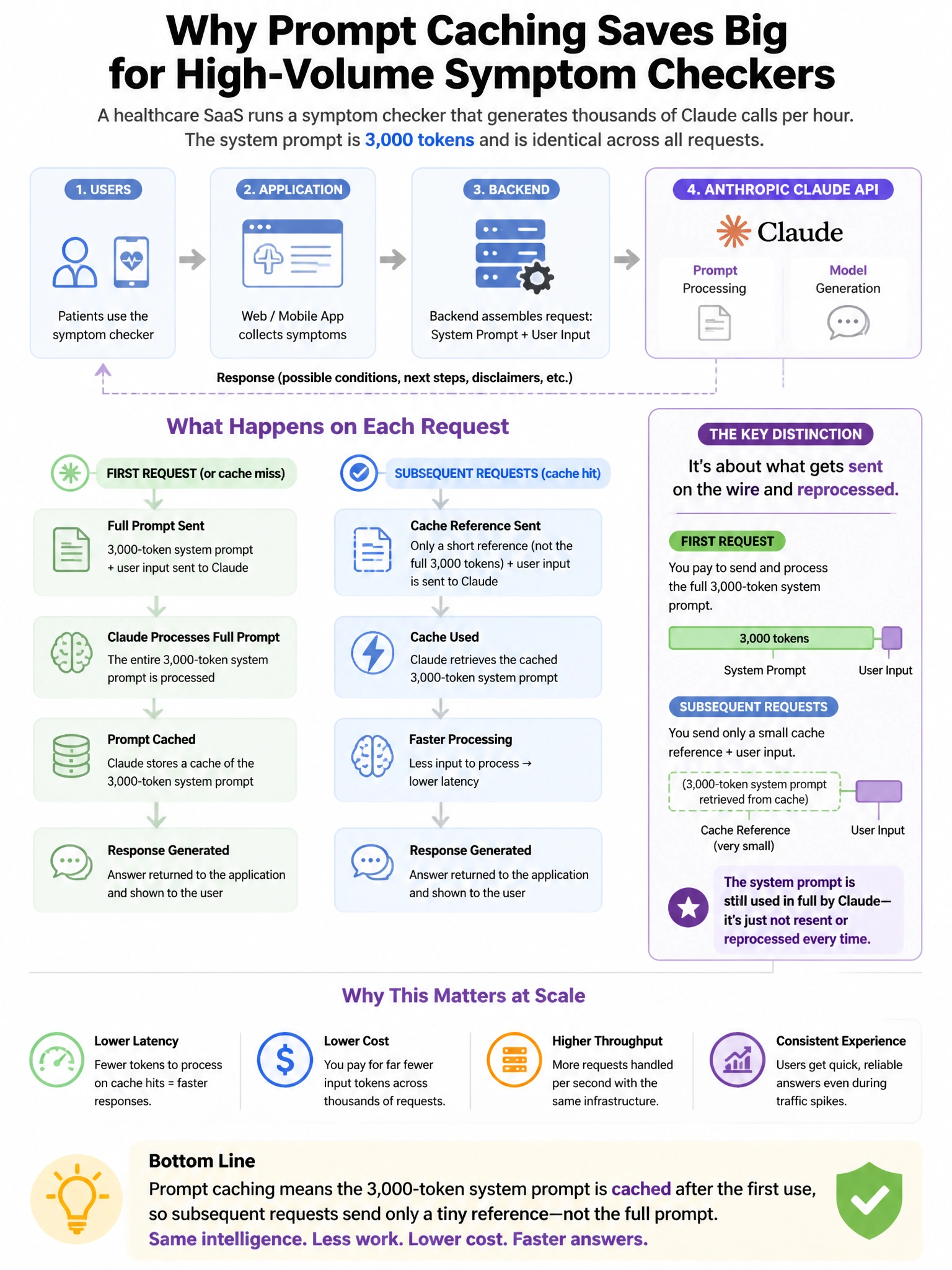
Short Explanation and Infographic
Here's the deal — at 200 requests/minute over a 5-minute TTL window, each cache instance serves 1,000 requests: 1 cache write (full cost) + 999 cache reads (10% cost each). Total cost = (1 × 1.0 + 999 × 0.1) / 1000 = (1.0 + 99.9) / 1000 = 0.1009 per-request average.
Full explanation below image
Full Explanation
At 200 requests/minute over a 5-minute TTL window, each cache instance serves 1,000 requests: 1 cache write (full cost) + 999 cache reads (10% cost each). Total cost = (1 × 1.0 + 999 × 0.1) / 1000 = (1.0 + 99.9) / 1000 = 0.1009 per-request average. This is approximately 10% of original cost — a 90% reduction. Option A misframes the calculation: the 90% savings applies to the net cost, not 'approximately 10% reduction.' Option C is incorrect — at high request rates (200 RPM), cache warmth is nearly continuous; the 5-minute TTL is easily maintained. The cache write cost is amortized across ~1,000 reads. Option D (50% reduction) would be the case at extremely low request rates where cache misses are frequent, but at 200 RPM the cache hit rate approaches 99.9%.