
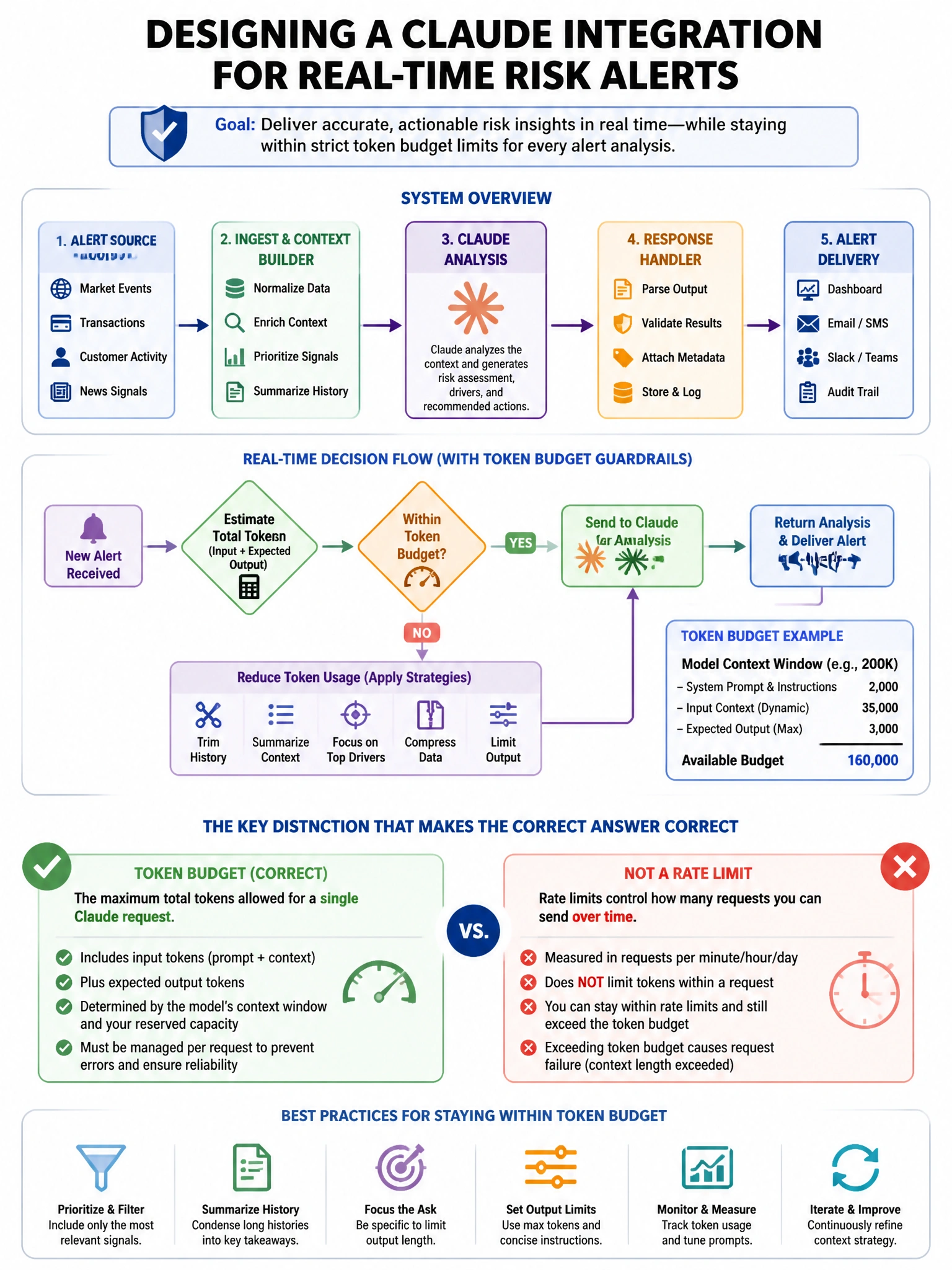
A financial services company is designing a Claude integration for real-time risk alerts. Their system must handle token budget constraints carefully: each alert analysis must stay within a specific token budget to control costs. When Claude produces a response that approaches the max_tokens limit and appears truncated, the current implementation silently delivers the truncated response to downstream risk systems. This has caused incidents where incomplete risk assessments were acted upon. What is the correct error handling approach?
Select an answer to reveal the explanation.
Short Explanation and Infographic
Here's the deal — the stop_reason field is the definitive signal for how Claude's generation ended. end_turn means Claude voluntarily stopped (natural completion).
Full explanation below image
Full Explanation
The stop_reason field is the definitive signal for how Claude's generation ended. end_turn means Claude voluntarily stopped (natural completion). max_tokens means generation was forcibly cut off. For risk assessments, a max_tokens stop is a data quality event, not normal operation — the assessment is provably incomplete. The correct handling is to either increase max_tokens and retry, or trigger a fallback (e.g., human review, simplified prompt) rather than silently delivering incomplete output. Option A (8,192 max_tokens universally) wastes tokens on short responses and may still truncate unusually long analyses. Option C (prompt-based length constraint) is unreliable — Claude may misjudge response length and the instruction doesn't prevent truncation when the actual content requires more tokens. Option D (post-processing classifier) can detect some truncations but is heuristic; checking stop_reason is authoritative and requires no inference.