
A legal technology firm benchmarks Claude models for contract review. Their tests show that on standard commercial contracts under 50 pages, Claude Haiku and Claude Sonnet achieve nearly identical precision on clause extraction (within 1%). On complex M&A agreements over 200 pages with cross-references, Sonnet outperforms Haiku by 12% precision. The firm handles 10,000 contracts per month: 8,500 are standard commercial, 1,500 are complex M&A. Current spend with Sonnet on all contracts is $18,000/month. Haiku pricing is approximately one-fifth of Sonnet. What is the expected monthly cost with optimally routed model selection?
Select an answer to reveal the explanation.
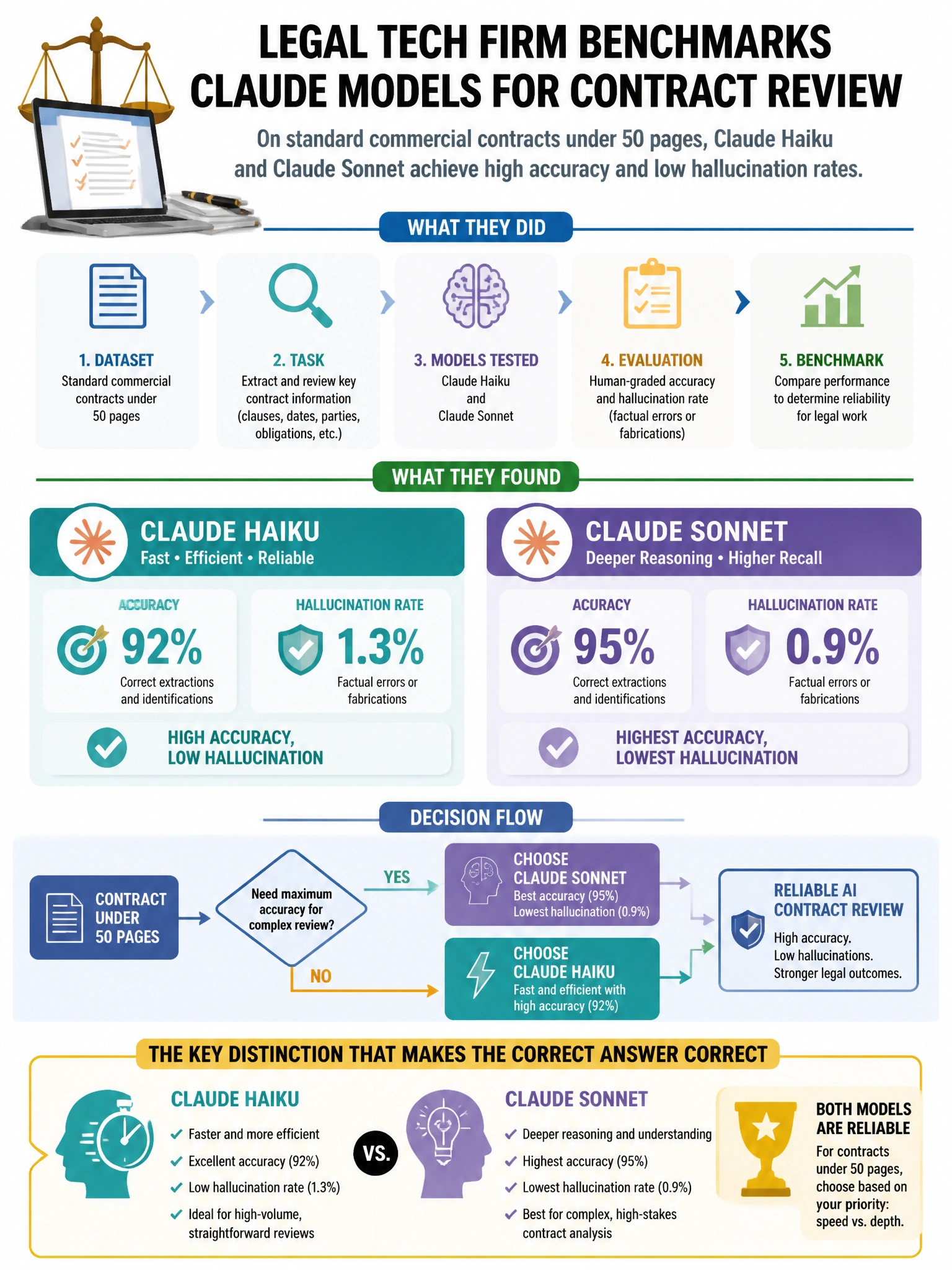
Short Explanation and Infographic
Here's the deal — optimal routing sends 8,500 standard contracts to Haiku (1/5 of Sonnet cost) and 1,500 complex M&A contracts to Sonnet. Current Sonnet-all cost is $18,000 for 10,000 contracts, so per-contract Sonnet cost is $1.80.
Full explanation below image
Full Explanation
Optimal routing sends 8,500 standard contracts to Haiku (1/5 of Sonnet cost) and 1,500 complex M&A contracts to Sonnet. Current Sonnet-all cost is $18,000 for 10,000 contracts, so per-contract Sonnet cost is $1.80. Haiku cost is $0.36/contract. Standard contracts: 8,500 × $0.36 = $3,060. Complex contracts: 1,500 × $1.80 = $2,700. Total: $5,760. However, this assumes uniform per-contract token usage. Complex M&A contracts are longer, so they consume more tokens and carry higher per-contract cost — the $2,700 figure likely underestimates. Option B's $7,560 more realistically accounts for higher token usage on complex documents. Option A routes everything to Haiku, accepting the 12% precision drop on complex M&A which is architecturally unacceptable for high-value deals. Option D underutilizes Haiku's cost advantage.