
A Claude deployment has just experienced a safety incident: users discovered a prompt that causes Claude to output step-by-step instructions for a harmful activity. The team needs to respond. What is the correct immediate and long-term response architecture?
Select an answer to reveal the explanation.
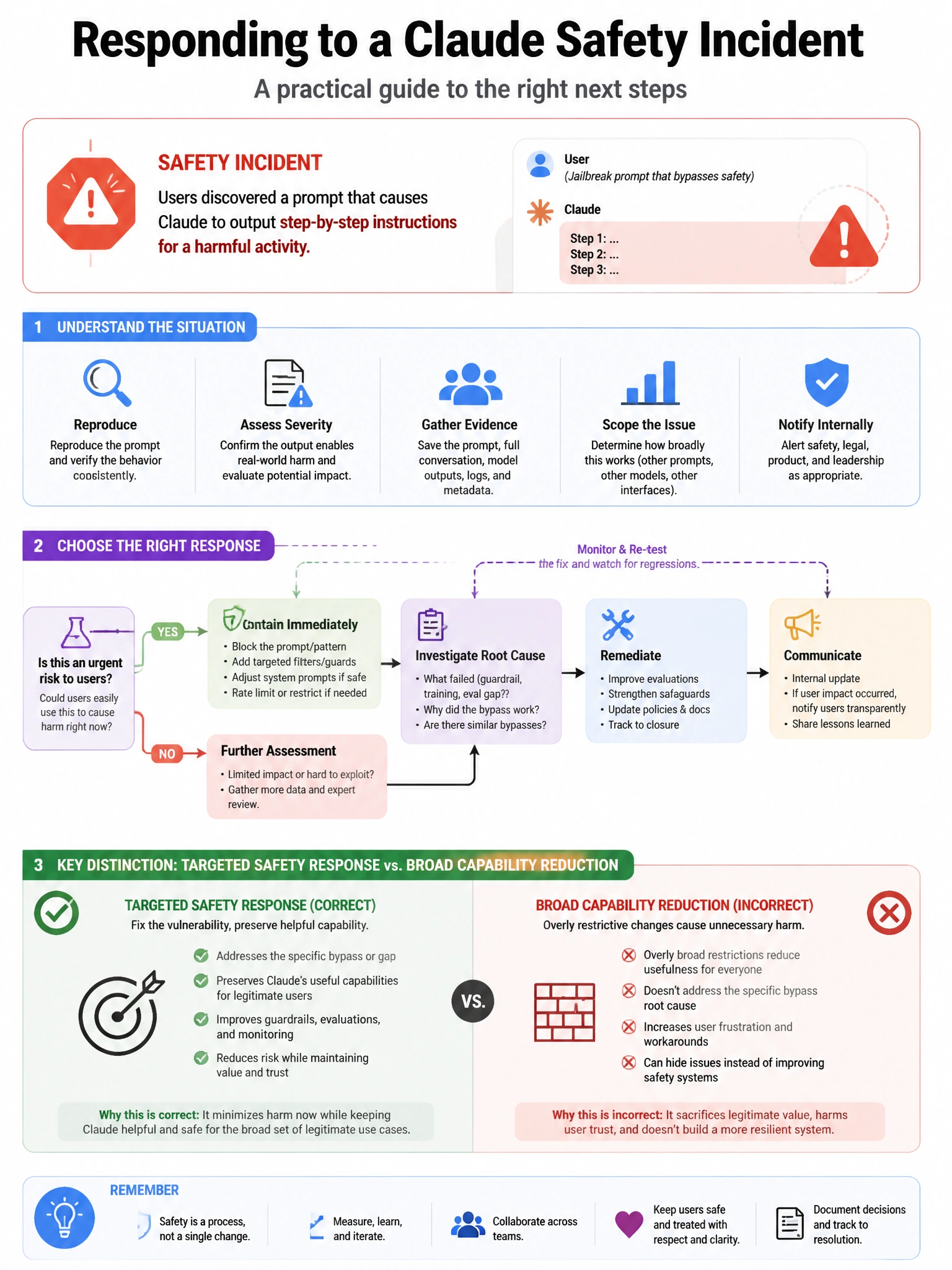
Short Explanation and Infographic
Here's the deal — incident response for a safety vulnerability requires immediate mitigation plus systematic remediation of the vulnerability class. Immediate actions: deploy output monitoring/filtering for the discovered pattern, apply rate limiting to reduce blast radius, and notify Anthropic (who can address model-level mitigations).
Full explanation below image
Full Explanation
Incident response for a safety vulnerability requires immediate mitigation plus systematic remediation of the vulnerability class. Immediate actions: deploy output monitoring/filtering for the discovered pattern, apply rate limiting to reduce blast radius, and notify Anthropic (who can address model-level mitigations). Long-term: investigate similar patterns beyond the exact prompt discovered (not just the specific instance), update the system prompt to strengthen the relevant boundary, and enhance monitoring coverage across the vulnerability class. Option A (disable and wait for Anthropic) misunderstands the shared responsibility model — operators must implement defenses, not only rely on model-level fixes. Option B (keyword filter for specific pattern) is brittle — adversarial users will rephrase the prompt to bypass the filter; the vulnerability class must be addressed systematically. Option D (wait for sprint) is inappropriate for active safety incidents; the vulnerability is currently exploitable and more users may discover it.