
An architect is designing content moderation for a social media platform using Claude. The system has a high false positive rate, causing legitimate posts to be incorrectly removed. The team proposes lowering the confidence threshold for flagging. What is the correct tradeoff analysis?
Select an answer to reveal the explanation.
Short Explanation and Infographic
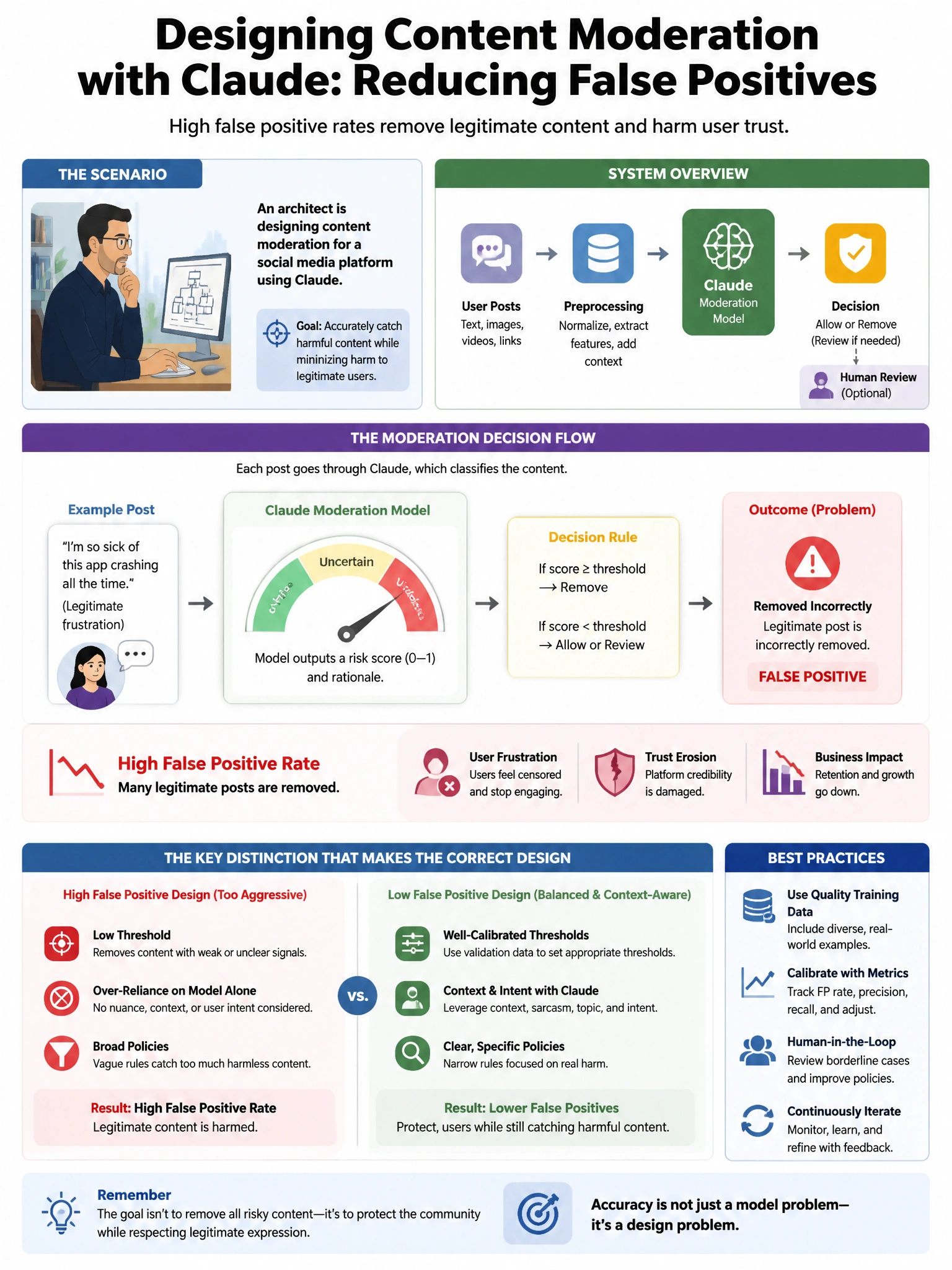
Here's the deal — content moderation involves a fundamental precision-recall tradeoff. Lowering the threshold increases recall (fewer harmful posts escape) but increases false positives (more legitimate posts flagged).
Full explanation below image
Full Explanation
Content moderation involves a fundamental precision-recall tradeoff. Lowering the threshold increases recall (fewer harmful posts escape) but increases false positives (more legitimate posts flagged). Raising it reduces false positives but allows more harmful content through. The correct answer is that there is no universally correct threshold — the optimal setting depends on the platform's policy framework: what harm category is being moderated, the consequences of false positives (user trust, legal exposure, appeals cost) vs false negatives (harm enabled, platform reputation). This is a policy decision requiring human governance input, not a purely technical optimization. Option B incorrectly attributes false positives to model version issues. Option C is wrong — 'always flag more' ignores the real costs of false positives (user trust damage, legal liability, moderation workload). Option D presents one stakeholder's perspective as the absolute priority, ignoring the platform's equal responsibility to prevent genuine harm.