
A legal RAG system requires that every claim Claude makes be attributable to a specific source document with page number and section. How should citation grounding be architecturally implemented?
Select an answer to reveal the explanation.
Short Explanation and Infographic
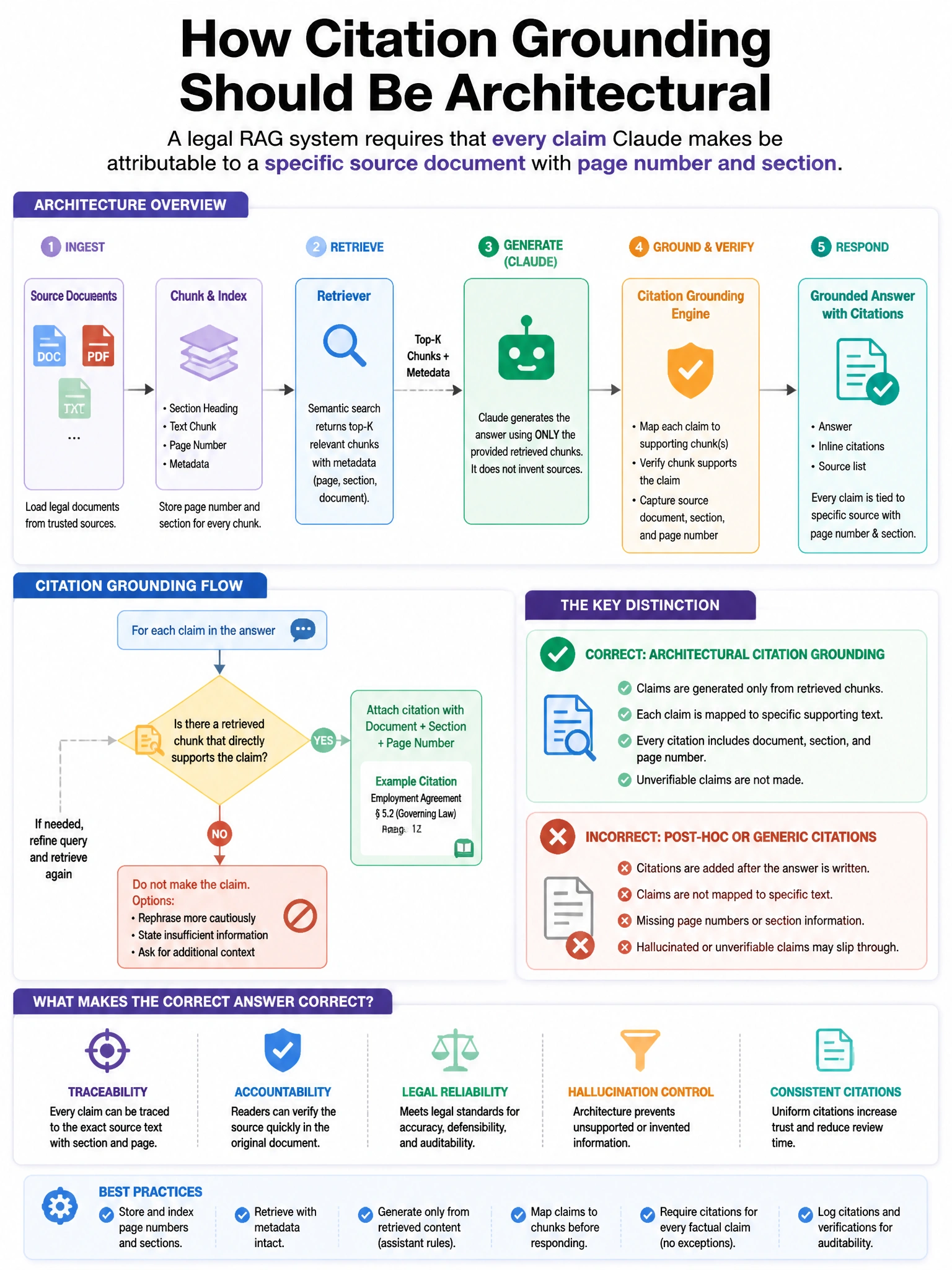
Here's the deal — robust citation grounding requires that metadata (document title, page number, section) be embedded alongside each chunk in the retrieval system, passed to Claude in a structured format (e.g., <source id='1' title='Contract A' page='12' section='3.2'>text...</source>), and that Claude be instructed to cite using the source IDs in a verifiable output format (e.g., [SOURCE:1] inline). This creates an auditable chain from claim to source.
Full explanation below image
Full Explanation
Robust citation grounding requires that metadata (document title, page number, section) be embedded alongside each chunk in the retrieval system, passed to Claude in a structured format (e.g., <source id='1' title='Contract A' page='12' section='3.2'>text...</source>), and that Claude be instructed to cite using the source IDs in a verifiable output format (e.g., [SOURCE:1] inline). This creates an auditable chain from claim to source. Option A ('always cite sources') produces citations but doesn't guarantee they reference actual retrieved chunks — Claude may fabricate plausible-sounding but incorrect citations from its training knowledge. Option C (web search) is for live web retrieval; the scenario specifies a pre-indexed legal corpus. Option D (post-processing second pass) adds latency and cost while still depending on Claude correctly mapping generated text to source chunks in a second pass, which has the same hallucination risk as the first.