
An architect is designing a RAG system for a financial news application where information freshness is critical (data must be from the last 24 hours). The vector database is updated in real-time. What architectural element is most critical for ensuring Claude never cites stale information?
Select an answer to reveal the explanation.
Short Explanation and Infographic
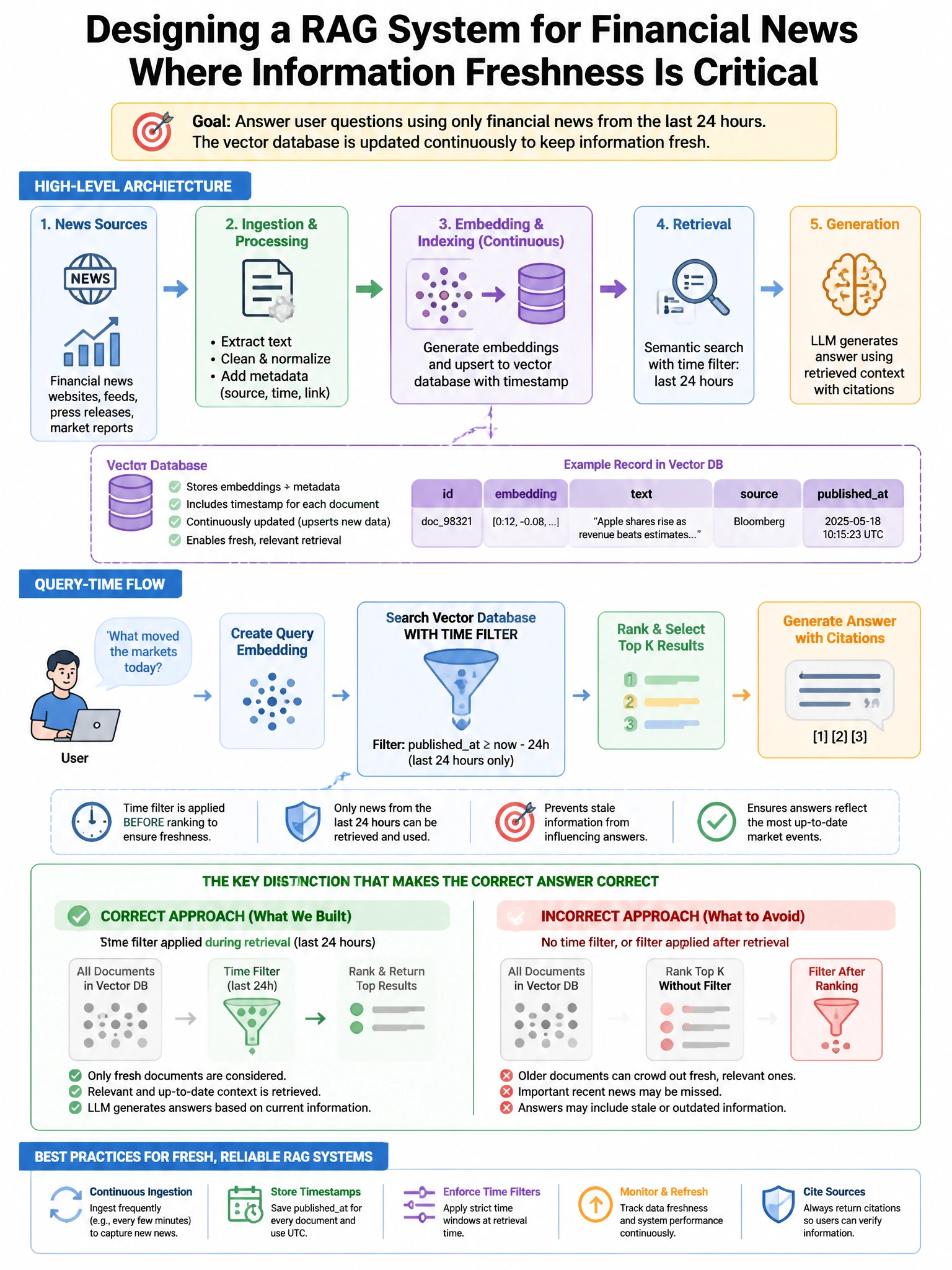
Here's the deal — temporal freshness in RAG requires metadata-filtered retrieval: each chunk must carry its indexing timestamp, and retrieval queries must apply a time-window filter (only return chunks indexed within the last 24 hours). Including the timestamp in Claude's context enables it to reason about recency and attribute information to its source date.
Full explanation below image
Full Explanation
Temporal freshness in RAG requires metadata-filtered retrieval: each chunk must carry its indexing timestamp, and retrieval queries must apply a time-window filter (only return chunks indexed within the last 24 hours). Including the timestamp in Claude's context enables it to reason about recency and attribute information to its source date. Option A is a fundamental misunderstanding — Claude's training cutoff is irrelevant for a RAG system; Claude is supposed to answer from retrieved context, not training knowledge, and no model version knows about yesterday's breaking news. Option C (API response caching) prevents re-computation of identical queries but doesn't address the freshness of retrieved content — a cached response from 23 hours ago is still stale. Option D (system prompt instruction alone) cannot work because Claude has no access to the current time and cannot independently determine what 'last 24 hours' means without timestamp data in context.