
A production RAG system uses cosine similarity vector search but users report that factual queries return semantically similar but topically irrelevant chunks (e.g., a query about 'contract termination fees' retrieves chunks about 'employee termination policies'). What architectural addition most directly addresses this precision problem?
Select an answer to reveal the explanation.
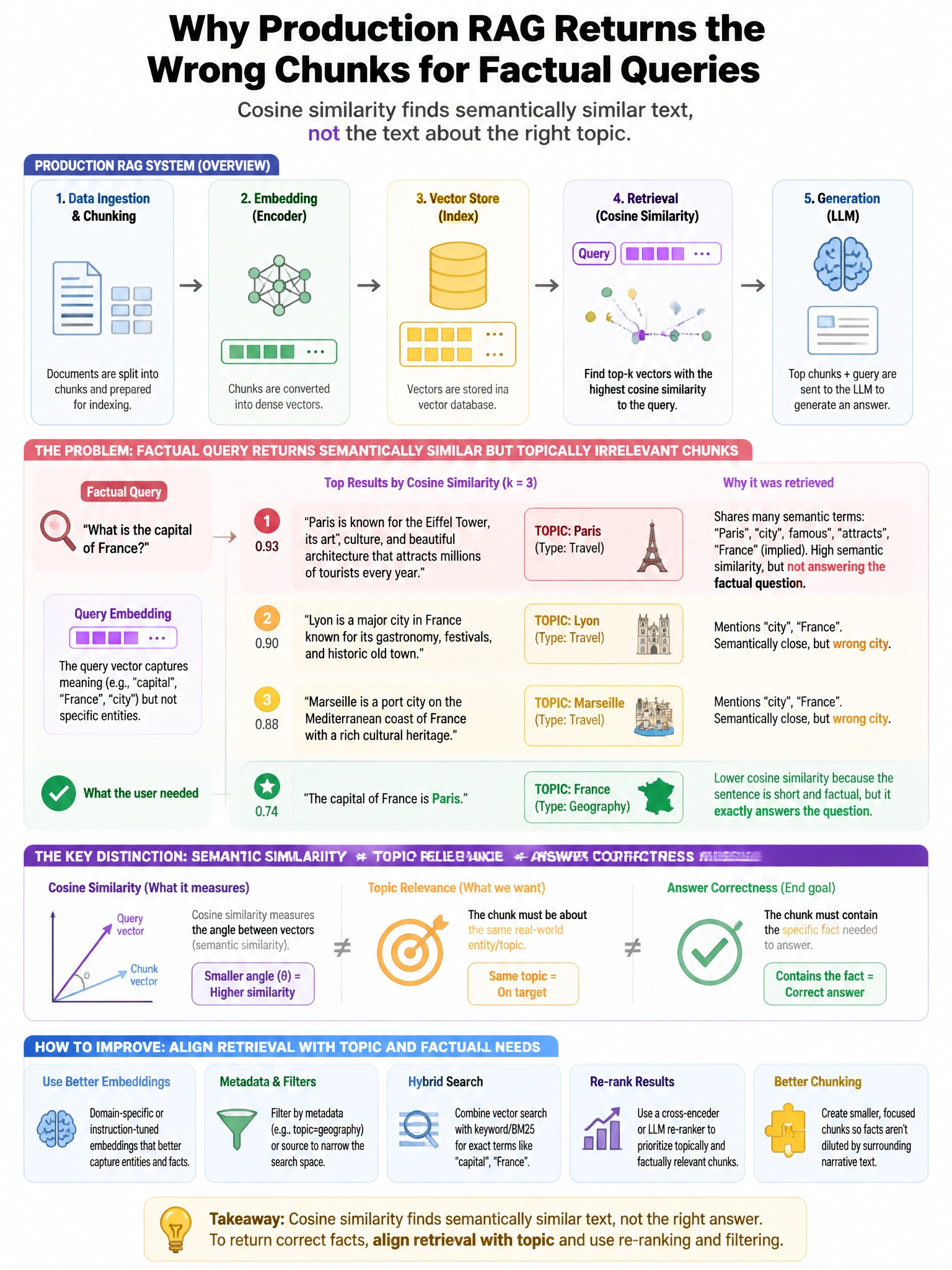
Short Explanation and Infographic
Here's the deal — the described failure mode — semantic similarity without topical precision — is a known limitation of dense-only retrieval. The solution is hybrid search: BM25 keyword search finds documents with exact term matches ('termination fees' vs 'termination policies' via different keywords), while dense retrieval finds semantic neighbors.
Full explanation below image
Full Explanation
The described failure mode — semantic similarity without topical precision — is a known limitation of dense-only retrieval. The solution is hybrid search: BM25 keyword search finds documents with exact term matches ('termination fees' vs 'termination policies' via different keywords), while dense retrieval finds semantic neighbors. A cross-encoder reranker then re-scores the combined candidate set by computing query-passage relevance directly (not just embedding similarity), dramatically improving precision. Option A (higher embedding dimensionality) can help at the margin but doesn't solve fundamental topic conflation — 'contract termination fees' and 'employee termination policies' will still appear semantically similar to any embedding model regardless of dimensionality. Option C (more documents) worsens the problem by adding more potential false positives. Option D (lower similarity threshold) reduces recall along with precision — the wrong tradeoff for a factual Q&A system.