
An architect is designing an agent handoff protocol from a Claude orchestrator to a specialized code review subagent. What information must the handoff packet include to enable the subagent to operate effectively without requiring further orchestrator interaction?
Select an answer to reveal the explanation.
Short Explanation and Infographic
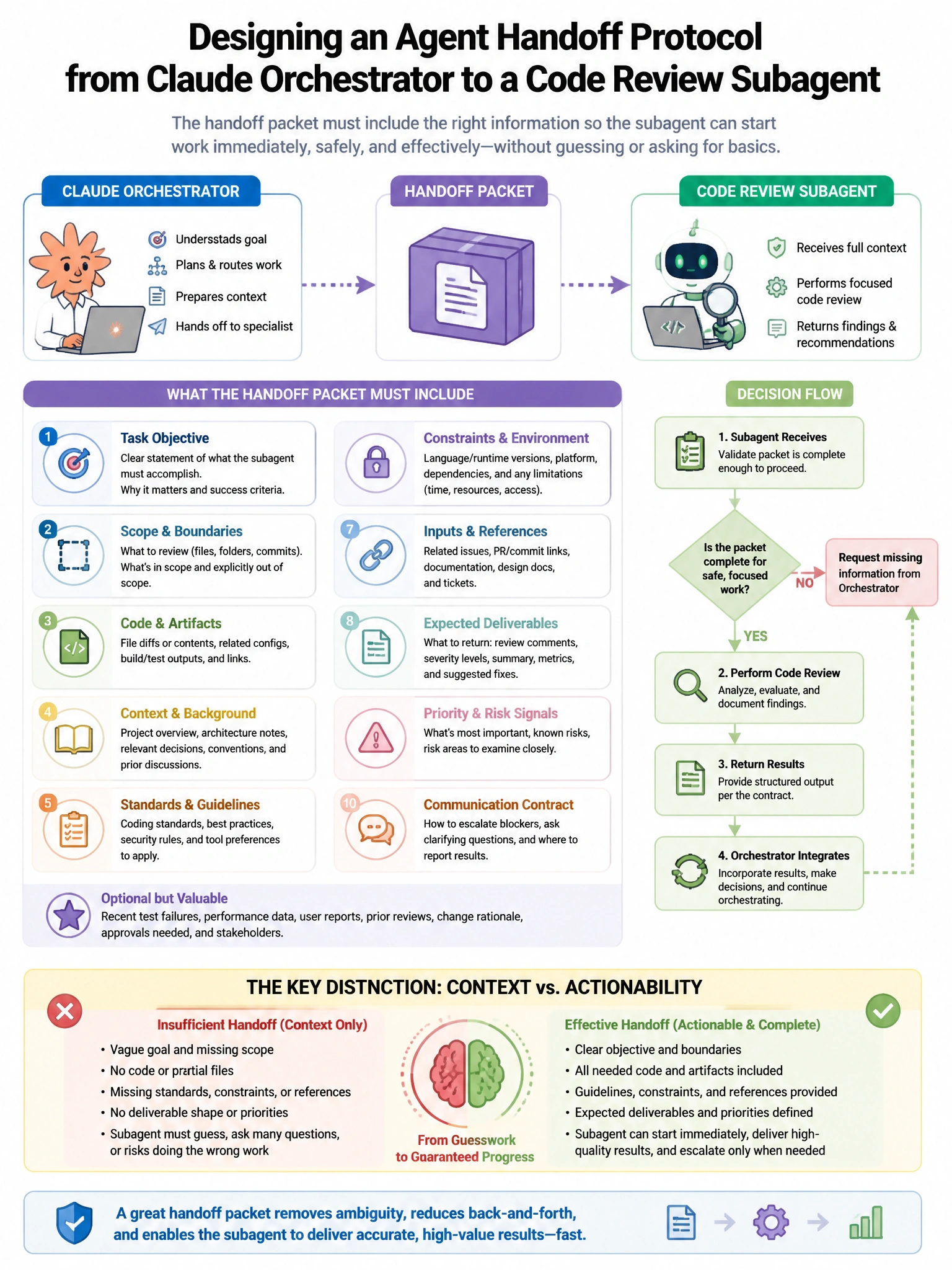
Here's the deal — an effective agent handoff packet must include four elements: (1) task objective — what specifically the code review should accomplish; (2) relevant context — PR description, coding standards, related files, or constraints; (3) success criteria — what constitutes a complete review (e.g., security check, style compliance, logic correctness); and (4) output format — how results should be structured for the orchestrator to consume programmatically. Option A (only code diff) is insufficient — without coding standards and objectives, the subagent cannot calibrate the review appropriately.
Full explanation below image
Full Explanation
An effective agent handoff packet must include four elements: (1) task objective — what specifically the code review should accomplish; (2) relevant context — PR description, coding standards, related files, or constraints; (3) success criteria — what constitutes a complete review (e.g., security check, style compliance, logic correctness); and (4) output format — how results should be structured for the orchestrator to consume programmatically. Option A (only code diff) is insufficient — without coding standards and objectives, the subagent cannot calibrate the review appropriately. Option C (full orchestrator history) passes irrelevant context, wastes tokens, and may expose sensitive information from earlier in the orchestrator's session. Option D (orchestrator's system prompt) is incorrect — the subagent has its own specialized system prompt and should not replicate the orchestrator's behavioral constraints.