
A team is implementing MCP (Model Context Protocol) to expose internal tools to Claude agents. They need to expose a customer database query tool. What is the primary architectural benefit of MCP over custom tool definitions in the API request payload?
Select an answer to reveal the explanation.
Short Explanation and Infographic
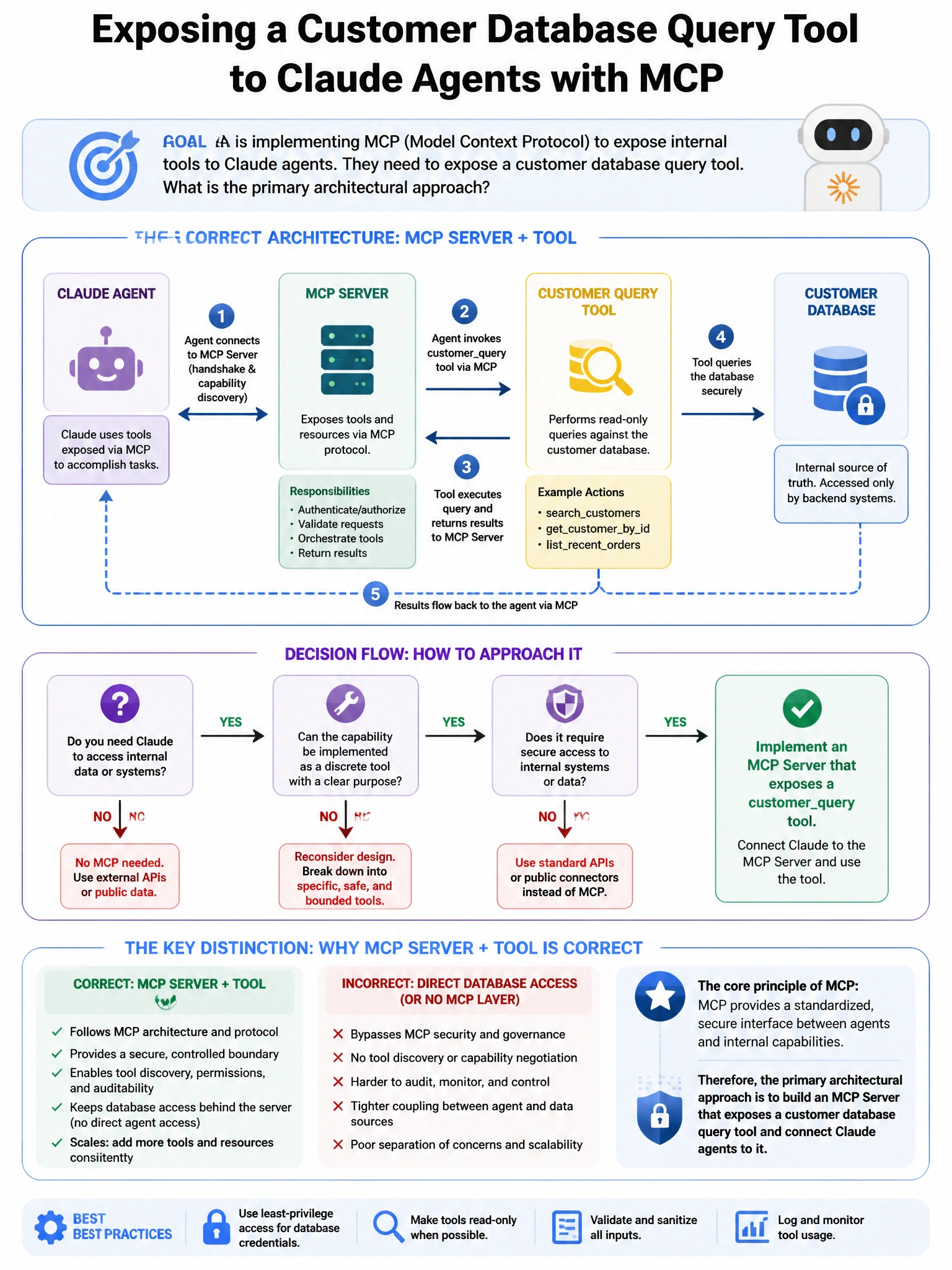
Here's the deal — mCP's primary architectural benefit is standardization and reuse: tools are defined once on an MCP server and can be discovered and used by any MCP-compatible client (Claude agents, Claude desktop, third-party clients) without re-implementing tool schemas in each API call. This creates a separation between tool implementation (MCP server) and tool consumption (agents), enabling a shared tool ecosystem.
Full explanation below image
Full Explanation
MCP's primary architectural benefit is standardization and reuse: tools are defined once on an MCP server and can be discovered and used by any MCP-compatible client (Claude agents, Claude desktop, third-party clients) without re-implementing tool schemas in each API call. This creates a separation between tool implementation (MCP server) and tool consumption (agents), enabling a shared tool ecosystem. Option A is incorrect — MCP tools don't execute faster; they're exposed over a protocol (stdio or HTTP) and go through the same API tool-calling mechanism. Option C invents an Anthropic requirement that doesn't exist; custom API tool definitions are fully supported and commonly used in production. Option B is incorrect — MCP does not provide automatic safety validation of tool outputs; that responsibility remains with the application layer.