
A production system using Claude for medical information queries experiences hallucinations where Claude cites non-existent studies. The system provides Claude with a retrieved context from a verified medical database. What prompt engineering change most directly reduces citation hallucination?
Select an answer to reveal the explanation.
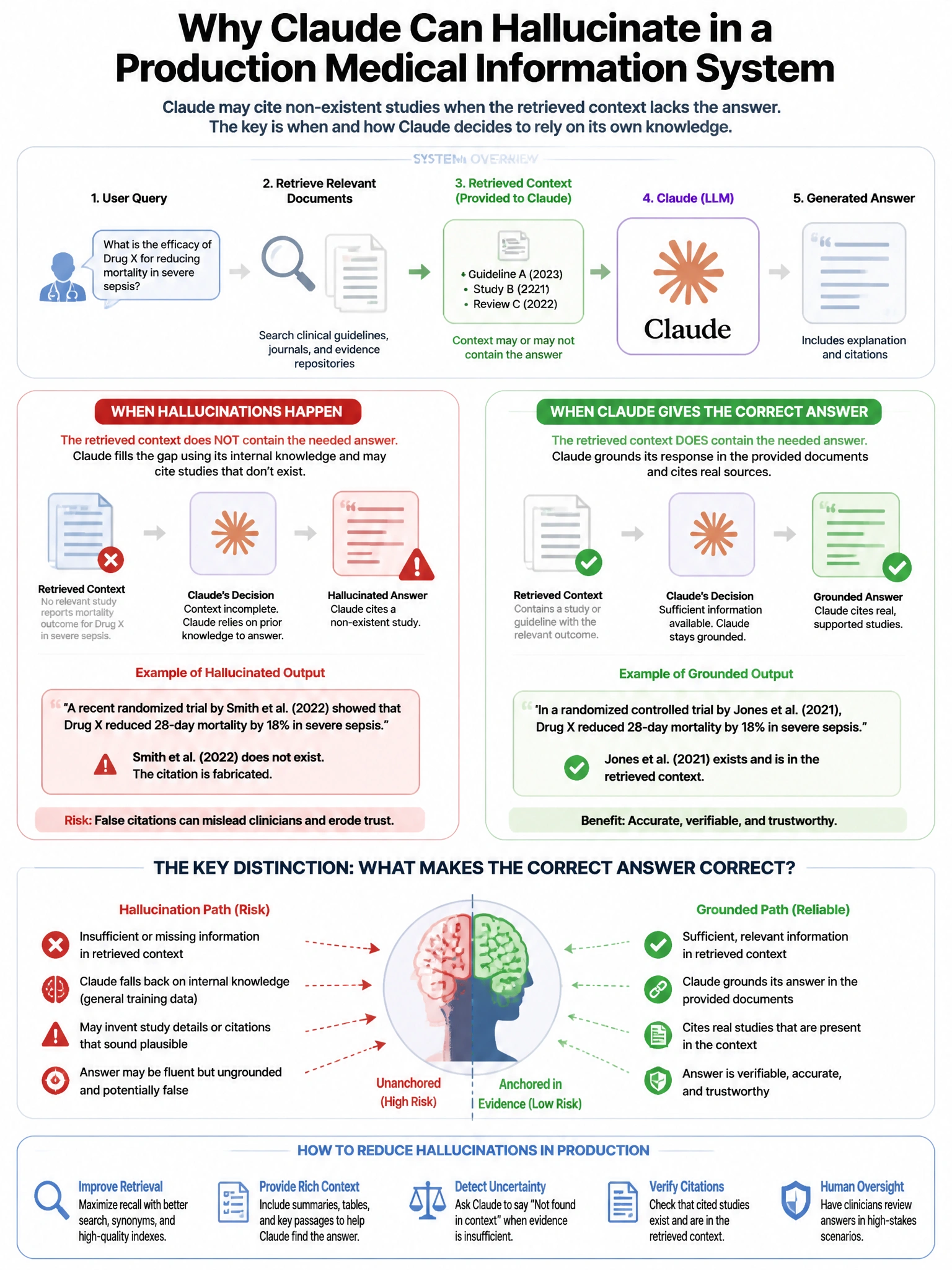
Short Explanation and Infographic
Here's the deal — reducing citation hallucination in RAG systems requires two complementary techniques: (1) explicit grounding instructions (Option B) that define the boundary of acceptable citations and provide a fallback behavior ('state no source is available'), and (2) few-shot examples (Option C) that demonstrate the desired behavior with concrete before/after scenarios showing correct refusal to fabricate. Instructions alone can be overridden by Claude's helpful tendencies to provide complete-seeming answers; examples alone may not generalize to novel citation scenarios.
Full explanation below image
Full Explanation
Reducing citation hallucination in RAG systems requires two complementary techniques: (1) explicit grounding instructions (Option B) that define the boundary of acceptable citations and provide a fallback behavior ('state no source is available'), and (2) few-shot examples (Option C) that demonstrate the desired behavior with concrete before/after scenarios showing correct refusal to fabricate. Instructions alone can be overridden by Claude's helpful tendencies to provide complete-seeming answers; examples alone may not generalize to novel citation scenarios. Together, they reinforce the grounding constraint at both the declarative and behavioral levels — the strongest combination. Option A (low temperature) reduces randomness but doesn't address the structural grounding problem; Claude hallucinating citations is primarily a grounding issue, not a temperature issue.