
A team needs Claude to generate responses in a strictly defined JSON format for downstream pipeline processing. Responses that deviate from the schema cause pipeline failures. Which combination of techniques most reliably enforces structured output?
Select an answer to reveal the explanation.
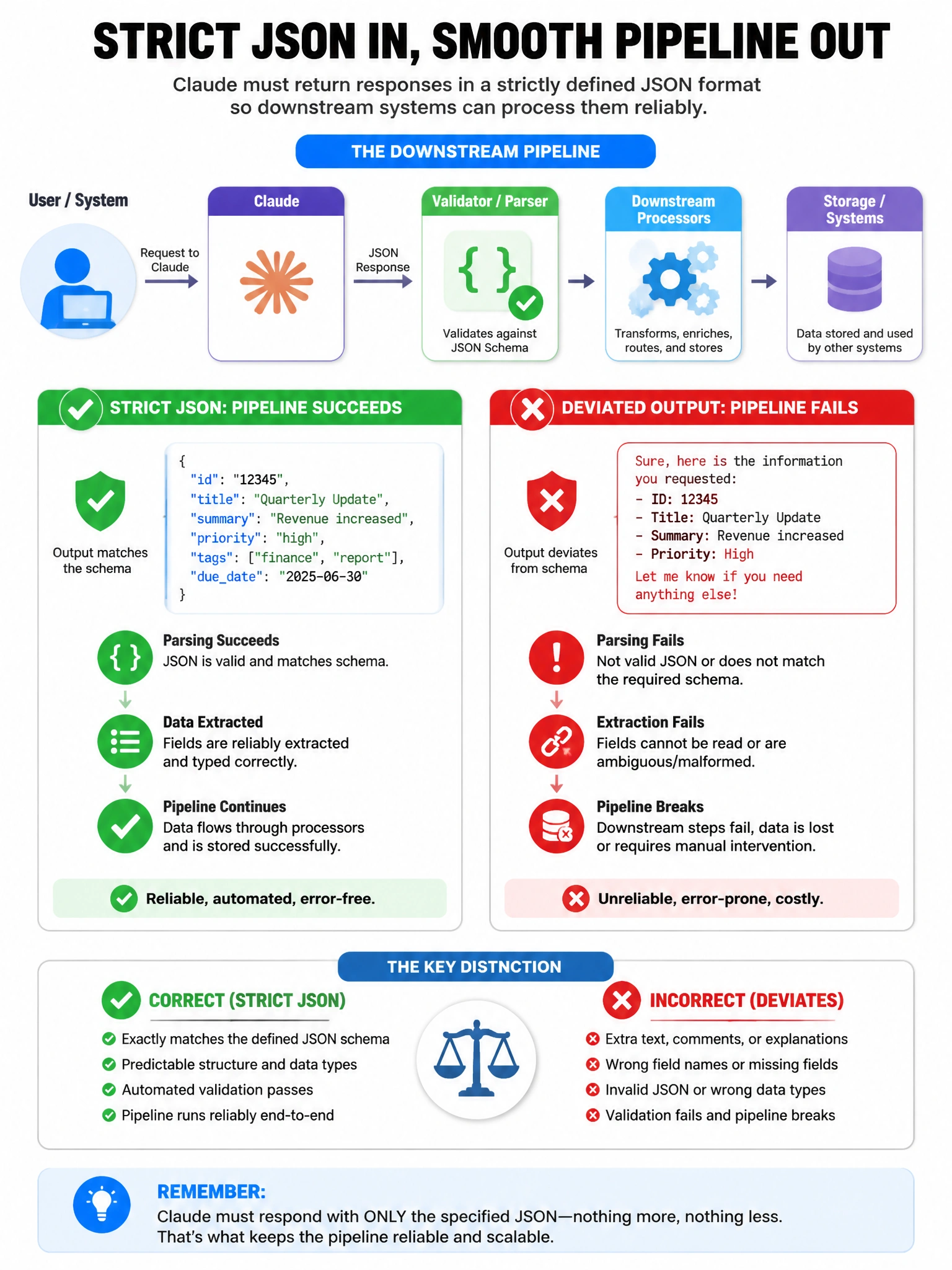
Short Explanation and Infographic
Here's the deal — using tool use with a well-defined JSON schema is the most reliable method for enforcing structured output. When Claude calls a tool, the input field must conform to the tool's schema, and the API validates this structure.
Full explanation below image
Full Explanation
Using tool use with a well-defined JSON schema is the most reliable method for enforcing structured output. When Claude calls a tool, the input field must conform to the tool's schema, and the API validates this structure. By framing the desired output as a tool call — even a 'dummy' output tool representing the response format — you get schema-level enforcement rather than relying on prompt compliance alone. Option A (temperature 0 + example) improves consistency but doesn't guarantee schema compliance; Claude can still add prose or deviate. Option B (regex post-processing) is fragile; complex nested JSON often defeats regex parsers, and retries add latency and cost. Option D misunderstands streaming — detecting JSON completeness in a token stream is complex and unreliable; it doesn't enforce schema validity.