
An architect is building a high-throughput document processing pipeline that needs to process 50,000 documents per day with results available within 24 hours. Real-time responses are not required. Which API approach is most cost-effective and architecturally appropriate?
Select an answer to reveal the explanation.
Short Explanation and Infographic
Here's the deal — the Message Batches API is purpose-built for high-throughput asynchronous workloads where results can be collected within a 24-hour window. It offers up to 50% cost savings compared to the standard Messages API and provides higher effective throughput limits because requests are processed in batches server-side.
Full explanation below image
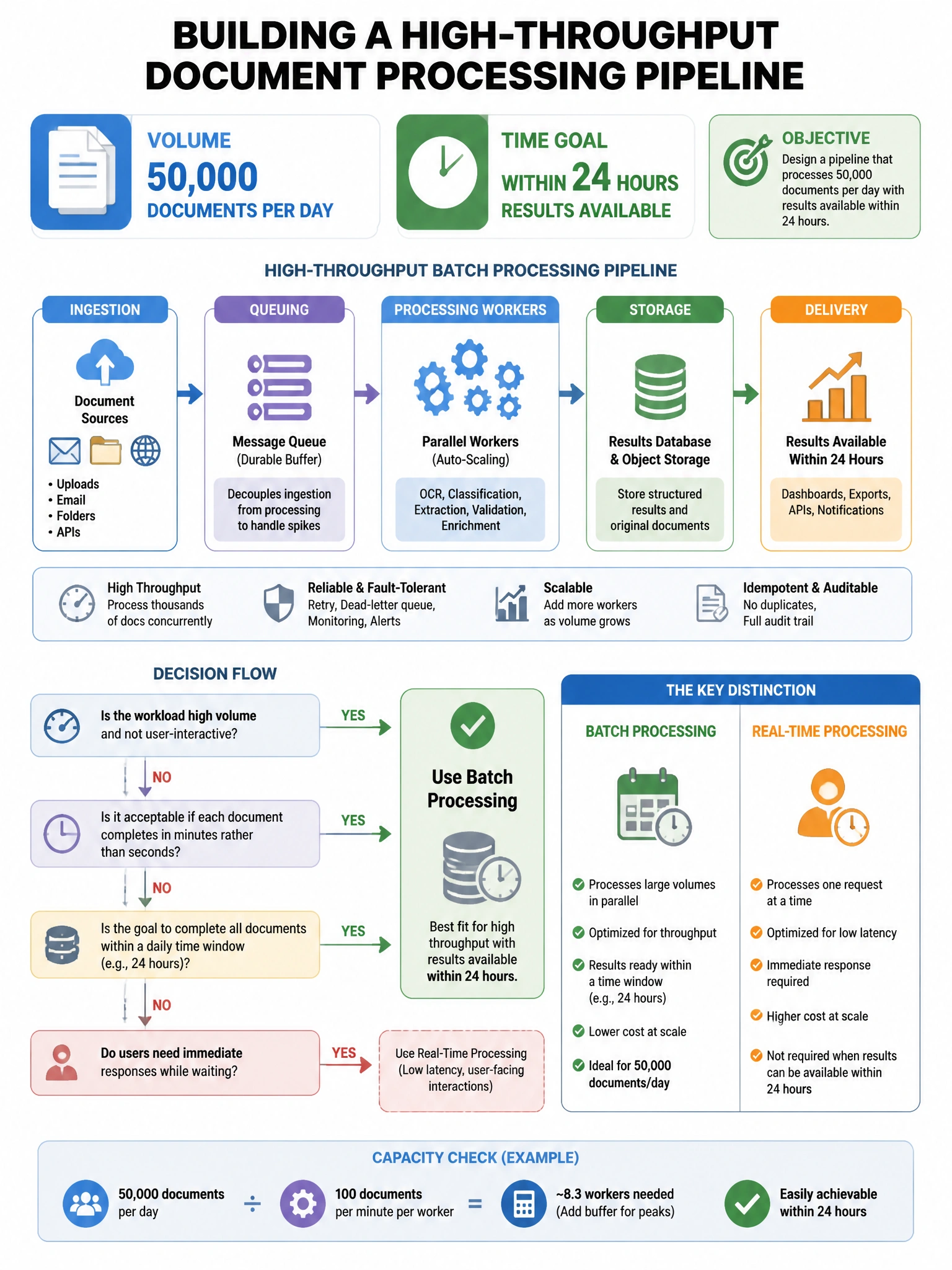
Full Explanation
The Message Batches API is purpose-built for high-throughput asynchronous workloads where results can be collected within a 24-hour window. It offers up to 50% cost savings compared to the standard Messages API and provides higher effective throughput limits because requests are processed in batches server-side. This exactly matches the described use case: 50,000 documents, 24-hour SLA, no real-time requirement. Option B (synchronous parallelism) works but at full price with complex rate limit management overhead. Option C (streaming) reduces token delivery latency but is irrelevant for batch processing — it doesn't improve throughput and adds connection management overhead. Option D (off-peak processing) is an unreliable heuristic; rate limits do not significantly vary by time of day, and it doesn't address cost.