
Some developers use Claude through an OpenAI-compatible API layer. What should developers be aware of when using these compatibility layers?
Select an answer to reveal the explanation.
Short Explanation
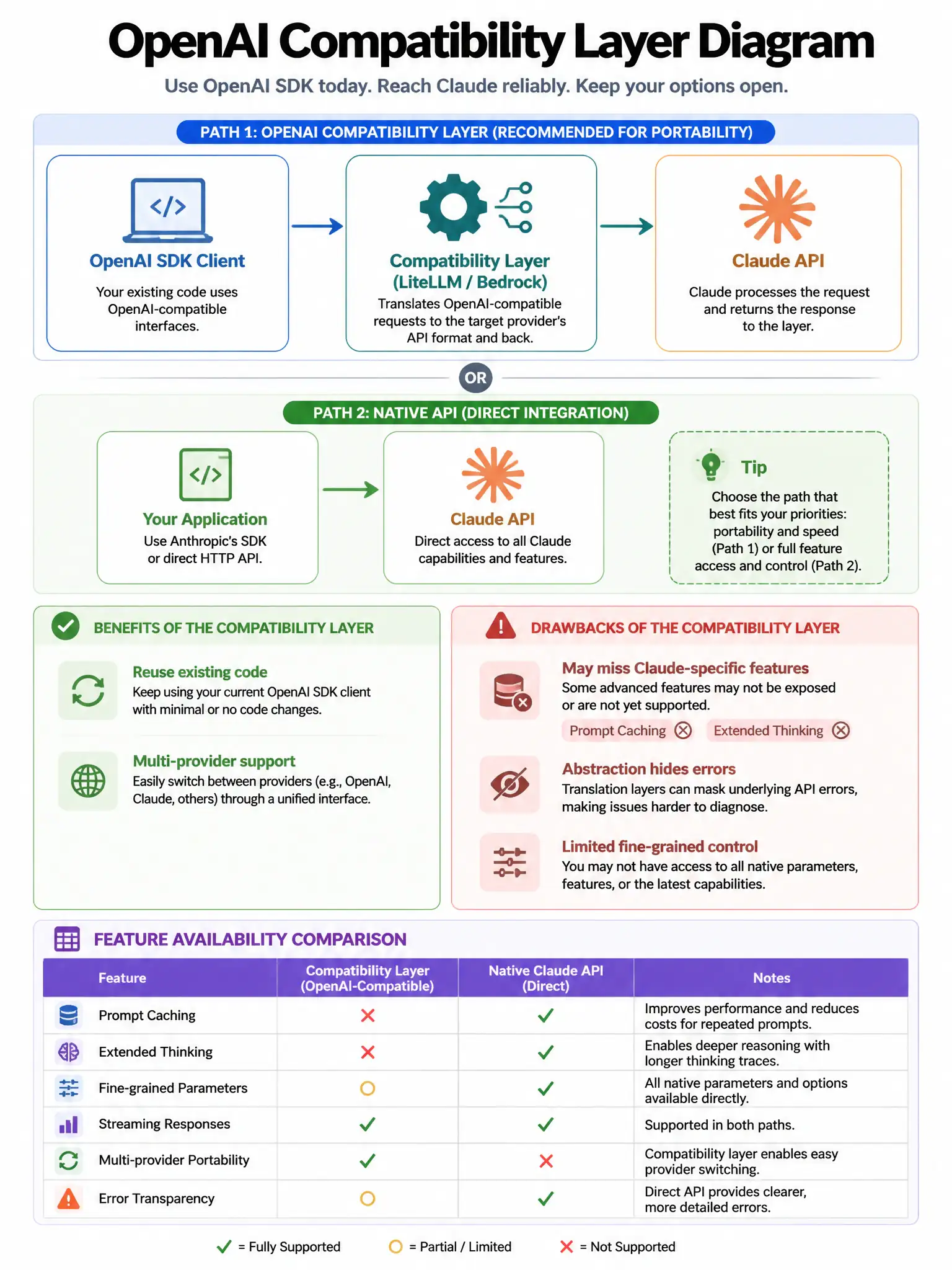
You can reuse OpenAI-style client code through compatibility layers, but you may lose Claude-specific features like prompt caching and extended thinking. You also add an abstraction layer that can obscure errors and make debugging harder.
Full Explanation
Some services, such as LiteLLM or Amazon Bedrock's Converse API, provide OpenAI-compatible endpoints that route requests to Claude. This can let teams reuse existing OpenAI client code without refactoring. The trade-off is that compatibility layers may not expose all Claude-specific capabilities, such as prompt caching, extended thinking, or Claude-specific tool-use features. Error messages may also be translated or obscured, and performance may differ from the native API. For full Claude feature access and clearer debugging, the native Anthropic API is preferable. Compatibility layers are useful for multi-provider flexibility, but they are not officially endorsed by Anthropic. The claim that compatibility layers are officially supported by Anthropic for all use cases is wrong because Anthropic does not officially support them. The claim that using a compatibility layer makes Claude identical in behavior to OpenAI's models is wrong because model behavior differences remain. The claim that compatibility layers are more secure than the native Anthropic API has no basis in fact.