
What is 'extended thinking' in Claude, and what types of tasks benefit most from it?
Select an answer to reveal the explanation.
Short Explanation
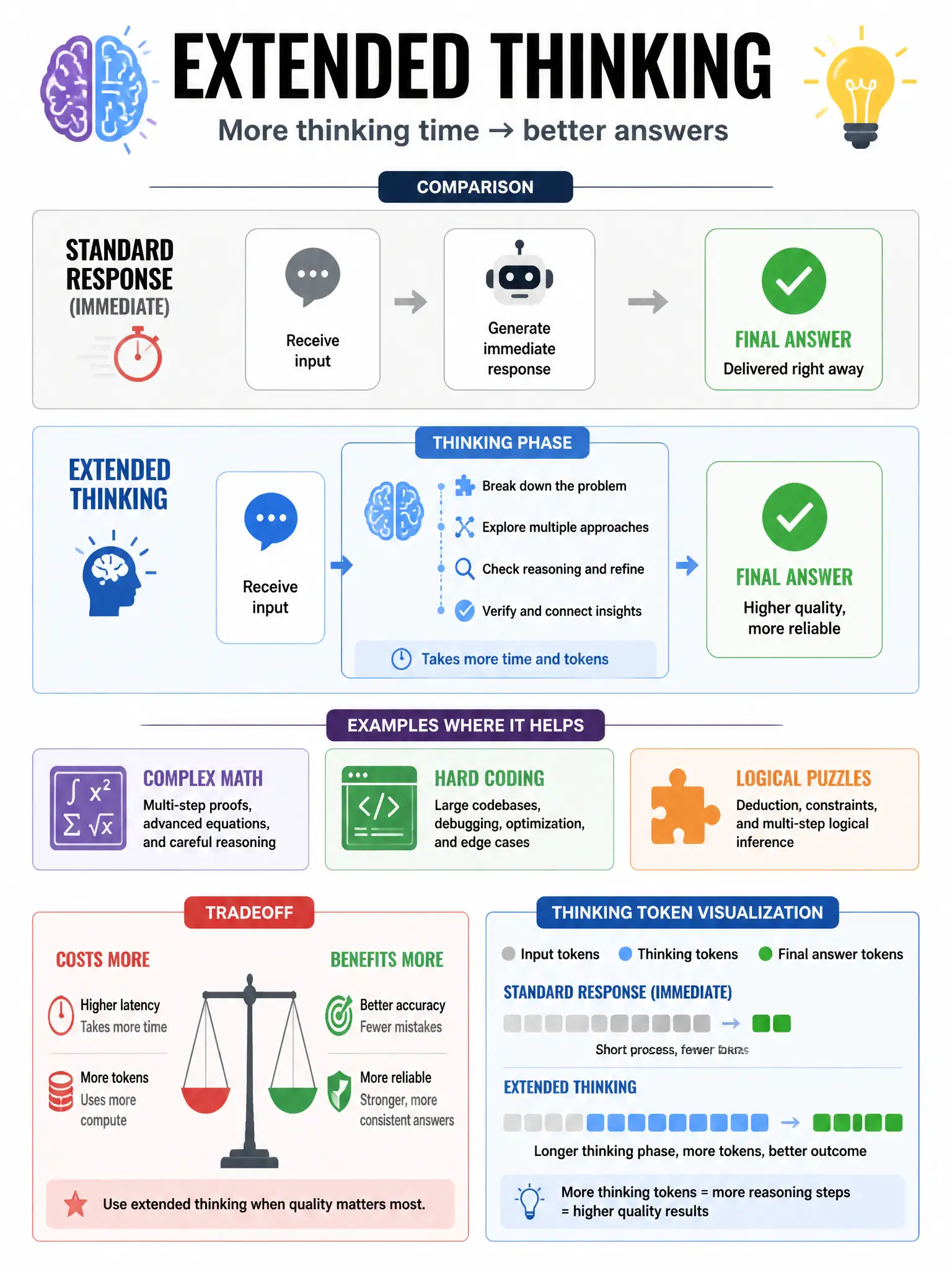
You can think of extended thinking as showing Claude's scratch work: it reasons through the problem step by step before committing to an answer, so you get better accuracy on hard math, coding, and multi-step logic.
Full Explanation
Extended thinking is a capability where Claude performs explicit internal reasoning, visible as thinking tokens in the response, before generating its final answer. This is similar to chain-of-thought but implemented at the model level with a dedicated reasoning phase. It most benefits complex mathematics, challenging coding problems, multi-step logical reasoning, scientific analysis, and any task where working through the problem carefully before answering matters. It generally increases latency and token usage in exchange for improved accuracy on hard problems. The claim that it simply gives Claude more time to generate longer responses without time limits describes response length, not the reasoning process. The claim that it means Claude searches the internet for more information before answering is not what extended thinking does. The claim that it is a training technique that extends the model's context window beyond standard limits describes context window expansion, not extended thinking.