
A developer asks Claude to translate a technical software manual from English to Japanese. What is a key consideration?
Select an answer to reveal the explanation.
Short Explanation
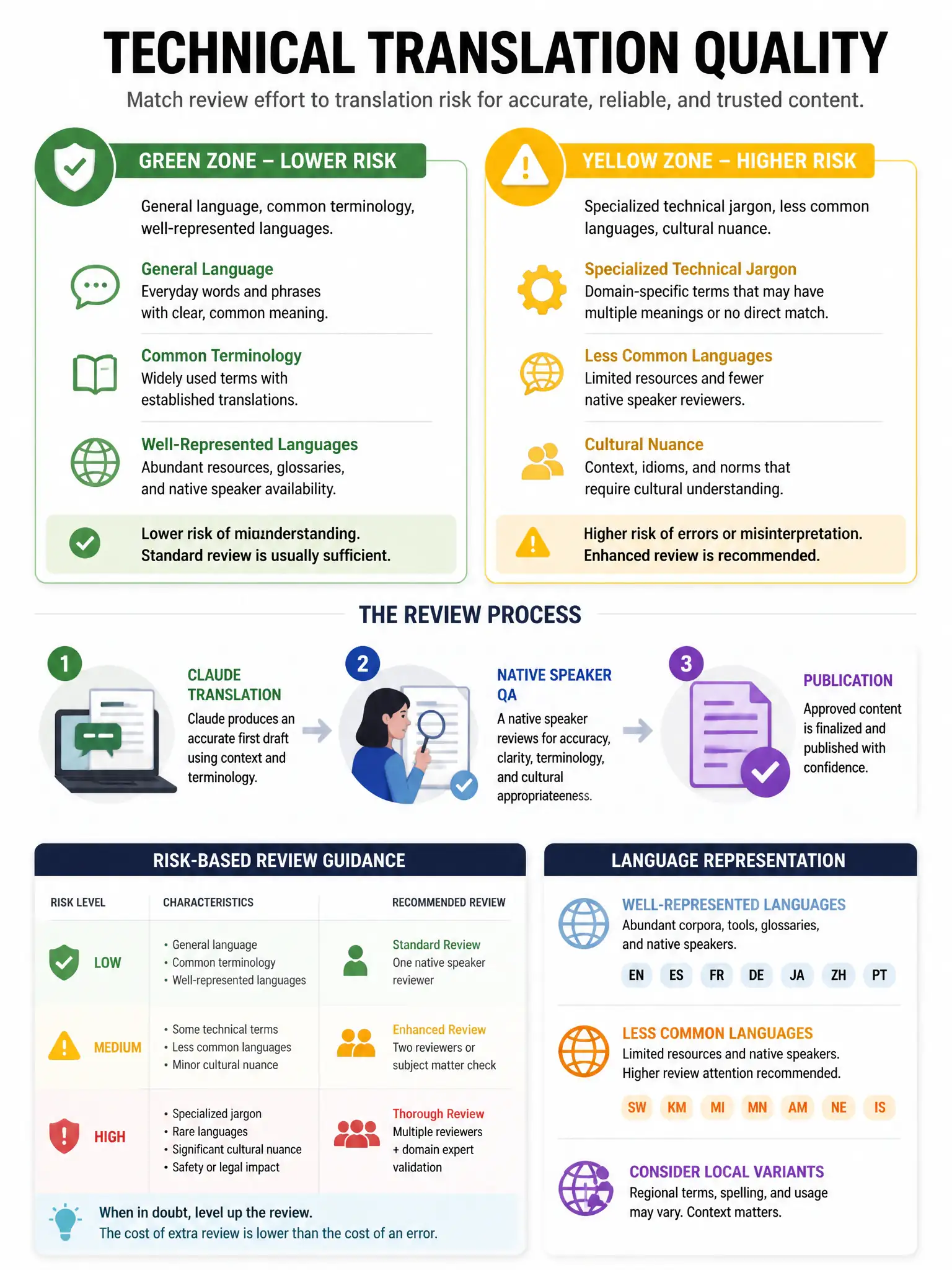
Claude can translate technical content into Japanese, but specialized jargon, software UI terms, and cultural nuance can trip it up. For high-stakes manuals, have a native speaker review it before you publish.
Full Explanation
Claude can translate between many language pairs, including English to Japanese, and it can handle technical content. The key consideration is that translation quality may vary with technical jargon: specialized terms may have specific Japanese equivalents that Claude might not use consistently, cultural nuance in technical documentation matters, and accuracy is critical in software manuals because incorrect instructions can cause user errors or damage. For internal drafts or low-stakes uses, Claude's translation may be sufficient. For customer-facing or safety-critical materials, professional review by a native speaker is advisable. The claim that Claude cannot translate technical content is false because Claude handles technical content. The claim that Japanese translation requires a separate Japan-specific Claude model is false because it invents a false model requirement. The claim that Claude translates from English only and cannot translate between other language pairs is false because Claude translates across many language pairs.