
What is 'dual-use' content and why does it present a challenge for AI safety?
Select an answer to reveal the explanation.
Short Explanation
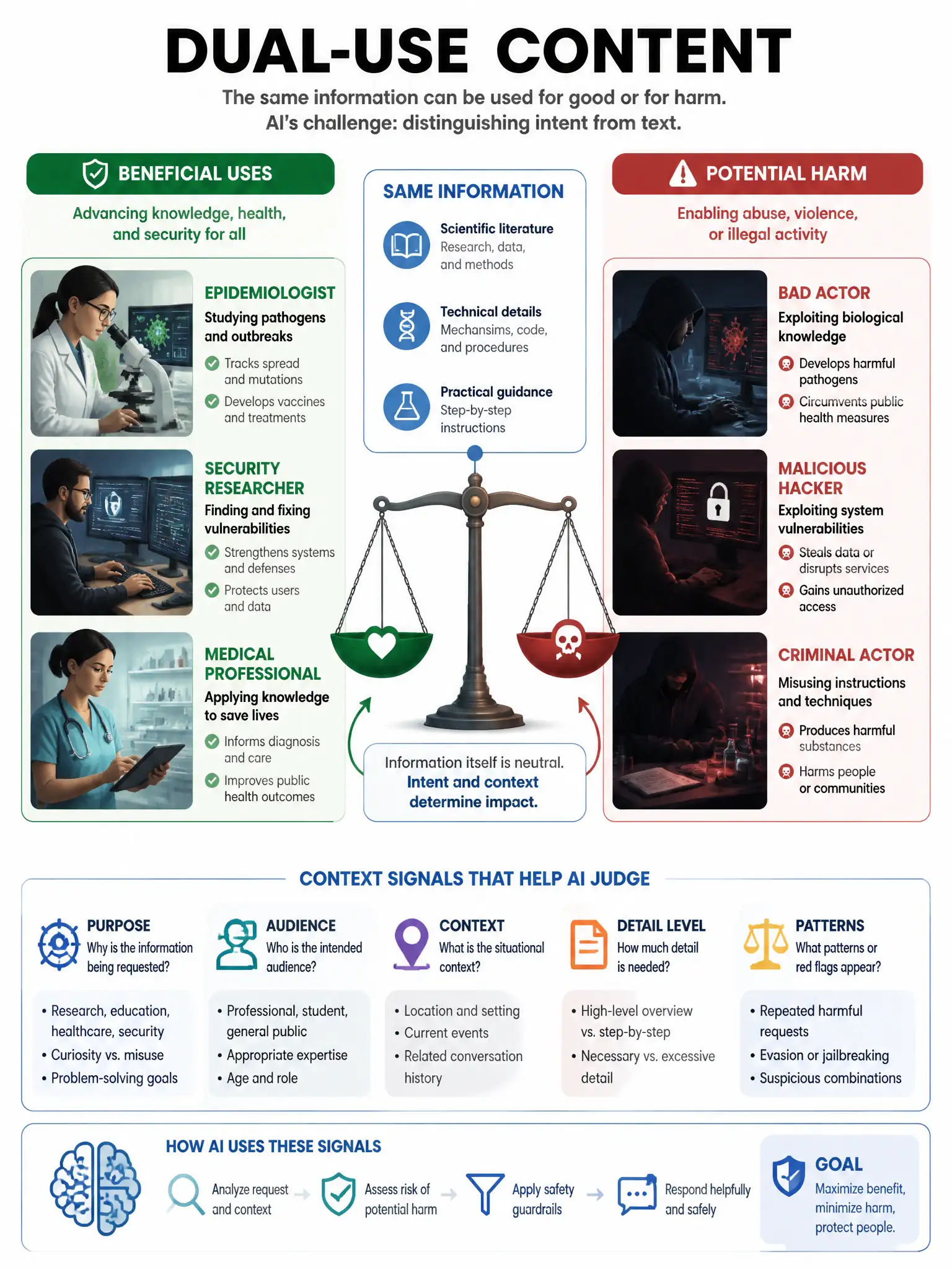
Dual-use content is information that helps researchers, educators, or defenders but could also help someone cause harm. You can't judge intent from the text alone, so AI safety has to balance access against risk.
Full Explanation
Dual-use content refers to information or knowledge that has legitimate beneficial applications—such as research, education, defense, or medical use—but could also be misused for harmful purposes. Examples include information about drug effects (harm reduction versus misuse), network security knowledge (defense versus attack), or chemistry knowledge (legitimate science versus weapons). This is a core challenge for AI safety because legitimate users vastly outnumber bad actors, the information is often already public, and blocking all dual-use content would cripple legitimate use. Claude uses contextual judgment to navigate these cases. The cross-platform content option describes compatibility across mobile and desktop platforms, not safety-relevant dual-use knowledge. The streaming-and-batch API option describes processing modes, not the risk of knowledge being used for both good and harm. The operator-and-user output option describes who receives or benefits from model output, not whether the underlying information can be misused.