
A developer sets temperature=0 when calling the Claude API. What effect does this have on Claude's responses?
Select an answer to reveal the explanation.
Short Explanation
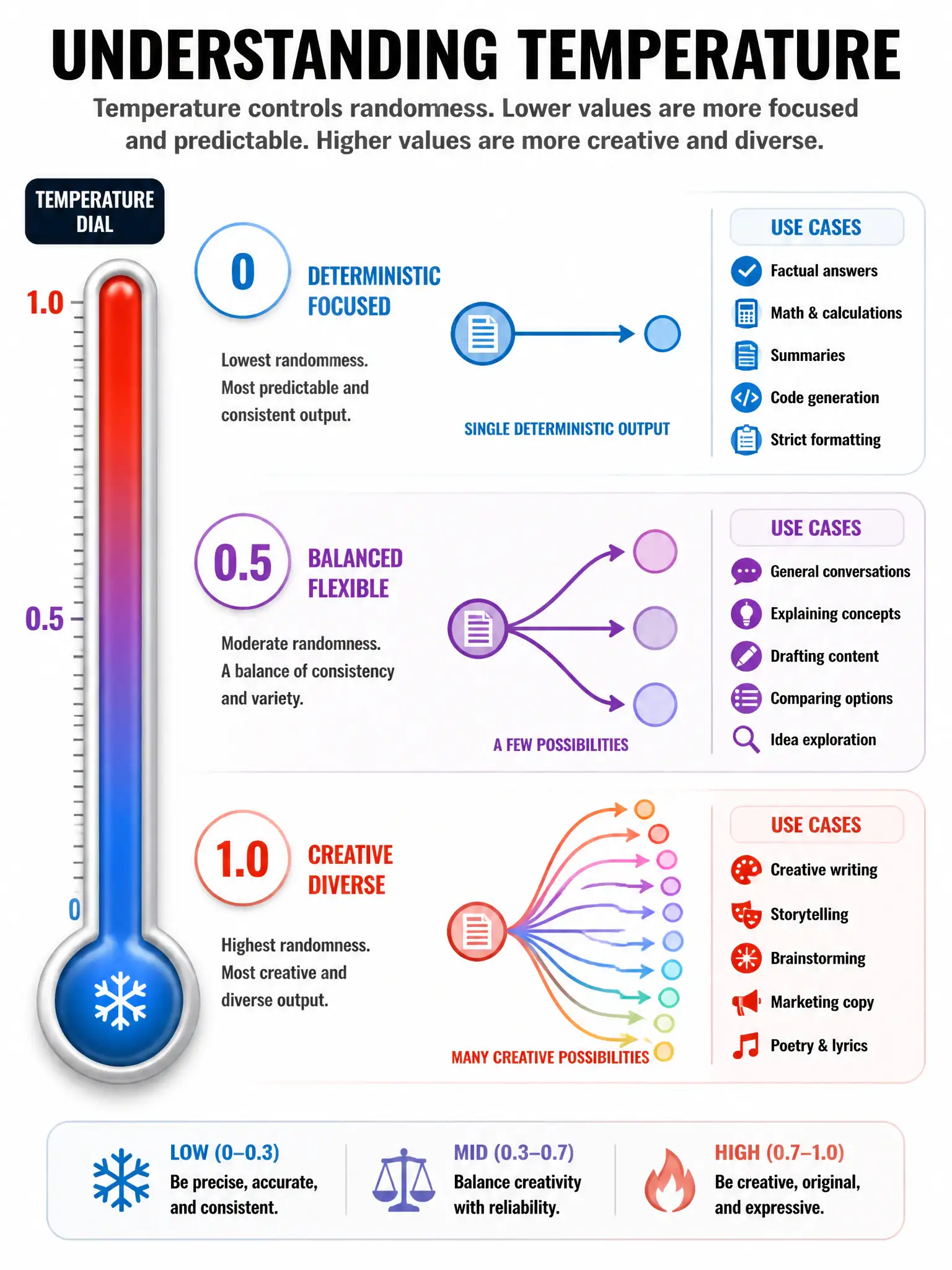
Temperature zero locks Claude into the most likely answer every time, so you get consistent, predictable responses. You want that for tasks where you need the right answer, not a creative one.
Full Explanation
Temperature controls the randomness of token selection during generation. At temperature=0, the model consistently selects the highest-probability token at each step, producing near-deterministic (highly reproducible) outputs. This is ideal for factual question-and-answer, classification, data extraction, and any task where consistency matters over creativity. Higher temperatures (0.5-1.0) introduce more variety and creativity. The correct effect is that Claude's responses become more deterministic and focused, with reduced randomness. The claim that Claude will refuse to answer any questions is incorrect — temperature has nothing to do with refusals. The claim that Claude will only respond in exactly 0 words (empty response) is nonsensical — temperature=0 means no randomness in token selection, not zero output. The claim that the service will return an error since 0 is not a valid temperature value is wrong — 0 is a valid and commonly used temperature value.