
A municipal eel-pass kiosk never says it is a machine and never posts what it cannot do. A governance reviewer wants a notice and a limitations statement. Which process is that?
Select an answer to reveal the explanation.
Short Explanation
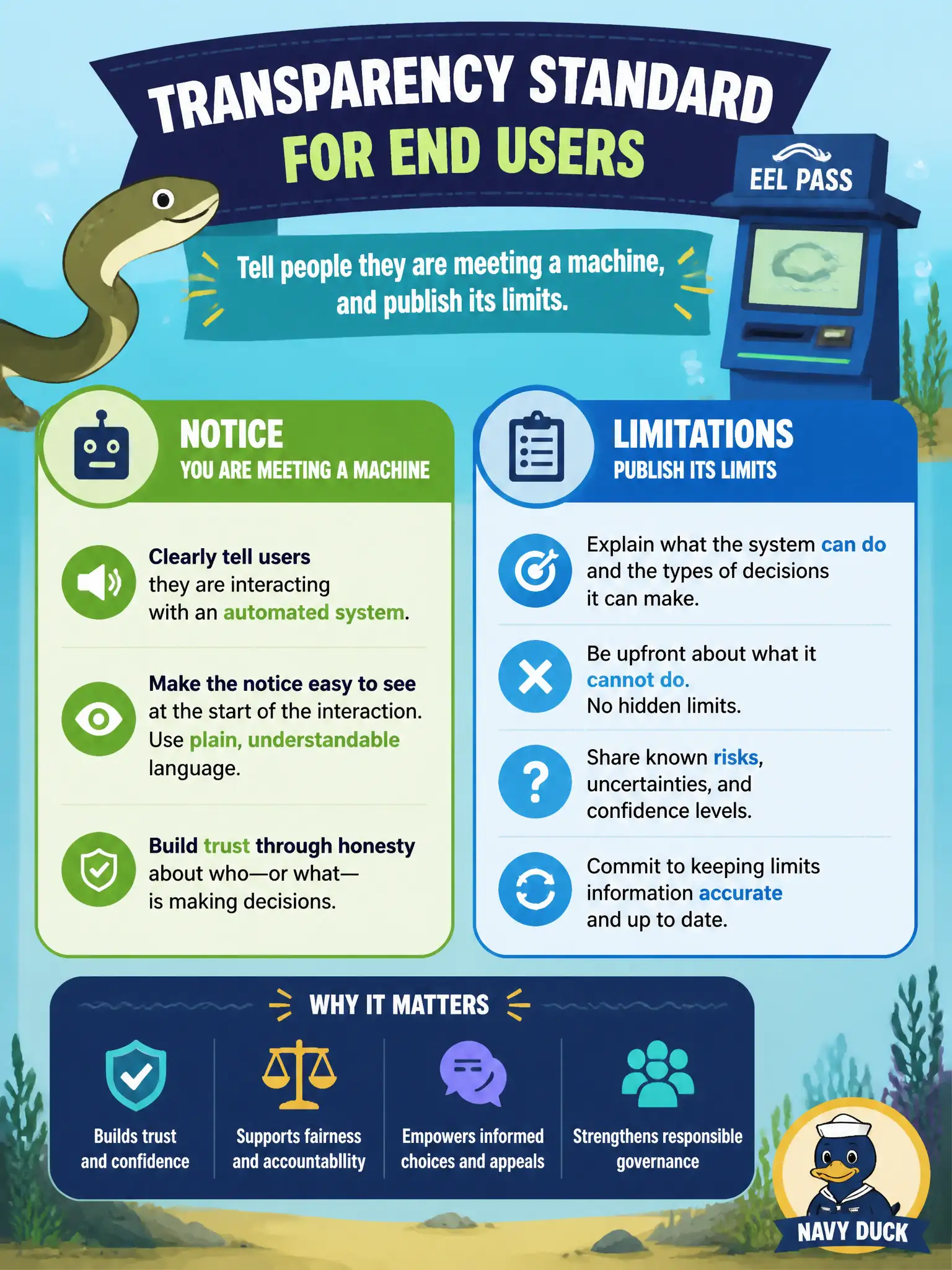
Think of a kiosk that never says it is a machine and never posts what it cannot do. Governance wants a notice and a limitations statement. Tell people they are meeting a machine, and publish the limits.
Full Explanation
A municipal eel-pass kiosk that never says it is a machine and never posts what it cannot do fails end-user transparency. Governance wants a notice and a limitations statement: tell visitors they are interacting with a machine, and publish what the kiosk cannot do—legal advice, emergency dispatch, guaranteed fish counts, or binding permit decisions. That transparency standard is a governance process aimed at informed use, calibrated trust, and reduced deception risk.
A Domain 4 model-card explainability tool only fails by concept when there is no notice to the visitor: internal model documentation for builders does not replace public disclosure at the kiosk. Hiding that it is a machine fails because pretending to be a person increases deception risk and undermines municipal expectations for honest AI presentation. Amazon Polly fails because speech output is not a limitations statement and does not disclose machine identity or bounds.
Exam caveat: transparency statements must stay accurate as capabilities change—update the posted limits when the model, tools, or decision authority change. Operational check: add a visible machine notice and limitations placard plus an on-screen equivalent, have a governance reviewer confirm both appear before interaction starts, and sample visitor comprehension in a brief field check at the eel-pass site.