
A municipal roller-rink helper begins returning slurs when teens dare it. How should toxicity filtering be treated?
Select an answer to reveal the explanation.
Short Explanation
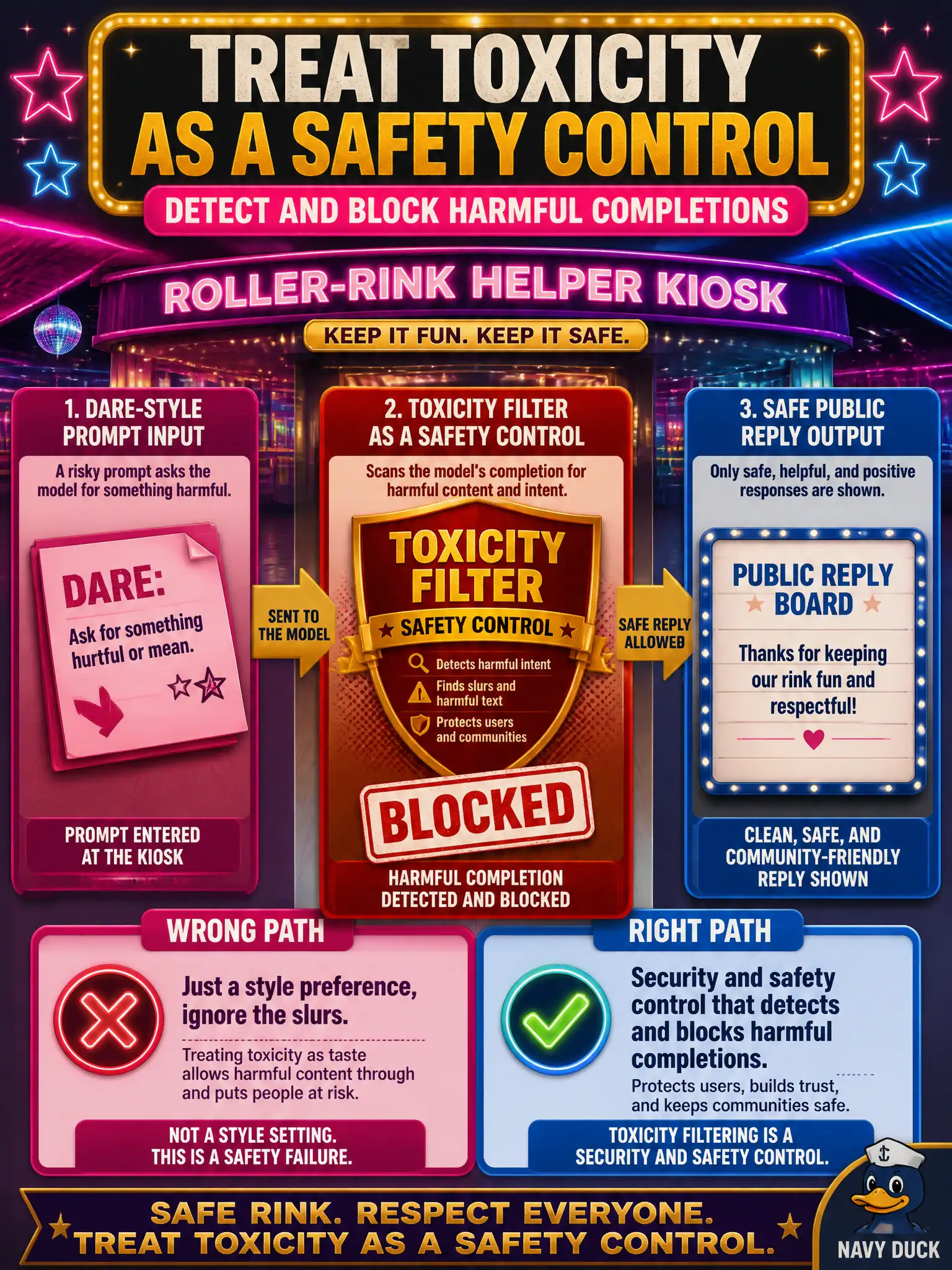
Think of slurs when teens dare the helper. Treat toxicity filtering as a security and safety control that blocks the completion. It is not a Domain 3 metric recap.
Full Explanation
When the roller-rink helper returns slurs after teens dare it, toxicity filtering must be treated as a security and safety control: detect harmful completions and block or rewrite them before they reach users. Live enforcement belongs on the serving path, with monitoring for repeated attempts and clear escalation when filters fail. That is how municipal helpers protect visitors and staff, not how they score a practice metric after the fact.
Treating toxicity as a Domain 3 evaluation-metric recap only fails by concept: offline scores without a live block leave the slur in production. Calling slurs a branding win fails because harmful language erodes trust and creates liability; engagement is not a license for abuse. Framing toxicity as a latency score fails because milliseconds do not measure harmfulness; speed metrics cannot substitute for safety detection.
Exam caveat: toxicity filters reduce risk but can miss novel phrasing or over-block benign text—tune thresholds and keep a human review path for edge cases. Operational check: run dare-style prompts in staging, confirm toxic completions are blocked, sample false positives for rink-safe slang, and verify alarms fire when block rates spike in production.