
A municipal sidewalk-repair helper must not emit a crew member’s personal email or a made-up emergency dig here instruction. Which control belongs before the text reaches the public?
Select an answer to reveal the explanation.
Short Explanation
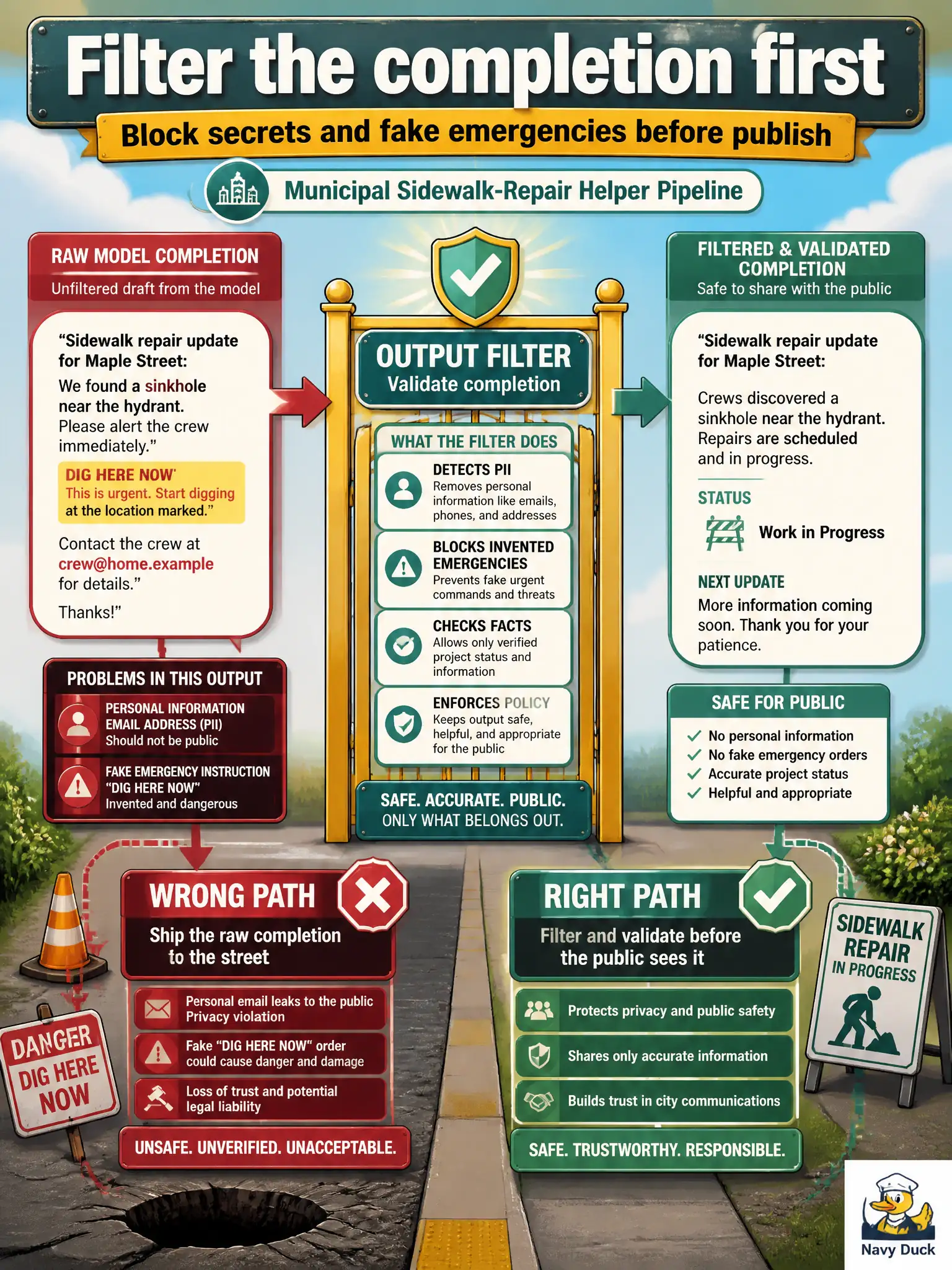
Think of a helper that must not emit a crew email or a made-up dig-here instruction. Filter and validate the completion before it hits the public. That is a security control, not optional polish.
Full Explanation
The sidewalk-repair helper must not emit a crew member’s personal email or a fabricated emergency dig-here instruction. The control that belongs before text reaches the public is output filtering and validation of the completion: pattern checks for emails and other PII, policy classifiers for unsafe work orders, and rejection or rewrite when the reply fails those checks. That is a security and safety gate on what leaves the model, not optional polish.
Treating public emission of a personal email as a style choice fails by concept: PII disclosure and false dig instructions are safety and privacy failures, not formatting. A dashboard title fails because charts and titles do not inspect or block completions; visualization is not an output filter. From-scratch pre-training fails because rebuilding a model from a weekend crawl does not implement a per-response gate and is the wrong layer for blocking a single harmful completion.
Exam caveat: output filters complement—not replace—input filtering and corpus controls; attackers may still try injection, so defense in depth matters. Operational check: send staged prompts that request crew emails or dig-here fabrications, confirm the filter blocks or redacts them, and verify blocked attempts are logged for review before the helper stays public.