
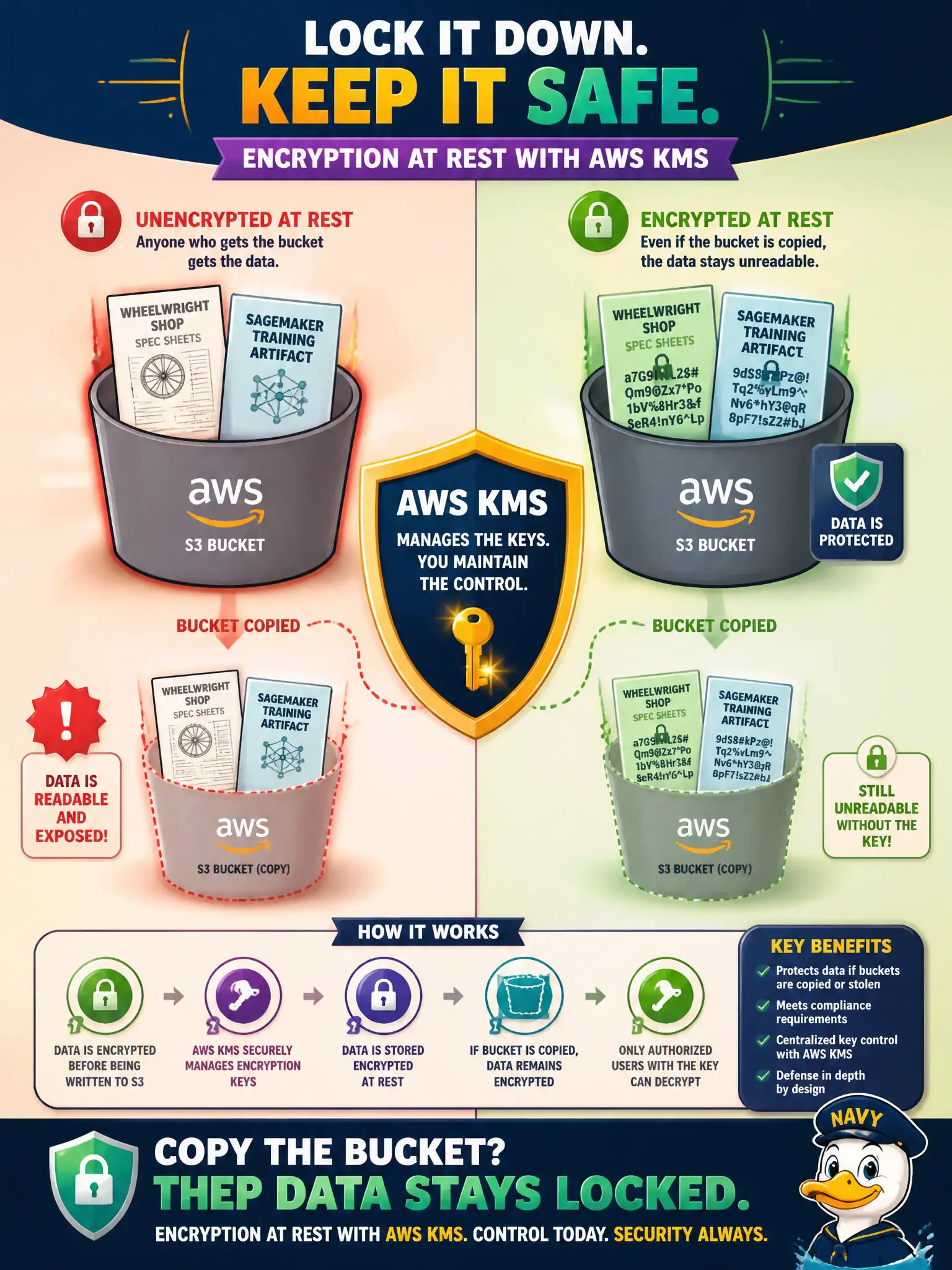
A historic wheelwright shop’s spec sheets and a SageMaker training artifact must be unreadable on disk if someone copies the bucket. Which control should they pick?
Select an answer to reveal the explanation.
Short Explanation
Think of spec sheets and a SageMaker artifact that must stay unreadable if someone copies the bucket. Encrypt at rest with AWS KMS. Hoping the model forgets is not a control.
Full Explanation
The historic wheelwright shop needs spec sheets and a SageMaker training artifact to be unreadable on disk if someone copies the bucket. The right control is encryption at rest with AWS KMS. Objects remain ciphertext without authorized use of the key, so a raw bucket copy does not yield usable plaintext specs or model artifacts. That protects training inputs and serialized model files sitting in object storage between jobs.
Leaving objects unencrypted and hoping the model forgets the specs fails because hope is not a control and models do not provide storage confidentiality for bucket copies. Amazon Polly fails because text-to-speech does not encrypt training artifacts or make copied objects unreadable. Raising temperature so a copied bucket becomes unreadable fails because temperature only affects generative sampling; it cannot make disk objects unreadable or replace envelope encryption.
Exam caveat: encryption at rest protects stored bytes; it does not replace IAM controls on who can decrypt via KMS or who can invoke endpoints that return sensitive content in plaintext responses. Operational check: enable SSE-KMS on the bucket and artifact store, restrict key users to the training and serving roles, deny anonymous or broad read, and verify a test principal without kms:Decrypt cannot read plaintext after copying object bytes.