
A municipal salt-barn wants nightly route blurbs. A vendor proposes a large from-scratch training run because bigger is more responsible. What should the team conclude?
Select an answer to reveal the explanation.
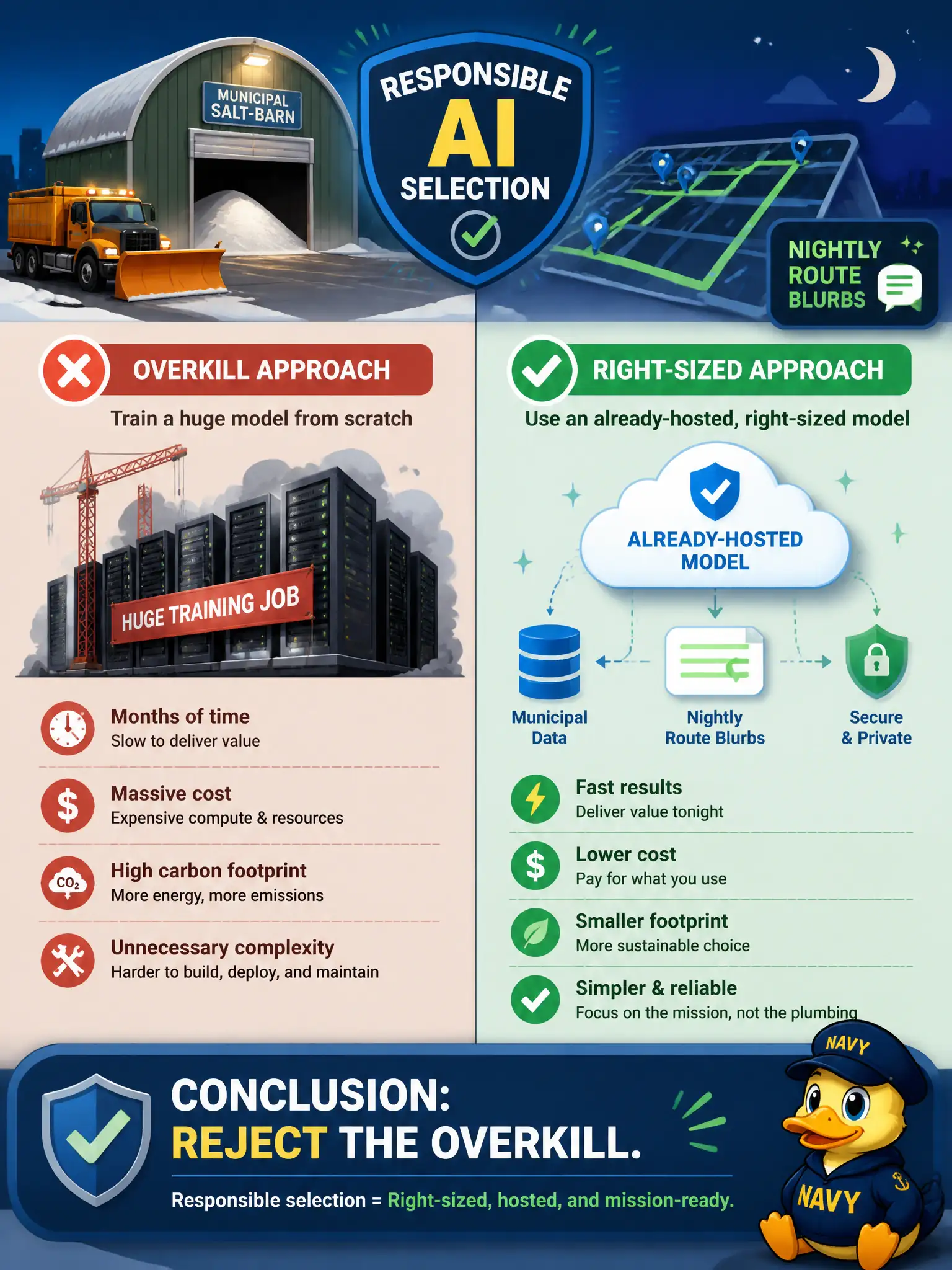
Short Explanation
Think of nightly salt-barn blurbs and a vendor pushing a giant from-scratch run because bigger is more responsible. Reject it. Right-sized and already hosted beats an unnecessary training job.
Full Explanation
For nightly municipal salt-barn route blurbs, responsible selection prefers a right-sized, already-hosted model over an unnecessary giant from-scratch training run. “Bigger is more responsible” confuses capability theater with stewardship: training from scratch consumes large compute and carbon budgets, introduces data-governance burden, and is disproportionate when a hosted generative model can already draft short blurbs. Rejecting the vendor pitch keeps the barn focused on fit-for-purpose generation, monitoring, and review rather than inventing a private foundation model for a narrow nightly job.
Accepting the run as inherently sustainable fails because large training jobs increase—not reduce—environmental and operational footprint when a smaller hosted option suffices. Claiming bigger is always more responsible fails the fitness-for-purpose test: responsibility includes proportionality, so overbuilding for nightly blurbs is the opposite of careful selection. Starting from random weights for “environmental credit” fails conceptually and practically; random initialization plus a full train is the expensive path, not a green badge, and does not improve accountability for the salt-barn’s published routes.
Exam caveat: rejecting an oversized training proposal does not mean never fine-tuning—lightweight adaptation or prompt/RAG patterns may still be warranted if hosted defaults miss local road names, but that is still not a from-scratch pre-train. Operational check: pilot the smallest approved hosted model on a week of real salt-barn routes, score factuality of street and barn references with a human reviewer, compare estimated training cost and energy against that pilot, and only escalate model size or adaptation when measured quality gaps remain.