
A volunteer rescue-auxiliary newsletter helper can refuse medical-dosing and hate-speech categories through a policy filter. A board member asks whether turning the filter on finishes responsible AI. What is the accurate reply?
Select an answer to reveal the explanation.
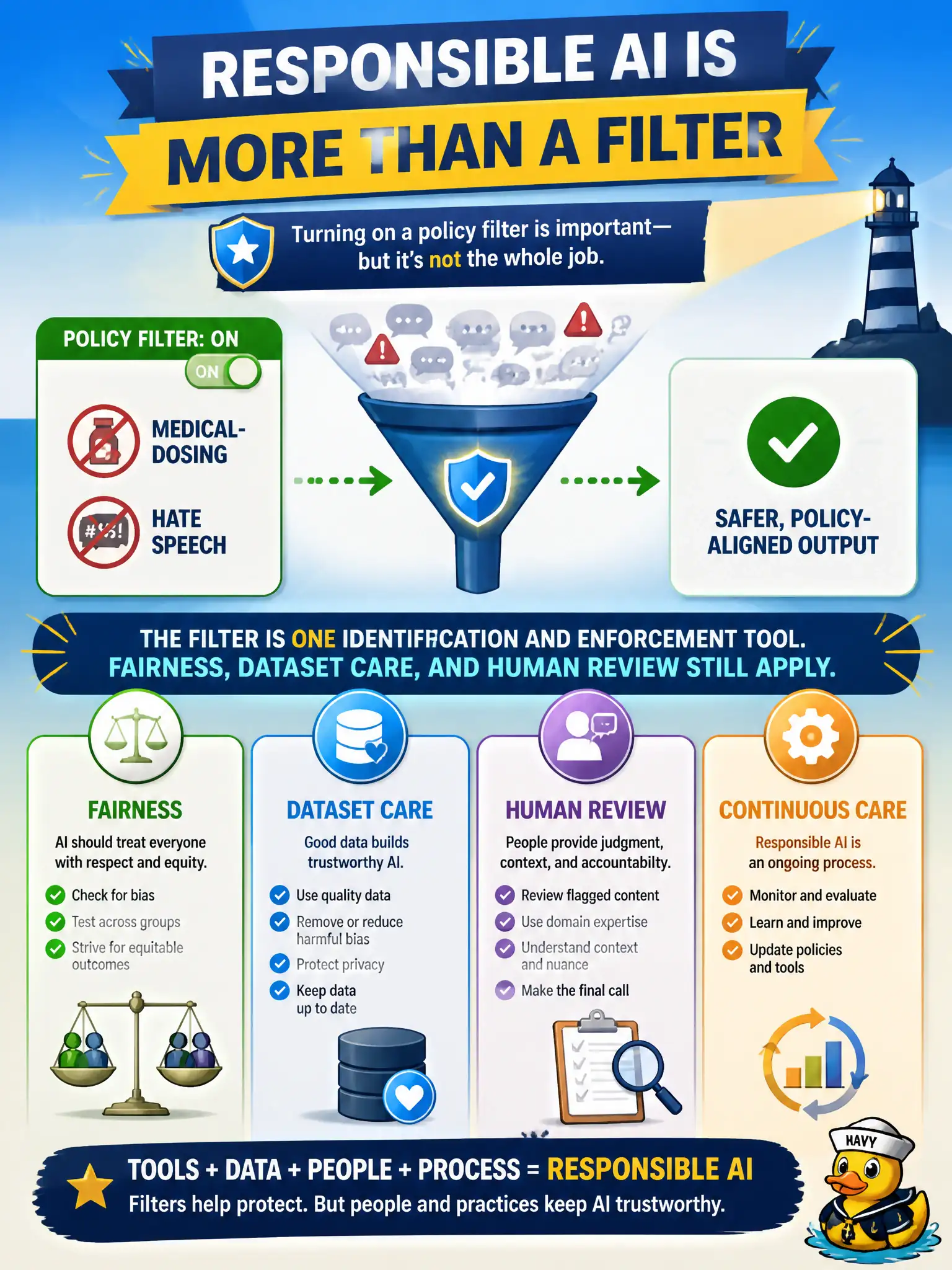
Short Explanation
Think of a policy filter that can refuse dosing and hate speech. That is one enforcement tool, not the whole responsible-AI job. Fairness, dataset care, and human review still apply.
Full Explanation
A policy filter that can refuse medical-dosing and hate-speech categories is one identification and enforcement tool—not the whole responsible-AI program for a volunteer rescue-auxiliary newsletter. Fairness, dataset care, and human review still apply after the filter is on. The helper still needs balanced data practices, unequal-treatment checks, and human oversight for edge cases the filter will miss in community communications.
Claiming the filter finishes responsible AI so no other principle applies is false completeness for a civic volunteer organization. Claiming it replaces dataset care and human review for every future release overstates what a content filter can do. Treating the filter as only a dashboard title understates it: a working policy filter can refuse categories, but refusal alone is still not the entire RAI stack for newsletters that may touch medical-adjacent topics.
Exam caveat: AWS and responsible-AI guidance treat guardrails and filters as part of a broader program. Exam answers that say “filter on = done” are usually wrong when the stem asks whether turning the filter finishes RAI.
Operational check: keep the dosing and hate-speech refusals enabled, schedule periodic fairness and dataset reviews for newsletter content, and retain human approval for medical-adjacent or high-impact drafts even when the filter does not fire.