
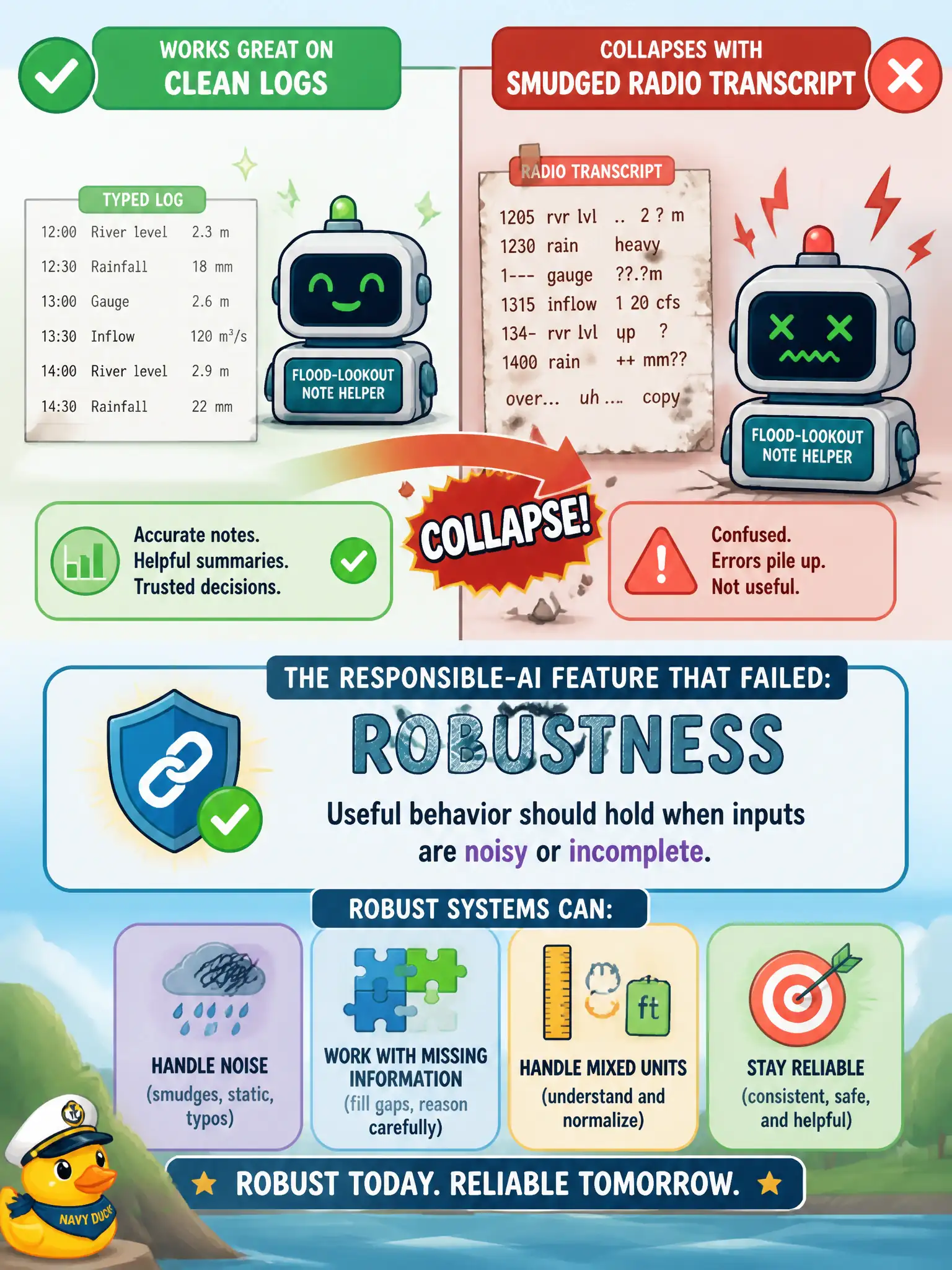
A municipal flood-lookout note helper works on clean typed logs but collapses when a ranger pastes a smudged radio transcript with missing words and mixed units. Which responsible-AI feature failed?
Select an answer to reveal the explanation.
Short Explanation
Think of a flood-lookout helper that works on clean typed logs and falls over on a smudged radio transcript. Robustness is staying useful when the input is messy. A bigger model, unit cost, and Prompt Management do not name that miss.
Full Explanation
Robustness means useful behavior should hold when inputs are noisy or incomplete. A flood-lookout helper that works on clean typed logs but collapses on a smudged radio transcript with missing words and mixed units failed robustness. Field municipal inputs are messy; the system must degrade gracefully instead of failing only outside the clean lab distribution used in demos for emergency staff.
Model size alone does not guarantee survival on smudged transcripts; bigger is not the definition of robustness for flood notes. Cost per interaction is an economics metric, not the name for collapsing on mixed units in ranger radio traffic. Prompt Management stores prompt versions; a messy transcript is an input-quality problem, not a prompt-library feature miss.
Exam caveat: robustness includes noisy, incomplete, and slightly adversarial inputs. Clean-only demos are insufficient evidence for field readiness in flood operations where radio paste-ins are common.
Operational check: build an evaluation set of messy transcripts with gaps, OCR noise, and mixed units; measure task success on that set; and add normalization or clarification prompts until performance on noisy inputs meets the same bar as clean typed logs.