
One intern wants to try a pretrained model. One wants a production runtime for agents already written. One wants an AI-assisted IDE. Which mapping is accurate?
Select an answer to reveal the explanation.
Short Explanation
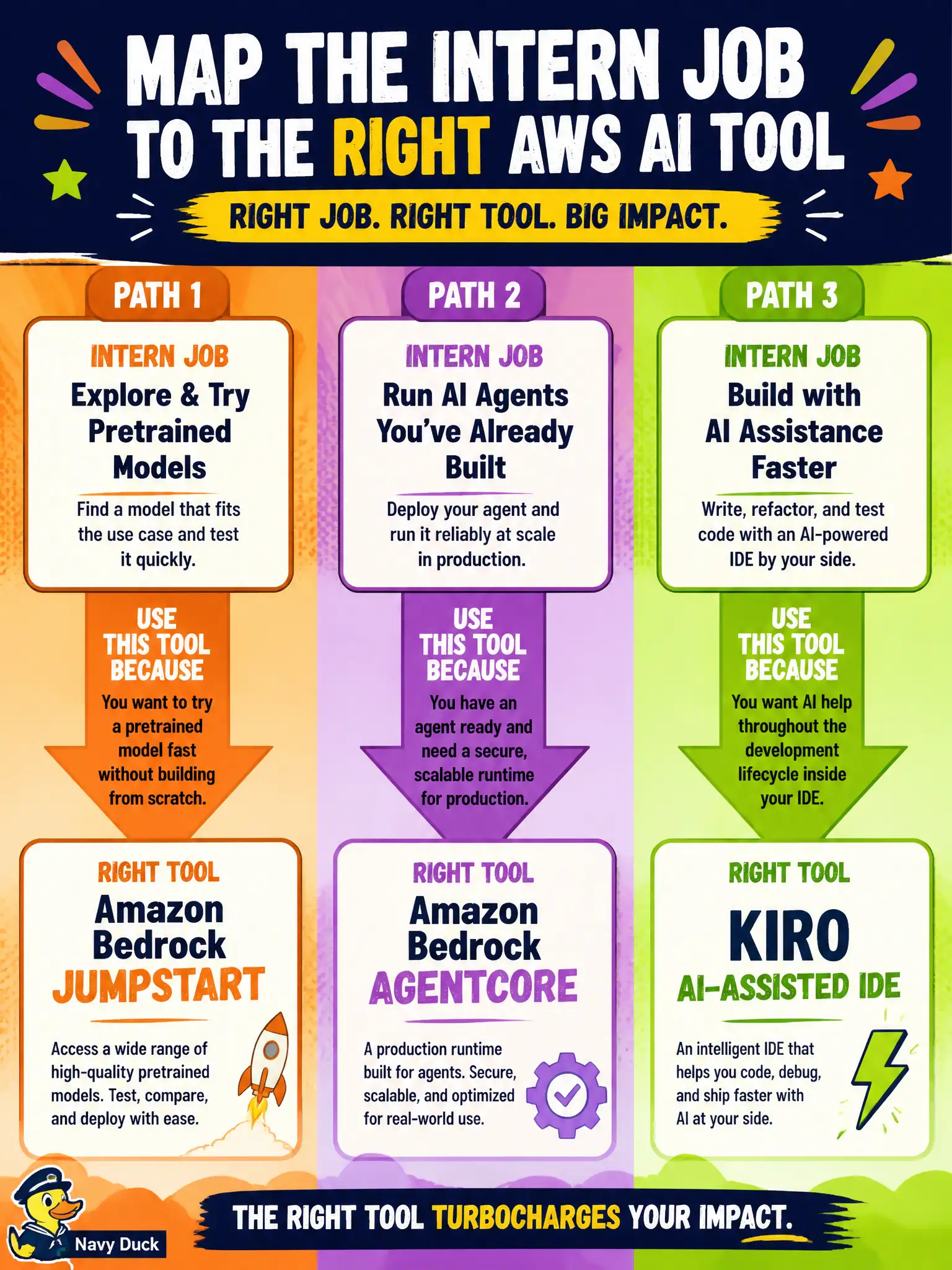
Think of three intern asks. JumpStart to try a pretrained model, AgentCore to run production agents, Kiro as the IDE. Polly does not cover all three.
Full Explanation
Three intern asks map to three different tooling layers: trying a pretrained model, running production agents that are already written, and working in an AI-assisted IDE. JumpStart is the catalog/experience for discovering and trying pretrained models. Amazon Bedrock AgentCore is the production runtime for agents that need a managed place to run. Kiro is the AI-assisted IDE for development work. Keeping those mappings straight prevents treating every AI-adjacent product as interchangeable.
Making Kiro the production agent runtime and JumpStart the IDE fails because it swaps a development environment with a runtime and a pretrained-model catalog with an editor. Treating AgentCore as a pretrained-model catalog and JumpStart as the visitor-facing runtime fails for the same reason: catalogs, runtimes, and IDEs solve different lifecycle stages. Assigning Amazon Polly to all three jobs fails because speech synthesis does not replace model catalogs, agent runtimes, or IDEs, even though Polly is an AWS AI service.
Exam caveat: practitioner exams mix adjacent AI products to test whether you can map job type—try/pretrained, run/agents, develop/IDE—rather than memorize branding alone. Operational check: label each intern request with the lifecycle stage (explore pretrained, run production agents, develop in IDE), pick JumpStart / AgentCore / Kiro accordingly, and confirm Polly is not being used as a stand-in for any of those stages.