
After go-live, school-board staff mark generated facilities replies as too vague or missing the building code cite. The team treated the lab score as finished work. What should those marks become?
Select an answer to reveal the explanation.
Short Explanation
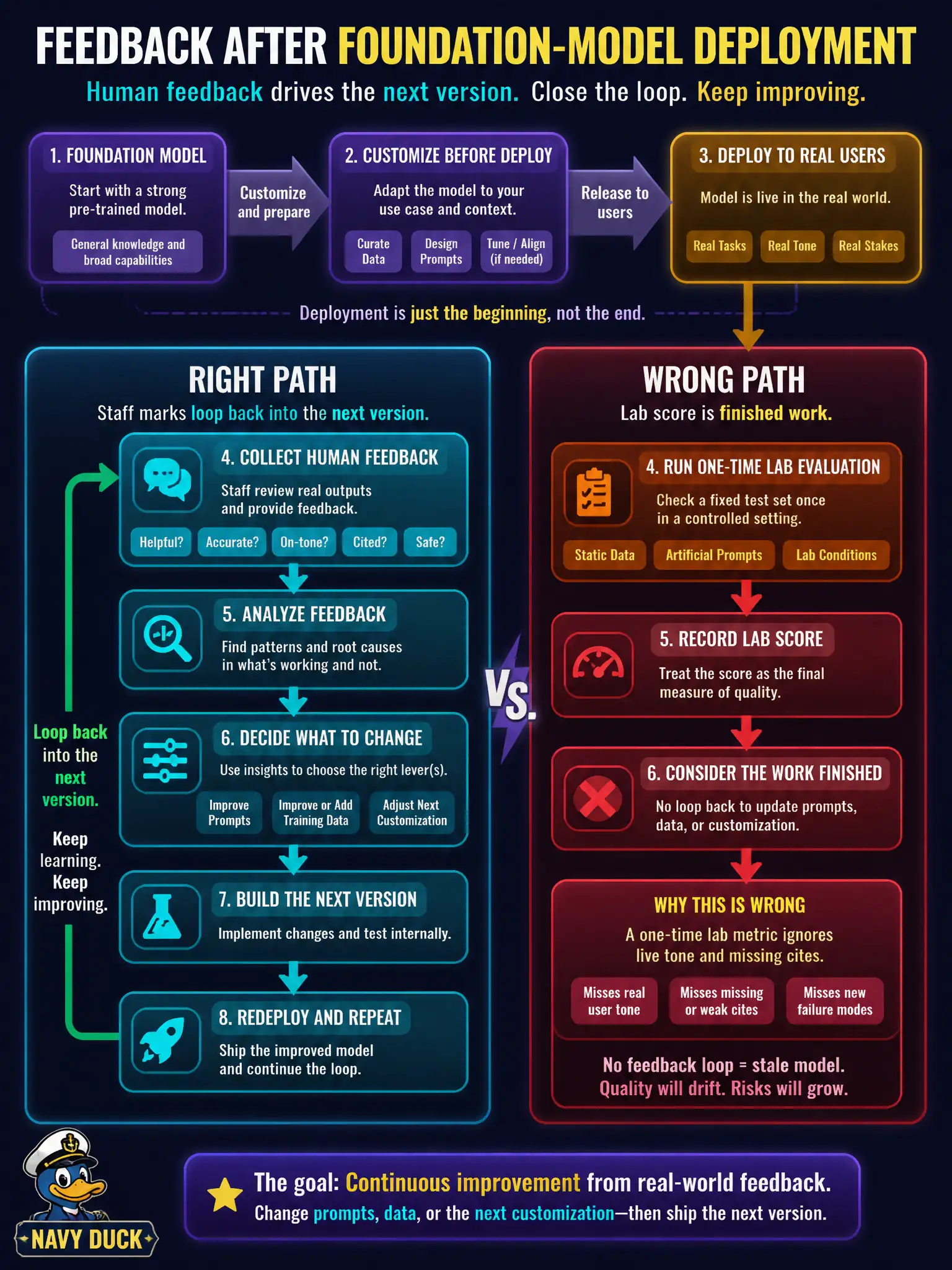
Think of the suggestion box after opening night. Staff marks about vague replies and missing cites should change prompts, data, or the next customization. A lab score is not the last word, and turning monitoring off does not fix the letters.
Full Explanation
After deployment, feedback is a living lifecycle stage. When school-board staff mark facilities replies as vague or missing building-code cites, those marks should drive changes to prompts, retrieval data, or the next customization cycle—not be filed away as finished lab work. A lab score is an earlier gate; it does not freeze the system after go-live, and operational marks are how the team learns what the lab set missed.
Treating marks as a one-time lab metric that is never looked at after launch abandons the feedback loop the lifecycle expects once real users appear. Proof that monitoring should be turned off is the opposite of good practice: vague or uncited replies are a reason to keep monitoring and to act on findings, not to disable them. Switching the job to image generation changes modality without fixing the text-reply quality problem the staff reported on facilities answers.
Exam caveat: evaluation before deploy and feedback after deploy are different stages. A strong lab score does not retire post-deploy learning from staff marks on tone and citations.
Operational check: route each vague or missing-cite mark into a triage queue that updates prompt templates or adds the cited code section to the retrieval corpus, then re-score a facilities regression set before the next promotion to production.