
A creamery intern describes, in English, a needed script that will clean tank-log spreadsheets. They want a first-draft program, not a grouping of unlabeled file names. Which use case is this?
Select an answer to reveal the explanation.
Short Explanation
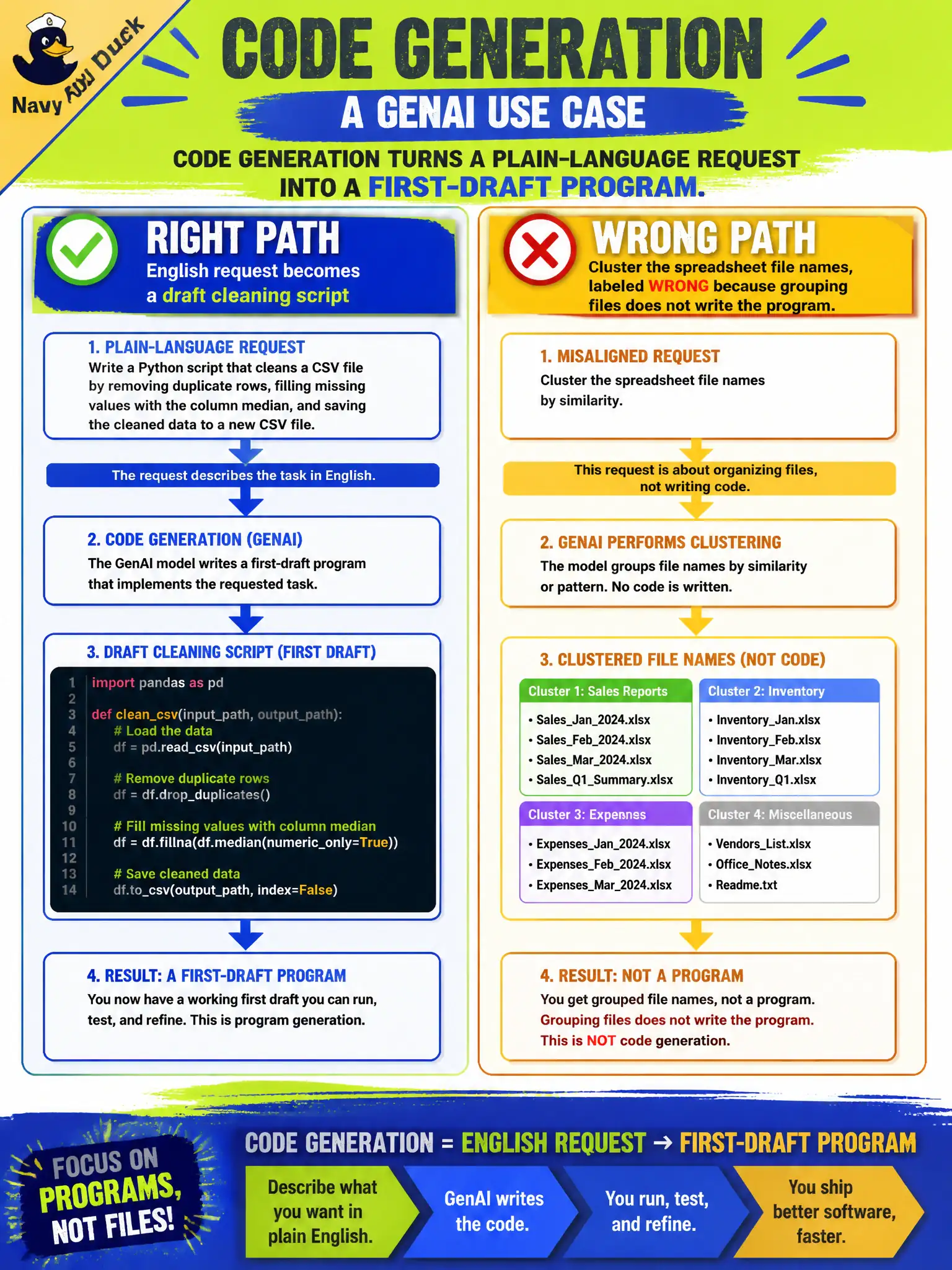
Think of describing the cleanup in English and getting a first-draft script back. That is code generation. Clustering filenames, drawing the creamery, and a milk-price forecast do not write the program.
Full Explanation
Code generation is the generative use case that turns a natural-language description of desired behavior into a first-draft program. The creamery intern is asking for a script that cleans tank-log spreadsheets, so the match is language-to-code generation rather than another classical or generative pattern. The draft may still need review, but the job is specifically to produce program text from the description.
Clustering of tank-log file names only groups unlabeled objects by similarity. It does not emit executable cleanup logic, so it cannot satisfy a request for a first-draft program. Image generation of the creamery building creates pixels or artwork; it has no bearing on spreadsheet-cleaning code. A regression forecast of next month's milk price predicts a continuous numeric outcome from features. That is classical supervised prediction, not synthesis of a cleanup script.
Exam caveat: do not conflate generative code assist with classical ML just because both appear in the same AI portfolio. The discriminator is what the system emits—source code versus clusters, images, or numeric forecasts.
Operational check: before accepting a generated script into the creamery's log pipeline, run it on a sanitized sample workbook, confirm column transforms and error handling, and keep a human review gate for any write path that touches production tank logs.