
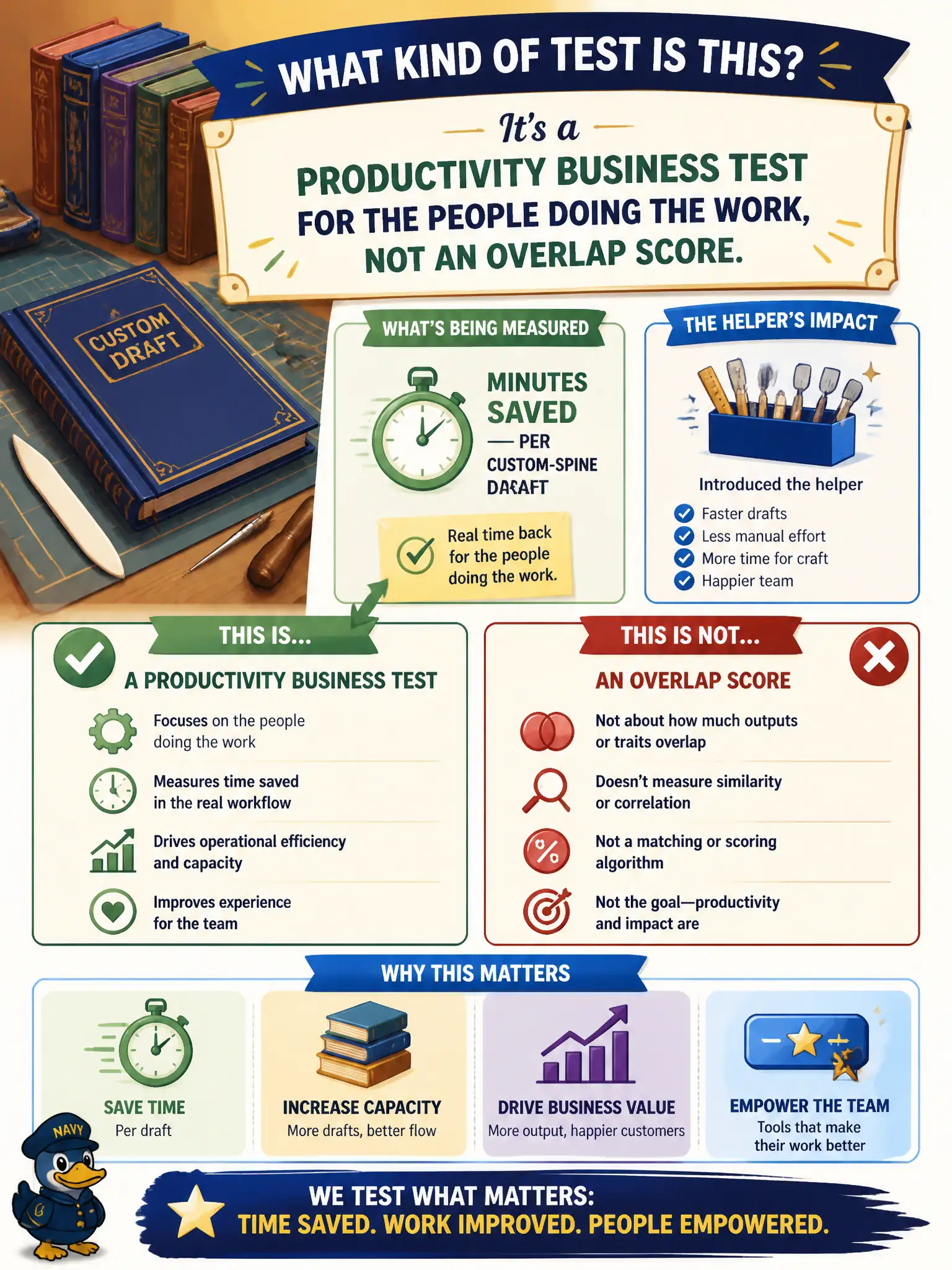
A community bookbindery measures minutes saved per custom-spine draft after introducing the helper. Which kind of test is that?
Select an answer to reveal the explanation.
Short Explanation
Think of minutes saved per custom-spine draft. That is a productivity test for the people doing the work. ROUGE, a public quiz, and an endpoint size do not measure those minutes.
Full Explanation
Minutes saved per custom-spine draft is a productivity business test for the people doing the work. It ties the helper to shop outcomes—time reclaimed on real bindery tasks—rather than to a text overlap score. That is how many civic and small-shop deployments justify keeping an assistant: measurable work acceleration for staff who still own quality of the finished spine and customer delivery dates.
ROUGE does not measure minutes saved and cannot stand in for a stopwatch on the bench. A public summarization benchmark scores generic summarization quality, not bindery throughput on custom jobs. Provisioned throughput is an endpoint capacity setting for inference, not a business productivity test for craftspeople at the community bookbindery.
Exam caveat: productivity gains can hide quality regressions. Pair time-saved measures with spot checks that custom-spine drafts still meet shop standards and do not create costly rework for volunteers or paid binders.
Operational check: baseline minutes per draft before the helper, measure after a fixed pilot window with the same job mix, and confirm that faster drafts do not increase redo rates from quality failures before expanding use across the bindery.