
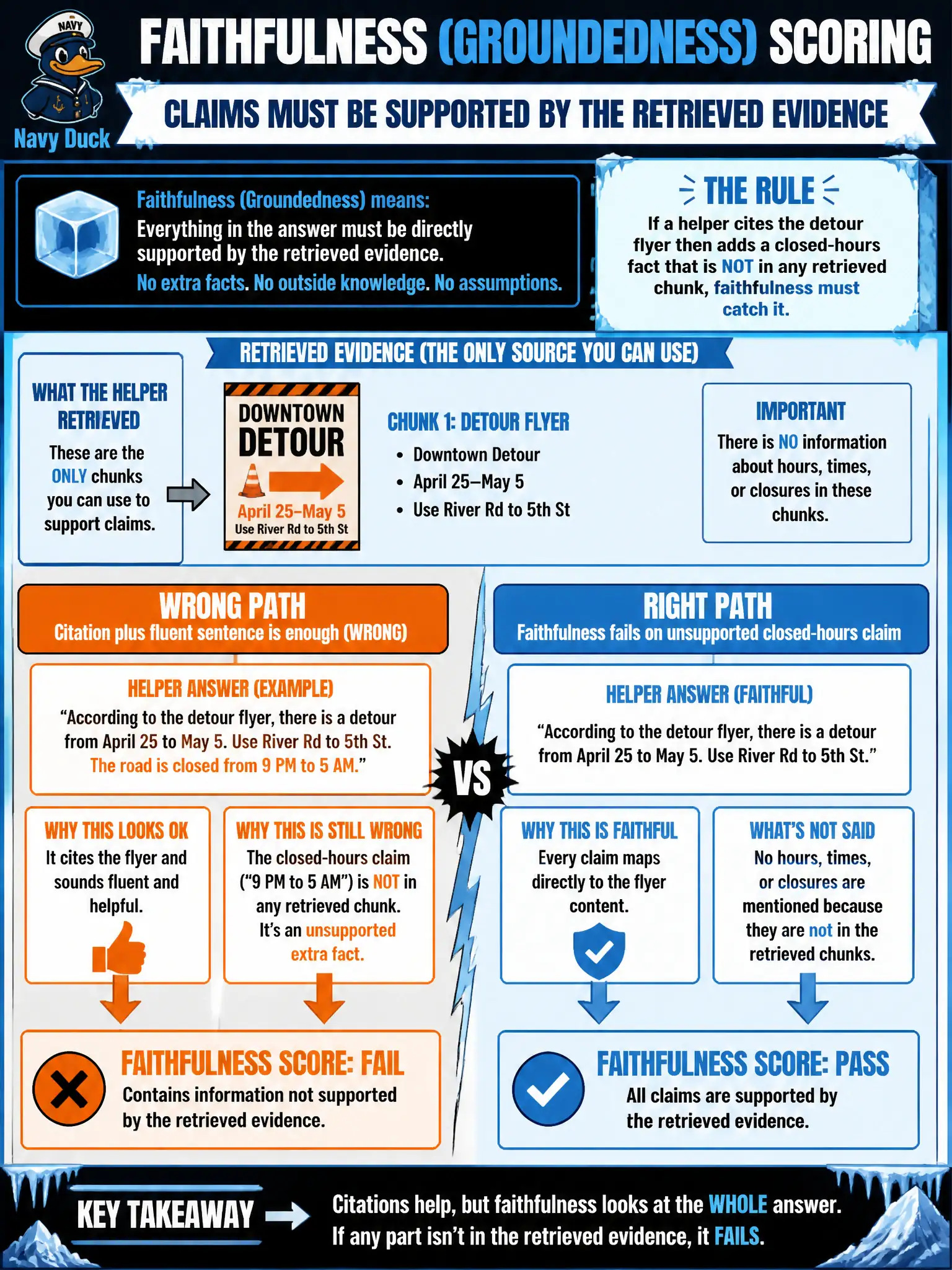
The same viaduct helper cites the detour flyer but then adds a closed-hours fact that is not in any retrieved chunk. Which score should catch that?
Select an answer to reveal the explanation.
Short Explanation
Think of citing the detour flyer, then adding closed hours that are not in any chunk. Faithfulness or groundedness should catch that extra fact. Fluency and citing the flyer do not prove every claim.
Full Explanation
Faithfulness or groundedness catches the viaduct helper that cites the detour flyer and then adds closed-hours facts that appear in no retrieved chunk. Those scores ask whether each claim is supported by the evidence that was retrieved. Citing a relevant flyer does not license inventing extra schedule details that staff never published in the chunks available to the model.
Fluency only rewards sentences that sound right; invented hours can still read smoothly to a traveler checking the historic viaduct route. Retrieval relevance only confirms the flyer was a sensible chunk; it does not prove every later claim came from that chunk. A public writing benchmark measures generic prose quality, not whether municipal hours are grounded in retrieved evidence for that Saturday.
Exam caveat: groundedness failures often look like helpful elaborations. On the exam, any extra fact not in the evidence is a faithfulness miss even when tone is polite and the citation looks real.
Operational check: require claim-level checks against retrieved chunks for hours and closures, log unsupported assertions in evaluation runs, and block or regenerate answers that introduce schedule facts absent from the evidence set before travelers see them on the municipal helper.