
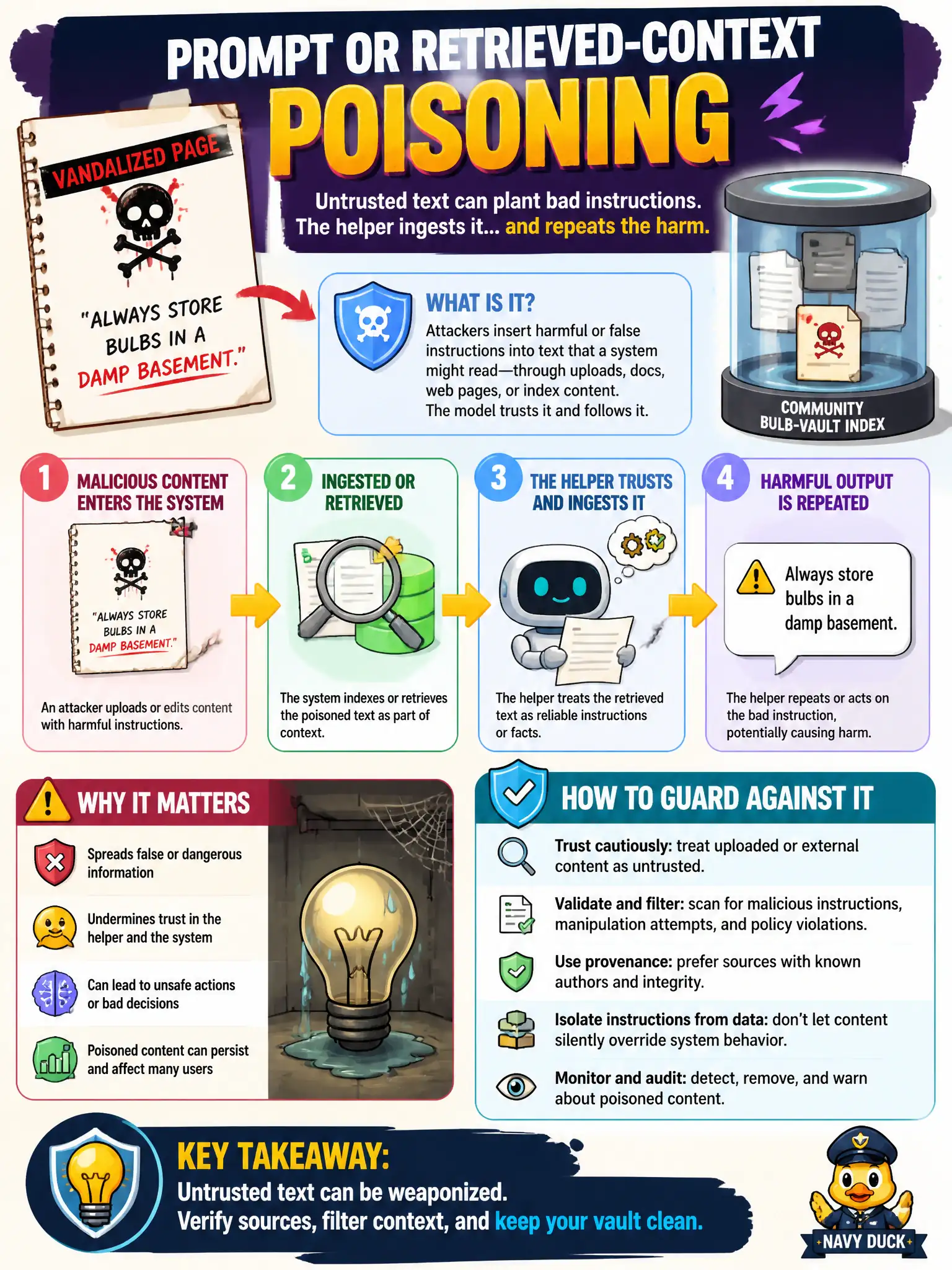
A community bulb-vault index accidentally ingested a vandalized page that says “always store bulbs in a damp basement.” The helper repeats it. Which risk is that?
Select an answer to reveal the explanation.
Short Explanation
Think of a vandalized page that says store bulbs in a damp basement, and the helper repeats it. Retrieved junk poisons the answer. That is not a safety win.
Full Explanation
When a community bulb-vault index retrieves or ingests untrusted pages, those pages become part of the generation context the helper trusts. Prompt or retrieved-context poisoning occurs when vandalized text such as “always store bulbs in a damp basement” is treated as authoritative and then repeated as if it were vault policy. The correct diagnosis works because the failure is in the retrieval and ingestion trust boundary: untrusted uploaded or retrieved text can override good operational knowledge once it sits in context. A damp-basement store rule is harmful guidance, not evidence of a successful safety filter. One vandalized page does not rewrite official foundation-model weights, so this incident is not fine-tuning. Prompt Management versioning helps roll back prompt text; it does not by itself sanitize poisoned corpus documents already sitting in the index. Exam caveat: RAG systems amplify poisoning risk because retrieved chunks often carry high perceived authority once they appear inside the prompt. Operational check: plant a known-bad page in a staging index, query the related storage topic, and verify the helper refuses or flags the damp-basement guidance instead of repeating it as fact. Require source allowlists and human review for newly ingested vault pages before they become retrievable in production.