
The same cider mill needs answers from the mill-history PDF, a tasting booking through APIs, and a block on medical advice. Which mapping of job to feature is accurate?
Select an answer to reveal the explanation.
Short Explanation
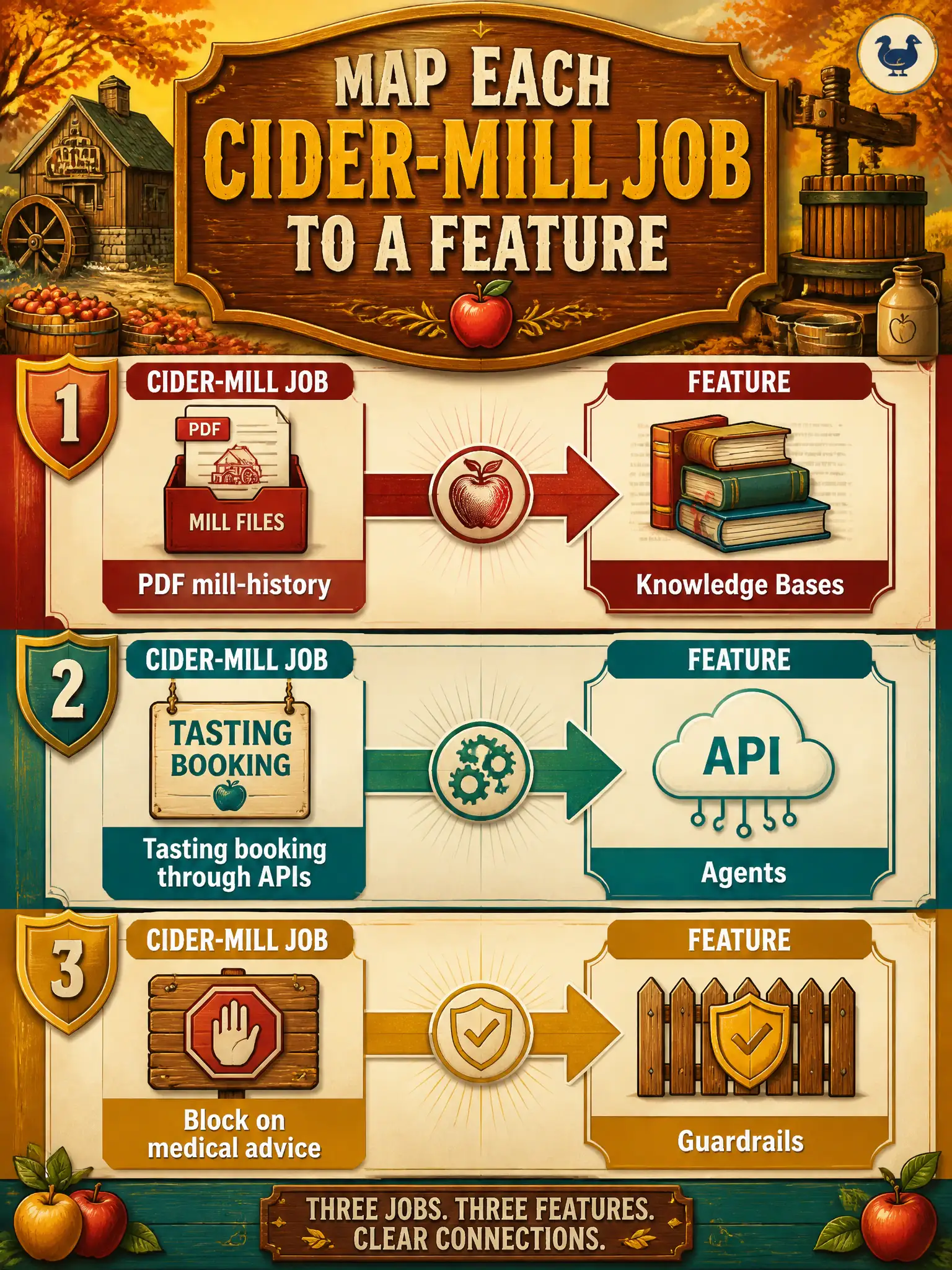
Think of three features, three jobs. Knowledge Bases for the PDF, Agents for the booking, Guardrails for the medical-advice block. Do not fold them into a dashboard or Polly.
Full Explanation
Bedrock-style application features map cleanly to the cider mill's three jobs. Knowledge Bases ground answers in the mill-history PDF through managed RAG. Agents orchestrate tasting bookings through APIs and multi-step tool use. Guardrails enforce policy blocks such as refusing medical advice. Separating retrieval, tool orchestration, and safety filtering keeps each concern testable and tunable.
Using Guardrails to retrieve a PDF misassigns retrieval to a safety layer. Using Knowledge Bases to call booking APIs misassigns tool orchestration to the RAG feature. Treating Agents as a dashboard drawer confuses action orchestration with visualization. One dashboard feature cannot simultaneously be RAG, tools, and a safety filter. Amazon Polly covers speech synthesis only—it does not retrieve PDFs, call booking APIs, or apply medical-advice filters.
Exam caveat: features compose—an agent may call a knowledge base and sit behind guardrails—but exam questions often ask which feature is the primary fit for each stated job; do not collapse them into one vague product.
Operational check: enable Knowledge Bases on the PDF and verify cited history answers; run an agent booking path against a test API; configure a Guardrail medical-advice denial and confirm blocked and allowed prompts behave as designed before go-live.